




Key Takeaways
- ABM drives 3x ARR growth for B2B SaaS in tech by targeting high-value accounts with complex buying committees, achieving 171% higher deal values and 40% shorter sales cycles.
- Define a precise ICP using technographics and intent signals, targeting 100-500 accounts for 68% higher win rates and 40% of pipeline from your top 50 accounts.
- Use intent data tools like Demandbase and ZoomInfo for real-time signals, and gain up to 25% conversion lifts through coordinated multi-channel campaigns.
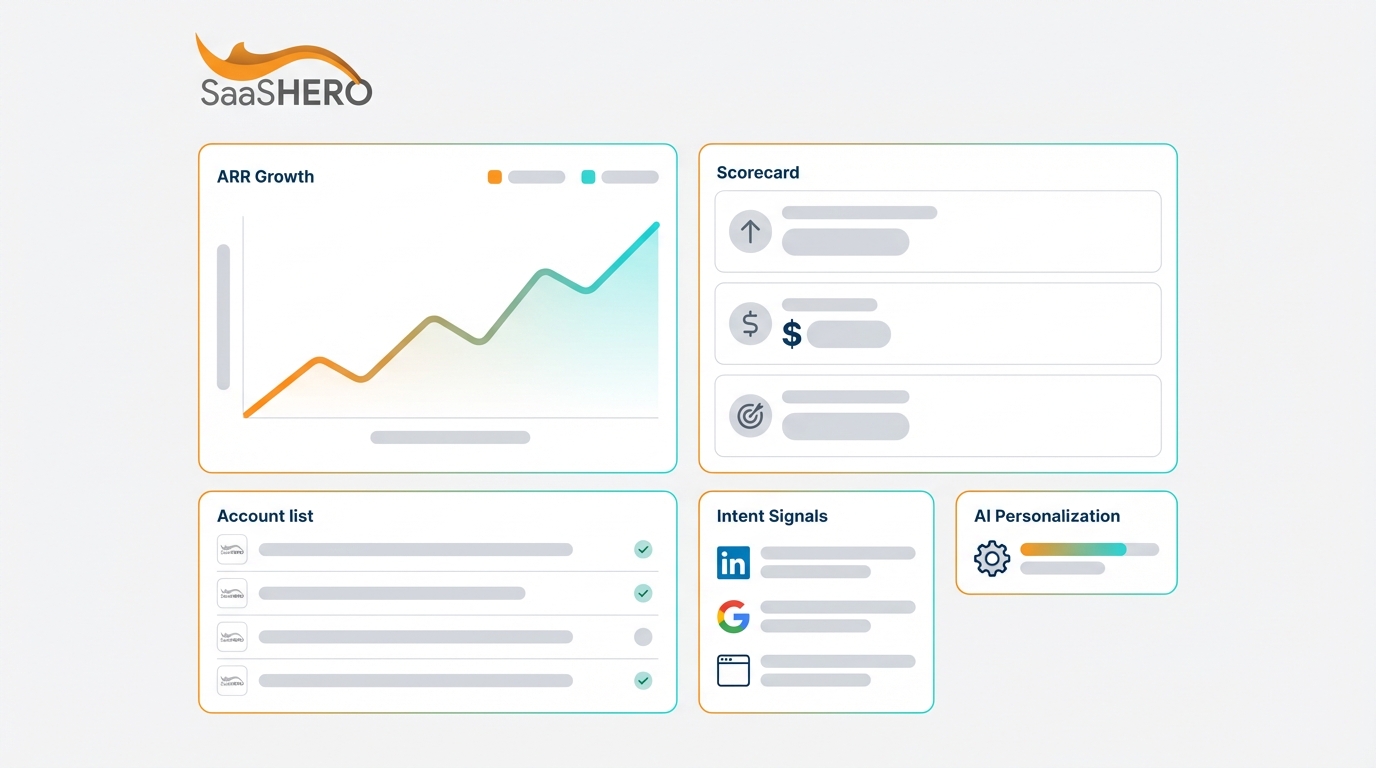
- Run tiered A/B/C account lists and AI-powered hyper-personalization across email, LinkedIn, and ads to scale engagement while aligning sales and marketing for 19% faster revenue growth.
- Track key metrics like sub-90-day CAC payback and $1M+ ARR per account, and partner with SaaSHero for proven ABM execution that has delivered $504k ARR wins.
1. Precision ICP Scoring for Tech SaaS ABM
Effective ABM in tech SaaS starts with a tightly defined ICP that goes beyond basic firmographics. Include technographics, behavioral signals, and buying readiness indicators for each account. Focus on CTOs and technical decision-makers at cybersecurity firms with $15-50M ARR that use HubSpot or Salesforce and show recent funding or security breach signals.
Score 100-500 accounts with ZoomInfo technographic data, and prioritize companies that show competitor research behavior or technology stack changes. Companies with clearly defined segments achieve 68% higher win rates through precise targeting. Avoid broad ICP definitions that double CAC, and keep your criteria specific to improve conversion.
Target metric: 40% of pipeline from your top 50 accounts. SaaSHero helped TestGorilla scale to 5,000 customers with an 80-day payback period through precise targeting. Use a tiered segmentation model that groups accounts into four performance tiers based on historical win rates, average selling price, and sales velocity.
2. Real-Time Intent Data Tactics for Tech ABM
87% of organizations now use AI in ABM. Use Demandbase and ZoomInfo to capture real-time signals such as security breaches, technology stack changes, and competitor research activity across your target accounts. These signals reveal which accounts are actively evaluating solutions.
Run coordinated LinkedIn and Google Ads campaigns that trigger from these intent signals to gain a 25% conversion lift over static campaigns. SaaSHero integrated intent data for TestGorilla and hit an 80-day CAC payback period with precise signal-based targeting.
|
Tool |
Key Feature |
Tech SaaS Fit |
Cost |
|
Demandbase |
Real-time signals |
Cybersecurity intent |
$10k+/yr |
|
ZoomInfo |
Tech stack changes |
HR tech silos |
$5k+/yr |
|
6sense |
Predictive analytics |
Enterprise buying committees |
$15k+/yr |
3. Tiered A/B/C Account Lists for Revenue Focus
Segment your target accounts into A, B, and C tiers based on revenue potential and fit. Treat A-tier accounts as $100k+ ARR opportunities that justify high-touch, highly personalized outreach. Limit this list to roughly 50 accounts so your team can give each one focused attention.
Use automation and templated outreach for B and C-tier accounts while still keeping messaging relevant. SaaSHero’s TripMaster case study shows this approach in action, generating $504k Net New ARR through focused A-tier account targeting. The tiered structure improves resource allocation and keeps pipeline velocity healthy across all segments.

SaaSHero’s senior teams run tiered ABM strategies with month-to-month flexibility and clear revenue tracking. Book a discovery call to roll out a tiered account framework tailored to your SaaS.
4. AI-Scaled Multi-Channel Personalization for Tech ABM
High-performing ABM in 2026 uses coordinated execution across email, LinkedIn, and Google Ads, supported by AI tools like GPT-4o for content creation. Modern AI platforms train on billions of intent data points to predict which accounts are ready to buy. This approach enables personalization at a scale that manual workflows cannot match.
Examples of Personalized ABM Campaigns
Create competitor pricing comparison pages for accounts that research alternatives, custom ROI calculators for enterprise prospects, and industry-specific case studies for each vertical. Generic campaigns cut engagement by 60%, while personalized microsites convert 8 of 15 tier-1 accounts into $4.2M ARR.

Target metric: 30% SQL-to-closed-won rate through hyper-personalized campaigns across every touchpoint in the journey.
5. Revenue Operations Scorecards for Sales and Marketing Alignment
Strong alignment between sales and marketing drives 19% faster revenue growth and 15% higher profitability. Use weekly Slack reviews with shared scorecards that track MQL-to-SQL conversion, pipeline velocity, and account engagement scores. Keep both teams focused on the same revenue outcomes.
Plan content jointly and keep data feedback loops tight to increase conversion rates by up to 67%. Build unified dashboards that show real-time account progression, intent signals, and engagement history for both teams. This shared view improves lead quality and helps sales close more revenue from ABM programs.
6. Competitor Conquesting for High-Intent Search
Competitor Conquesting ABM Strategy
Capture high-intent traffic from accounts that search for phrases like “[Rival] pricing,” “[Competitor] alternatives,” and “[Competitor] vs [Your Company].” Direct this traffic to dedicated comparison landing pages that speak directly to evaluators. Use negative keywords for pure brand searches so you focus spend on evaluative intent instead of navigational queries.
SaaSHero cut Cost Per Lead by 10x for Playvox through competitor conquesting and intent-focused campaigns. Build comparison tables that highlight your unique value, switching resources such as free migration tools, and testimonials from customers who switched from competitors.
Target problem and complaint keywords like “[Competitor] support issues” or “cancel [Competitor]” to reach frustrated users who are ready to change vendors.
7. Predictive AI for Scaling ABM Personalization
AI in ABM SaaS now supports management of 1000+ accounts at once through tools like Apollo integrated with ChatGPT. Predictive AI delivers 5x efficiency gains with 87% adoption rates across B2B organizations. These tools help teams focus on the accounts most likely to convert.
Use AI platforms for account identification, intent detection, and conversion prediction, while keeping humans in charge of strategy and relationship building. TestGorilla reached an 80-day payback period with AI-enhanced ABM execution, which shows clear ROI from automation investments.
Predictive analytics forecast account progression and guide resource allocation beyond simple historical trends. Adjust campaigns in real time based on buying committee behavior and engagement patterns.
Tech SaaS ABM Wins: Cybersecurity, HR Tech, and Logistics
Cybersecurity: Intent targeting on breach-related keywords produced $4.2M ARR through personalized microsites that featured custom security assessments and compliance frameworks.
HR Tech: TestGorilla secured a $70M Series A with an 80-day CAC payback using SaaSHero’s competitor conquesting and intent-based targeting across more than 5,000 new customers.
Logistics: TripMaster generated $504k Net New ARR with multi-channel ABM that combined paid search, social campaigns, and conversion-focused landing pages.
ABM Revenue Metrics for ARR Impact
|
Metric |
Target Tech SaaS |
SaaSHero Benchmark |
|
ARR Influenced |
>$1M/account |
$504k TripMaster |
|
CAC Payback |
<90 days |
80 days TestGorilla |
|
Pipeline Velocity |
19 days deals |
10x CPL drop Playvox |
|
Win Rate |
30%+ mid-market |
68% ICP refinement |
Track ARR influenced instead of only pipeline created, and focus on closed-won revenue attribution through integrated CRM tracking. Watch CAC payback periods and keep them under 90 days to protect unit economics while you scale ABM investment.
Frequently Asked Questions
What defines an effective ICP for tech ABM?
An effective ICP for tech ABM includes clear firmographics such as $15-50M ARR, specific technographics like Salesforce or HubSpot usage, and behavioral signals such as competitor research or funding events. Focus on technical decision-makers including CTOs, VP Engineering, and CISOs inside your target segments. Score accounts with tools like ZoomInfo to find the highest-probability prospects based on technology stack fit and buying readiness. SaaSHero applies this approach for clients like TestGorilla and supports an 80-day payback period through precise ICP refinement.
Which intent data tools deliver the best ROI for ABM in 2026?
Demandbase and ZoomInfo lead intent data platforms for B2B SaaS ABM and provide real-time signals on technology stack changes, competitor research, and buying committee activity. 6sense adds predictive analytics for complex enterprise accounts, and Apollo connects with AI tools for scaled personalization. The strongest results come from combining multiple data sources into a single account view instead of relying on one tool. SaaSHero uses this blended approach to drive intent-based campaigns for B2B SaaS clients.
How do you measure ABM ROI effectively?
Measure ABM ROI with ARR influenced, CAC payback periods, and pipeline velocity instead of vanity metrics such as impressions or clicks. Track closed-won revenue attribution through integrated CRM systems that connect ad interactions to final deals. Monitor account engagement scores, multi-touch attribution, and sales cycle compression to prove program impact. Target sub-90-day CAC payback, 30%+ win rates on targeted accounts, and $1M+ ARR influenced per account tier. Use platforms like HubSpot or Salesforce for complete revenue tracking and attribution modeling.
Next Steps to Launch Your SaaS ABM Framework
These seven account based marketing strategies for B2B SaaS in the tech sector form a practical ABM framework for sustainable growth. Bootstrapped companies can start with strategies 1 through 3 to build a strong ICP and integrate intent data. Scale-stage companies can layer in advanced tactics such as competitor conquesting and AI-driven personalization from strategies 6 and 7.
SaaSHero offers flat retainers from $1,250 per month and has managed significant B2B SaaS ad budgets. The team’s methodology delivers measurable outcomes, including $504k ARR wins and 80-day payback periods.

Book a discovery call at saashero.net to roll out these account based marketing strategies for B2B SaaS in the tech sector with a senior-led team.