




Key Takeaways
- WhatsApp, Twilio, and HubSpot campaigns cut B2B SaaS acquisition costs by 20-50%, with 80-98% open rates versus email’s 20-40%.
- Smilodox’s 9.6x ROAS and Takko Fashion’s 36.8x ROAS show WhatsApp Flows can drive large revenue lifts from personalized campaigns.
- Stripe and HubSpot APIs support event-driven upsells, lead scoring, and unified attribution that shorten sales cycles and increase ROI.
- LinkedIn Predictive Audiences and coordinated multi-channel campaigns improve lead quality, reduce CAC, and lift conversion rates by 40-60%.
- Follow SaaSHero’s 5-pillar framework for API success and schedule a discovery call with SaaSHero to implement these strategies.
The following 10 solutions highlight proven API-based marketing plays that B2B SaaS teams use to improve ROI. Each solution outlines the challenge, the approach, the measurable results, and a practical insight you can apply to your own stack.
Solution 1: WhatsApp Business API for E-Commerce Personalization
Challenge: E-commerce brands struggled with low engagement in cart recovery campaigns, as traditional email delivered only 20-40% open rates and under 4% conversion.
Strategy: Teams implemented WhatsApp Business API with automated flows triggered by CRM events. These flows delivered personalized, media-rich messages at scale.
Results: Smilodox generated €261,676 in revenue from a single WhatsApp campaign, achieving 9.6x ROWS. WhatsApp campaigns deliver around 80% open rates, with 80% of messages read within 5 minutes. Businesses using WhatsApp Flows often see higher conversion rates than standard web forms.
Insight: WhatsApp’s immediacy and personal feel create urgency that email rarely matches, especially for time-sensitive offers and abandoned cart recovery.
Solution 2: Twilio SMS API for Cart Recovery and Follow-Up
Challenge: SaaS companies with complex sales cycles lost revenue through abandoned leads and weak follow-up sequences.
Strategy: Teams used Twilio’s SMS API to send automated, personalized messages based on user behavior and engagement history, synced with CRM data for context.
Results: Companies using Twilio’s SMS platform report significantly higher click and response rates than email. Resy processes more than 21 million messages each month through Twilio. In B2B environments, SMS campaigns can reach 45% response rates compared with roughly 6% for email, which translates into more recovered opportunities and faster pipeline movement.
Insight: SMS offers near-instant visibility, with open rates reaching up to 98%, which makes it a strong channel for urgent notifications and time-bound follow-ups in B2B sales.
Solution 3: HubSpot API for CRM Automation and Lead Scoring
Challenge: Inaccurate lead scoring and clumsy sales handoffs slowed conversions while marketing and sales teams worked in silos.
Strategy: Companies built deep HubSpot API integrations that powered automated lead enrichment, predictive scoring, and multi-touch attribution across the full customer lifecycle.
Results: HubSpot-based automation reduces wasted ad spend, increases meetings booked, and shortens sales cycles when implemented correctly. Clearbit’s native HubSpot integration supports real-time lead enrichment, which improves data quality and routing speed.
Insight: Automated enrichment and scoring remove manual qualification steps so sales teams can focus on high-intent prospects while still maintaining clear attribution.
Solution 4: Stripe API for Revenue-Based Triggers
Challenge: Many SaaS companies missed upsell moments and managed customer lifecycles poorly, which reduced revenue per account and extended payback periods.
Strategy: Teams used Stripe payment events to trigger real-time customer journeys and targeted upsell campaigns based on usage and billing patterns.
Results: API-first SaaS companies report 12.5% higher revenue growth than peers. Stripe processes $1.9 trillion in annual payment volume, which shows the scale and reliability of automated payment workflows.
Insight: Payment events act as strong intent signals for upsell timing, and when teams connect them to attribution systems, they often achieve payback periods under 90 days.
Solution 5: AI-Enhanced WhatsApp Flows for Personalization
Challenge: Static messaging flows could not adapt to individual customer preferences or behavior, which limited personalization at scale.
Strategy: Companies introduced AI-enhanced WhatsApp Flows that used dynamic content and behavioral triggers to create tailored conversation paths for each segment.
Results: Takko Fashion achieved 36.8x ROAS with WhatsApp campaigns and 92% open rates. SNOCKS generated more than €1 million in revenue via WhatsApp marketing, with 80% of workflows fully automated.
Insight: AI-driven personalization lifts engagement while reducing manual work, which creates scalable revenue streams with lean operational overhead.
Solution 6: LinkedIn Predictive Audiences for Enterprise Targeting
Challenge: Broad LinkedIn targeting produced expensive leads and weak qualification for B2B SaaS teams selling into enterprises.
Strategy: Marketers used LinkedIn’s Predictive Audiences API to build high-intent custom audiences from first-party data and AI models for account-based campaigns.
Results: LinkedIn’s Predictive Audiences API blends first-party data with predictive AI to build bottom-funnel audiences. The Company Intelligence API supports company-level attribution and conversion tracking, which helps teams prove impact on target accounts.
Insight: Predictive modeling improves targeting precision, reduces wasted ad spend, and increases lead quality for complex B2B sales motions.
Solution 7: Multi-Channel Attribution Across Ads, CRM, and Billing
Challenge: Fragmented attribution across channels made budget allocation guesswork and weakened marketing’s credibility with executives.
Strategy: Teams built unified attribution systems that connected Google Ads, LinkedIn, HubSpot, and Stripe APIs to track journeys from first touch through revenue recognition.
Results: LinkedIn’s Company Intelligence API aggregates paid and organic engagement for deeper attribution analysis. Companies that adopt unified attribution report 25-40% gains in budget allocation efficiency.
Insight: Full-funnel visibility supports data-backed budget shifts and gives CFOs and boards the metrics they expect.
Solution 8: Automated Customer Success Workflows
Challenge: Manual customer success processes did not scale with growth, which increased churn and limited expansion revenue.
Strategy: Companies connected usage data, support tickets, and billing events through APIs to trigger proactive success outreach and expansion campaigns.
Results: J&T Express improved delivery success rates and lowered operating costs with API automation. Michael Kors increased conversion rates by 20% and reached 95% customer satisfaction through automated, API-based customer contact, which shows the impact of timely, data-driven engagement.
Insight: Proactive workflows based on behavior reduce churn risk and surface expansion opportunities, which lifts both retention and revenue per customer.
Solution 9: Event-Driven Lead Scoring for Real-Time Intent
Challenge: Static lead scoring missed real-time buying signals, which hurt sales and marketing alignment and left revenue on the table.
Strategy: Teams built dynamic scoring models that used APIs to combine website behavior, email engagement, and product usage data for more accurate intent prediction.
Results: Clearbit’s real-time API integration supports product-led growth use cases such as lead routing and form shortening. Companies using dynamic scoring often see 30-50% improvements in sales-qualified lead conversion rates.
Insight: Real-time intent signals outperform demographic data alone, which helps sales teams focus on the prospects most likely to close.
Solution 10: Cross-Platform Retargeting Orchestration
Challenge: Disconnected retargeting across platforms created message fatigue and wasted budget because teams could not control frequency across channels.
Strategy: Marketers built unified retargeting systems that used APIs to coordinate messaging across Google, LinkedIn, and Meta, with shared frequency caps and sequenced creative.
Results: Click-to-WhatsApp Ads revenue grew 60% year-over-year in Q3 2025. Companies that coordinate retargeting often achieve 40-60% higher conversion rates while lowering overall cost per acquisition.
The following table summarizes key performance metrics from several of the most impactful API implementations above so you can compare outcomes across platforms at a glance.
| API Platform | Company | Key Metric | Source |
|---|---|---|---|
| WhatsApp Business | Smilodox | 9.6x ROWS | Chatarmin |
| Twilio SMS | Smava | Higher click rates | Twilio |
| HubSpot | Hey Sid | Ad spend reduction | Hey Sid |
| Stripe | API-First SaaS | 12.5% Revenue Growth | SaaSMag |
While these case studies show what is possible, consistent success comes from a repeatable framework. The next section distills shared success factors into five practical pillars you can apply across channels.
SaaS-Specific Framework: 5 Pillars for API Success
Effective API-led marketing in B2B SaaS relies on five connected pillars that support sustainable growth and measurable ROI.
Intent Targeting: Focus on high-intent keywords and behavioral triggers that signal active buying consideration instead of broad awareness campaigns. This foundation ensures you reach prospects who are evaluating solutions, not just researching problems.
Attribution Tracking: After defining intent signals, implement tracking through HubSpot or Salesforce integrations that connect ad clicks to closed revenue. This connection allows accurate ROI measurement and validates your targeting decisions.
Conversion Optimization: With tracking in place, apply structured CRO methods to landing pages and forms. Use heuristic analysis to find and remove friction so the traffic you pay for converts at a higher rate.

Competitor Conquesting: Once core funnels convert reliably, launch targeted campaigns against competitor keywords. Support these campaigns with comparison pages that address specific pain points and switching barriers for your ideal customers.

AI-Enhanced Scaling: As data volume grows, use AI-powered APIs to automate optimization and personalization. Gartner predicts more than 30% of the increase in demand for APIs will come from AI and tools using large language models (LLMs) by 2026, which underscores how central AI will become to scaling efforts.
Why SaaSHero is Your Revenue-First API Partner
Many agencies reinforce the very problems that modern API-based marketing solves. Percentage-of-spend pricing rewards higher budgets instead of efficiency. Long contracts protect mediocre performance and shift risk to clients. Junior account managers often lack the depth required for complex B2B SaaS campaigns.
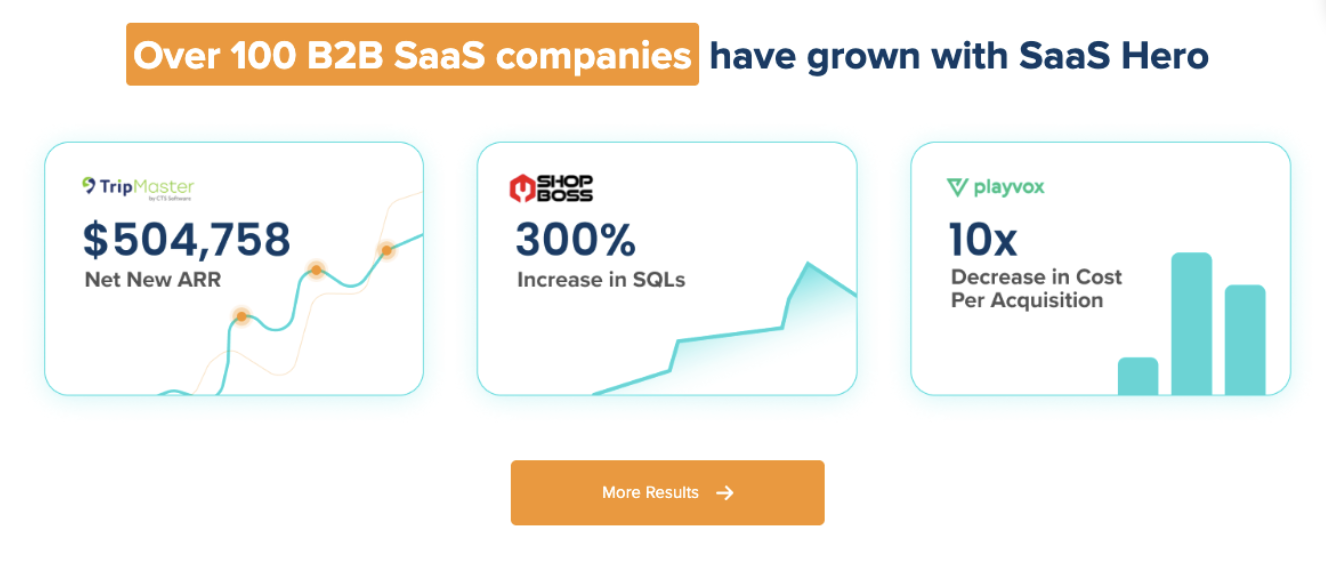
SaaSHero removes these misalignments with a flat-fee, month-to-month model that ties our success to your revenue growth. Our senior-led team focuses only on B2B SaaS and understands metrics like CAC, LTV, and churn that generalist agencies overlook. TripMaster achieved $504k in Net New ARR with 650% ROI, while TestGorilla reached an 80-day payback period, which supported their $70M Series A raise.

This transparent pricing structure ensures you know exactly what to expect at each spend level, with no hidden fees or percentage markups.
| Monthly Spend | 1 Channel (Month-to-Month) | 2 Channels | 3+ Channels |
|---|---|---|---|
| Up to $10k | $1,250 | $2,500 | $3,750 |
| $10k – $25k | $1,750 | $3,000 | $4,250 |
| $25k – $50k | $2,250 | $3,500 | $4,750 |
| $50k+ | $3,250 | $4,500 | $5,750 |
Talk to our team to explore how our API-focused approach can replicate these outcomes for your SaaS company.

Implementation Checklist for API-Led Growth
Whether you partner with SaaSHero or execute in-house, use this checklist as a practical sequence for rolling out API-driven marketing.
Audit Current Integrations: Start by documenting existing connections and gaps in your stack that block full-funnel attribution. This baseline shows where to focus first.
Establish ROI Tracking: With your map of integrations, set up tracking that ties marketing activity to revenue, especially Net New ARR. These metrics will guide every later decision.
Test WhatsApp Flows: Launch simple automated sequences for cart abandonment or trial expiration and compare engagement against email. These early tests create benchmarks for your messaging.
Deploy Competitor Campaigns: After you understand baseline performance, build landing pages for competitor comparison keywords. Emphasize pricing and feature differences that matter to your highest-intent prospects.
Integrate CRM APIs: Connect ad platforms to HubSpot or Salesforce for real-time lead scoring and automated sales handoffs. This step ensures that new demand reaches the right reps quickly.
Implement Cross-Platform Attribution: Once CRM data flows cleanly, add unified tracking across all touchpoints. This view clarifies which channels and campaigns truly drive revenue.
Scale with AI Enhancement: With reliable data in place, introduce AI-driven personalization and optimization gradually as your volume and sophistication grow.
FAQ
What are the best APIs for B2B SaaS marketing in 2026?
The most effective APIs for B2B SaaS marketing include WhatsApp Business API for high-engagement messaging, Twilio for SMS automation, HubSpot for CRM integration and lead scoring, Stripe for payment-triggered workflows, and LinkedIn’s Predictive Audiences API for account-based marketing. These platforms offer deep integration options and strong ROI potential for complex B2B sales cycles. AI-enhanced versions of these APIs now improve targeting precision and automation efficiency even further.
What is a famous API marketing case study that demonstrates clear ROI?
Smilodox’s WhatsApp marketing campaign stands out as a landmark example, generating €261,676 in revenue from a single campaign achieving 9.6x ROWS. This result shows how personalized, automated messaging can create scalable revenue streams. The campaign also highlights how WhatsApp engagement outperforms email, with roughly 80% open rates compared with email’s 20-40% average.
How do you measure API marketing ROI effectively?
Accurate ROI measurement focuses on Net New ARR instead of vanity metrics like clicks or impressions. Key indicators include lower Customer Acquisition Cost, shorter payback periods, and faster pipeline velocity. To track these, you need attribution systems that connect initial ad interactions through to closed revenue, which usually requires tight integrations between ad platforms, CRM tools, and billing APIs.
Can API marketing strategies actually reduce customer acquisition costs?
API-led strategies regularly reduce CAC by 20-50% through better targeting and automation. Savings come from cutting spend on unqualified prospects, speeding sales cycles with improved lead scoring, and lifting conversion rates through personalized messaging. Many companies report meaningful ad spend reductions while maintaining or improving lead quality.
What compliance considerations exist for API marketing in 2026?
Modern API-based marketing must comply with regulations such as GDPR, CCPA, and the EU AI Act, the majority of rules of which come into force and enforcement starts on 2 August 2026. Core requirements include explicit consent for automated messaging, data sovereignty controls for cross-border calls, and transparent AI-driven personalization. Teams must also respect platform rules such as WhatsApp’s business messaging policies and LinkedIn’s data usage restrictions.
Conclusion: Scale with APIs and Partner with SaaSHero
API-centric marketing now offers one of the clearest paths for B2B SaaS companies to escape rising CAC and broken attribution. From Smilodox’s 9.6x ROWS on WhatsApp to TestGorilla’s 80-day payback that supported their Series A, these case studies show consistent, measurable gains across different verticals and stages.
As the AI-driven API adoption trend mentioned earlier accelerates, early movers will build advantages that lagging competitors struggle to match. Companies that act now will refine their data, automation, and targeting while others remain stuck with outdated models and inefficient channels.
SaaSHero’s specialization in API-led marketing, combined with a risk-free month-to-month model, offers a fast path to similar results. Start the conversation to turn your marketing stack into a revenue engine that scales with your growth goals.