




Key Takeaways
- Meta’s 2025 OCAPI deprecation and v24.0+ API changes make CAPI server-side tracking essential for B2B Facebook ads attribution under iOS privacy limits.
- HubSpot fits mid-market B2B with native webhooks and a free tier, while Salesforce fits enterprises. Zapier connects almost any CRM with no-code automation.
- The 7-step framework covers Pixel and CAPI setup, CRM webhooks, offline conversions, attribution tools, and cohort analysis to tie ad spend to closed-won ARR.
- Dreamdata and Cometly support multi-touch attribution for complex B2B sales cycles and help teams prioritize pipeline velocity over raw lead volume.
- SaaSHero has driven $500K+ Net New ARR through CRM-integrated campaigns. Schedule a discovery call for a free attribution audit.
Executive Summary and 7-Step B2B Facebook Attribution Plan
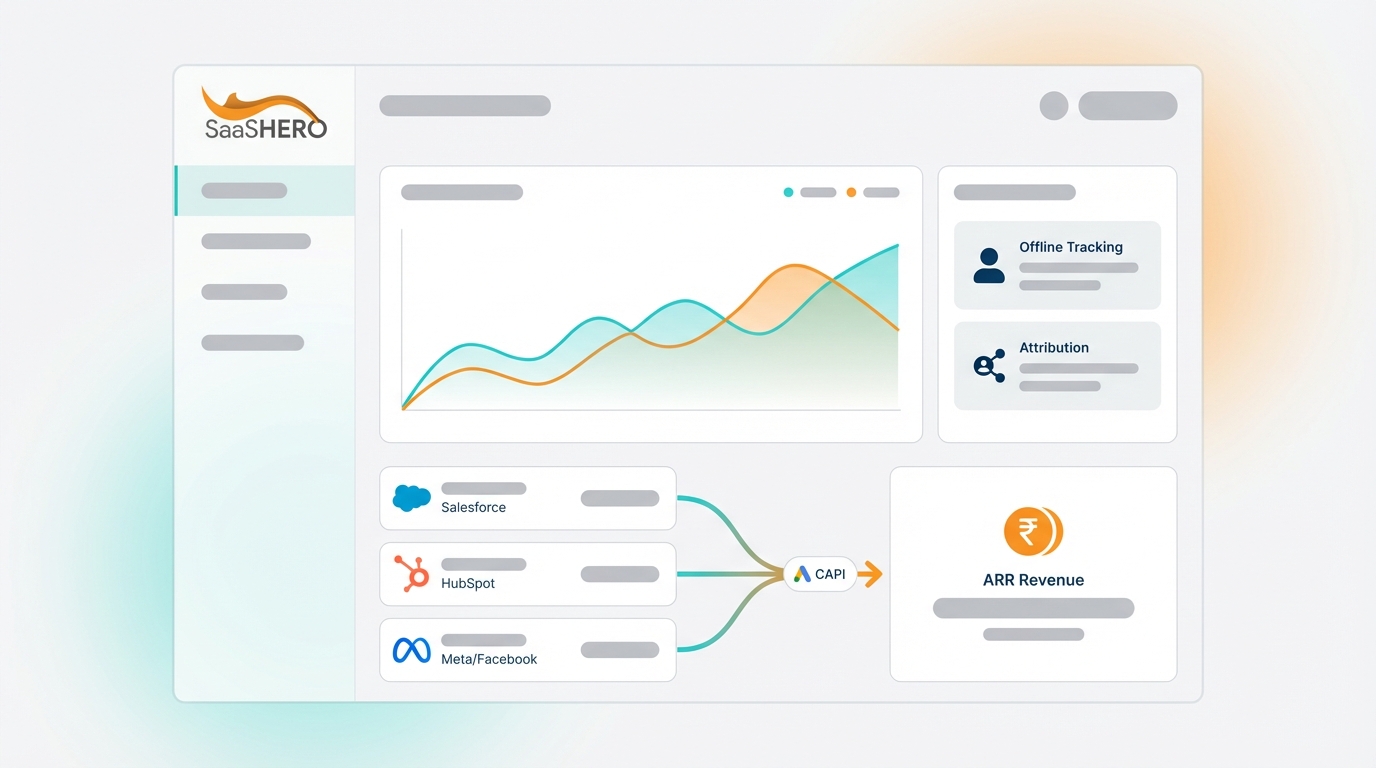
Effective B2B Facebook attribution relies on five pillars. First, CAPI server-side tracking recovers over 10% of lost data after iOS changes, as shown by Triple Whale benchmarks. Second, CRM webhook integrations with HubSpot, Salesforce, or Zapier connect ad clicks to pipeline. Third, offline event uploads track SQLs through to revenue. Fourth, multi-touch tools like Dreamdata or Cometly reveal the full journey. Fifth, 90-day cohort analysis keeps the focus on pipeline, not just leads.
The 7-step framework for revenue-accurate attribution is straightforward. First, install the Pixel and configure CAPI. Second, connect your CRM with webhooks. Third, upload offline conversion CSV files. Fourth, integrate third-party attribution tools. Fifth, analyze 90-day buyer cohorts. Sixth, optimize campaigns for pipeline metrics. Seventh, report on Net New ARR impact.
Choosing the Right CRM for B2B Facebook Attribution
The CRM you choose shapes your attribution accuracy and rollout speed. HubSpot leads mid-market B2B teams with native webhooks and a generous free tier. Salesforce scales for enterprise companies managing more than $10M ARR and complex sales structures. Zapier fills gaps between tools and supports fast, no-code integrations.
|
CRM |
Sales Cycle Fit |
Cost |
Integration Ease |
Attribution Score |
|
HubSpot |
Mid-market (90-day cycles) |
Free tier available |
High (native webhooks) |
9/10 |
|
Salesforce |
Enterprise (120+ day cycles) |
$25+/user/month |
Medium (requires dev) |
8/10 |
|
Zapier Bridge |
All cycle lengths |
$20+/month |
Highest (no-code) |
9/10 |
HubSpot Facebook CAPI setup follows a clear sequence. First, install the Facebook Pixel through the HubSpot Partners integration. Second, configure CAPI in Events Manager and send server events. Third, create a Zapier webhook that syncs form submissions as custom events. Fourth, track SQL and MQL milestones as distinct conversion events. Salesforce setups add custom field mapping and API configuration for reliable offline event uploads.
Meta CAPI and Offline Tracking for B2B Pipelines
OCAPI was deprecated in May 2025, so CAPI now serves as the only supported method for offline conversion tracking. CAPI records CRM updates such as deal stages, closed-won status, and contract values. These events keep B2B attribution accurate beyond the standard 7-day window. Running both Pixel and CAPI improves Event Match Quality and protects attribution under iOS restrictions.
Offline conversion tracking follows three main steps. First, configure CAPI in Events Manager and complete domain verification. Second, upload CSV files that include deal values and close dates within a 90-day attribution window. Third, use linear attribution instead of last-click for multi-touch B2B journeys. January 2026 API changes remove several default windows, so custom reporting now plays a central role.
|
Attribution Tool |
B2B Focus |
Pricing |
CRM Integration |
Best For |
|
Dreamdata |
Full-funnel MTA |
$1,500+/month |
HubSpot, Salesforce |
Complex sales cycles |
|
Cometly |
Multi-platform tracking |
$99+/month |
Direct CRM sync |
Facebook-heavy campaigns |
SaaSHero combines tools like Looker Studio with HubSpot integrations to build complete multi-touch views and lift pipeline performance.

SaaSHero’s Revenue-First B2B Paid Ads System
SaaSHero runs as a B2B SaaS paid ads agency with flat-fee pricing that starts at $1,250 per month and month-to-month terms. This structure aligns agency incentives with client ARR growth instead of ad spend. The team focuses on GCLID-to-CRM passthrough tracking, weekly pipeline reporting, and aggressive competitor conquesting across Google, LinkedIn, and Facebook.

Case studies validate this revenue-first approach. TripMaster generated $504,758 in Net New ARR through precise CRM tracking and attribution. TestGorilla reached an 80-day payback period using HubSpot integration, which supported their $70M Series A raise. SaaSHero serves only B2B SaaS companies and assigns senior leaders to accounts instead of junior generalists.

SaaSHero’s edge comes from connecting ad clicks to closed-won deals with advanced attribution models. The team implements custom conversion events for SQL milestones and builds lookalike audiences from high-value customer lists. Campaigns are tuned around pipeline velocity and revenue, not just cost-per-click. Partner with SaaSHero for direct support on CRM integration and attribution setup.

B2B Facebook Attribution Best Practices and Common Traps
Strong B2B attribution relies on 90-day cohort analysis that reflects longer sales cycles and replaces deprecated 7-day windows. Teams should deduplicate leads across channels and prioritize SQL quality over MQL volume. Linear or U-shaped models work well for journeys with four to six touches.
Several pitfalls appear repeatedly. Many teams chase vanity lead metrics instead of revenue. Others keep Facebook and CRM data in silos or ignore iOS data loss by skipping CAPI. Companies with multi-touch attribution often see 40–60% more pipeline value than those that rely only on native Facebook reporting.
Winning teams set custom attribution windows of at least 7-day view and 30-day click. They track micro-conversions such as pricing page views and demo requests. They also maintain consistent UTM parameters across every campaign. SaaSHero runs detailed attribution audits to uncover and fix these tracking gaps.
Attribution Tool Selection and Rollout Strategy
Attribution tools should match your budget, technical depth, and sales cycle complexity. Enterprise companies often choose Dreamdata for full multi-touch attribution across long journeys. Growth-stage SaaS companies frequently start with Cometly for multi-platform tracking, then upgrade to full-funnel tools as needs expand.
|
Solution |
B2B Accuracy |
Monthly Cost |
Setup Complexity |
SaaSHero Advantage |
|
Dreamdata |
High (full MTA) |
$1,500+ |
Medium |
$500K ARR case studies |
|
Cometly |
Multi-platform |
$99+ |
Low |
Expert execution available |
|
Zapier |
Bridge solution |
$20+ |
No-code |
Flat-fee implementation |
|
SaaSHero |
Revenue-verified |
$1,250+ |
Full-service |
Proven ARR tracking |
The strongest setups combine several methods. CAPI handles server-side tracking. CRM integrations capture offline events. Third-party tools connect data across channels. SaaSHero manages these complex configurations within a flat-fee retainer, so teams avoid hiring extra technical staff.
Conclusion: Turn B2B Facebook Ads into a Revenue Channel
CRM integration and robust attribution convert Facebook ads from experimental spend into a predictable revenue engine for B2B SaaS. The 7-step framework in this guide connects ad spend to closed-won ARR and supports capital-efficient growth in 2026.
Success depends on technical accuracy, continuous optimization, and deep B2B SaaS experience. Book a discovery call with SaaSHero to review your attribution setup and build a revenue-focused Facebook growth plan.
Frequently Asked Questions
Should I use HubSpot or Salesforce for Facebook ads attribution?
HubSpot usually works best for mid-market B2B SaaS companies with sales cycles under 120 days. It offers native webhooks, a free tier, and simple CAPI integration through the Facebook Partners program. Salesforce suits enterprises with complex deal structures, multiple stakeholders, and longer cycles over 120 days, although it needs more technical effort for accurate attribution.
How long does CAPI setup take for B2B attribution tracking?
Professional CAPI setup often takes one to two business days for the basics. That includes domain verification, event configuration, and initial CRM webhook connections. Full attribution with offline uploads, custom conversion optimization, and multi-touch reporting usually takes one to two weeks to implement and validate. Timelines depend on CRM data quality, technical resources, and the level of attribution detail you want.
Can I measure Facebook ads ROI within 90 days for B2B SaaS?
Ninety-day cohort analysis gives enough data to measure Facebook’s impact on pipeline and early revenue signals. Lifetime value requires more time, but you can still track SQL conversion rates, pipeline velocity, and deal movement within 90 days. Offline event tracking remains essential, because it captures CRM milestones that occur long after the initial lead.
What’s the best way to measure ARR attribution from Facebook ads?
Accurate ARR attribution starts with offline conversion tracking through CAPI. Upload closed-won deal data with contract values and close dates within a 90-day window. Create custom events for each sales milestone, including MQL, SQL, Opportunity, and Closed-Won. Then apply linear or position-based models to spread credit across the journey. This structure ties Facebook ad spend directly to recurring revenue.
Which multi-touch attribution model works best for long B2B sales cycles?
Linear attribution fits B2B cycles with four to six touchpoints, because it gives equal credit to each interaction and avoids first-click or last-click bias. For journeys with seven or more touches, position-based U-shaped models work better by emphasizing early awareness and final conversion while still recognizing mid-funnel touches. Time-decay models help when recent interactions strongly influence purchase decisions in competitive B2B markets.