




Written by: Aaron Rovner, Founder, Saas Hero | Last updated: August 24, 2026
Key Takeaways
- Boards now expect revenue-based GTM reporting that ties every dollar of spend to gross-profit-adjusted ARR and payback periods, not vanity metrics like impressions and clicks.
- The three-pillar framework of Acquisition (Net New ARR), Retention (NRR), and Efficiency (CAC Payback and Rule of 40) gives leaders a unified view for capital-efficient decisions.
- Most $5M–$50M ARR companies still rely on disconnected reporting systems that fail to connect ad spend to closed-won revenue, which creates misallocated budgets and board distrust.
- Implementing a revenue-connected framework requires three stages, Foundation, Integration, and Optimization, while avoiding pitfalls like misaligned incentives and segment-level data masking.
- Teams ready to move beyond vanity metrics can adopt a Net New ARR framework that connects GTM spend directly to revenue outcomes. Book a discovery call to explore revenue-based GTM reporting with SaaS Hero.
Executive Summary: Metrics That Drive a Revenue-First GTM System
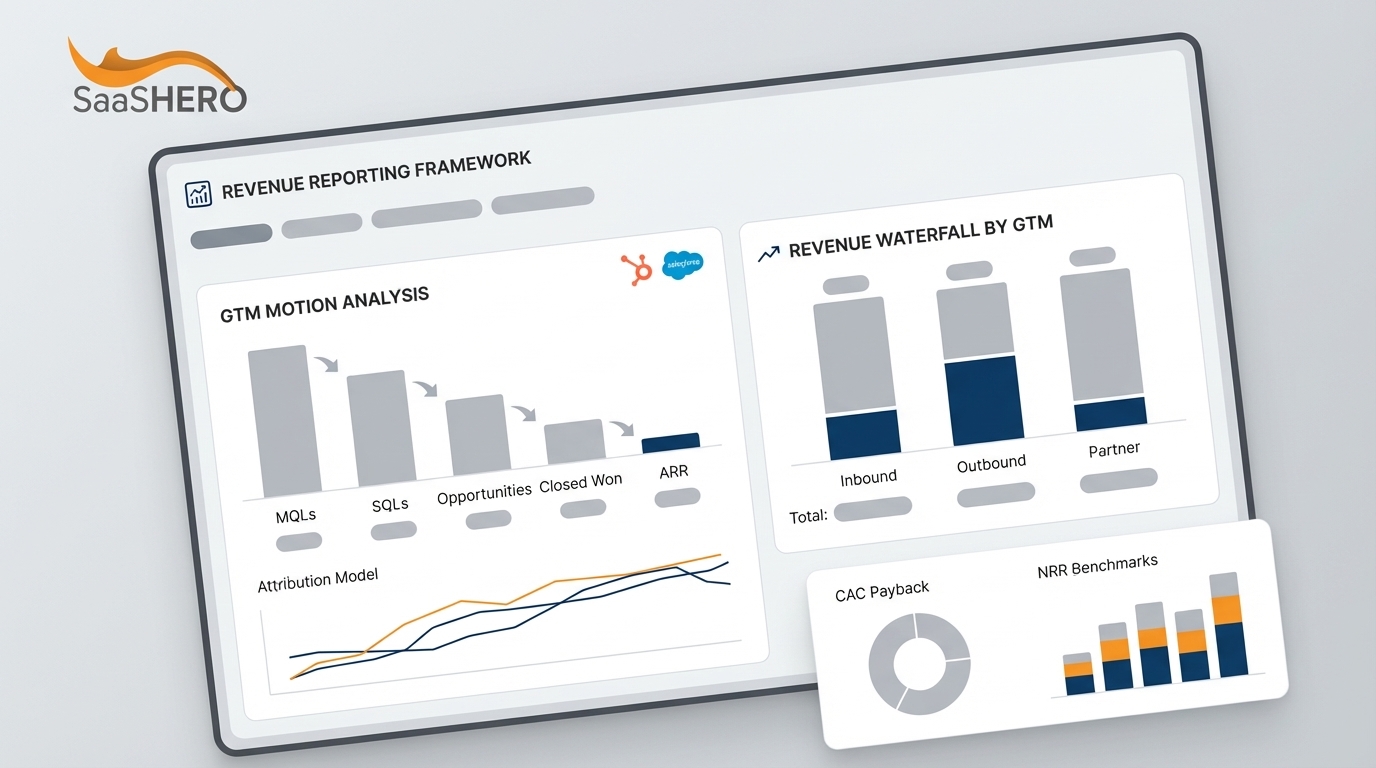
Revenue-based GTM reporting centers on three pillars, Acquisition, Retention, and Efficiency. Each pillar has a governing metric, a formula, and a 2026 benchmark that boards now expect to see. Mastery of all three pillars, and their interaction, is the foundation for board-ready capital allocation.
Net New ARR is the primary Acquisition metric. It measures ARR added from new logos in a given period and reflects the output of a functioning ARR waterfall. Net New ARR differs from pipeline or bookings, because it represents closed, contracted, recurring revenue.

Net Revenue Retention (NRR) governs the Retention pillar. The formula is: NRR = (Beginning ARR + Expansion ARR − Contraction ARR − Churned ARR) / Beginning ARR. The Optifai Pipeline Study (2026, N=939 B2B SaaS companies) defines best-in-class NRR as above 130%, good as 100–120%, and concerning as below 100%.
CAC Payback Period and the Rule of 40 govern the Efficiency pillar. CAC Payback measures the months required to recover customer acquisition cost from gross margin. Reports indicate that median CAC payback periods vary by segment.
The three pillars interact in ways that shape strategy. A company with strong Acquisition but weak Retention fills a leaking bucket. A company with strong Retention but poor Efficiency grows without the capital discipline boards now require. A unified framework surfaces all three pillars at once so leaders can see trade-offs clearly.
The Current Reporting Ecosystem and the Structural Gap
Before teams implement a three-pillar framework, they need a clear view of why current reporting approaches fail. Most B2B SaaS companies at $5M–$50M ARR rely on one of three reporting configurations, an in-house RevOps analyst building shadow models in Excel, a generalist agency delivering last-click attribution reports, or a point solution, such as a BI tool disconnected from the CRM, producing charts that no one trusts.
The structural gap in all three configurations is the same, the reporting layer does not connect fully to revenue. Attribution that connects to Net New ARR requires one system that links activity, pipeline, bookings, renewals, and expansion, replacing siloed funnel metrics with shared revenue ownership across the full customer lifecycle.
Legacy last-click attribution assigns conversion credit to the final touchpoint before a form fill. In a multi-stakeholder B2B sale with a 90-day cycle, that method systematically undervalues top-of-funnel demand generation and overvalues branded search. Companies then cut the channels that build pipeline and double down on the channels that only capture it.
SaaS Hero uses a CRM-connected model that tracks Google Click IDs (GCLIDs) through landing pages into HubSpot or Salesforce so every campaign is evaluated against who bought, not who clicked. This operating model turns revenue-based GTM reporting into a daily practice and already runs for clients across HR Tech, Cybersecurity, and Transportation SaaS.

Strategic Trade-offs for Revenue-Based Reporting Decisions
Revenue leaders at $5M–$50M ARR face three recurring strategic decisions when they roll out a revenue-based reporting framework. Each decision carries distinct financial and organizational consequences.
Build vs. Buy: Building a revenue-connected reporting stack in-house requires a RevOps engineer, a data warehouse, and a BI layer. Internal builds provide full customization and direct data ownership. They also create time-to-value measured in quarters, not weeks, and ongoing maintenance costs that rise with team size. Buying a pre-integrated solution speeds deployment but introduces vendor dependency and may not support custom ARR waterfall definitions.
Insource vs. Partner: Insourcing concentrates institutional knowledge and keeps context close to the team. It also creates key-person risk and limits exposure to benchmarks drawn from many SaaS environments. Partnering with a specialized revenue-first agency adds external perspective and pre-built reporting infrastructure. That approach requires tight CRM access and strong stakeholder alignment so the work does not turn into a “black box” that mirrors generalist agency problems.
Generalize vs. Verticalize: A generalist reporting framework covers all metrics for all segments. A verticalized framework highlights the metrics that predict outcomes in a specific ACV band. Blended NRR can mask segment-specific problems, so segment-level cohort economics become essential in a board-ready framework.
Cadence and Tooling Used by Capital-Efficient SaaS Teams
Capital-efficient SaaS organizations use a three-tier reporting cadence that matches the speed of their decisions.
Weekly: Teams review pipeline coverage by segment, stage conversion rates, and deal velocity. A forecast backed by week-over-week trend data on consistent deal movement, stable coverage ratios, and predictable stage conversion gives the board the evidence trail needed to trust the revenue leader’s view of the business. These reviews focus on operational execution rather than strategic outcomes, so teams use them internally to inform the monthly and quarterly reports that the board receives.
Monthly: Leaders reconcile the ARR waterfall, review cohort-level NRR by segment, track CAC payback by channel, and analyze gross margin. Most venture-backed SaaS companies send a written monthly update between quarterly board meetings so the quarterly package contains no surprises.
Quarterly: Executives run Rule of 40 allocation workshops, deep-dive into segment-level cohort economics, and make capital reallocation decisions. The Rule of 40 works best when presented with its growth-rate and profit-margin drivers rather than as a standalone number, because boards then see how each lever affects capital allocation.
The tooling stack that supports this cadence uses CRM, typically HubSpot or Salesforce, as the system of record, a data warehouse for cohort modeling, and Looker Studio for visualization. SaaS Hero delivers this stack as part of every retainer, with board-ready dashboards for CAC, LTV, payback, Net New ARR, SQLs, and pipeline, all connected directly to the client’s CRM.
Three-Stage Model for Implementation Readiness
Organizations that adopt revenue-based GTM reporting move through three observable stages. Knowing the current stage helps leaders focus investment where it will pay back fastest.
Stage 1 — Foundation: The organization uses inconsistent ARR definitions, lacks a reconciled waterfall, and tracks GTM metrics that do not connect to CRM data. Common signs include manual monthly reporting in Excel, disagreement between Sales and Finance on what counts as “closed,” and CAC calculated from total marketing spend instead of channel-level data. Teams at this stage should confirm whether they can produce a reconciled ARR waterfall for last quarter in under 24 hours and whether the CRM captures the original lead source for every closed-won deal.
Stage 2 — Integration: The team reconciles the ARR waterfall monthly, CRM data flows into a BI layer, and segment-level NRR is visible. Signs include a shared definition of New ARR versus Expansion ARR, channel-level CAC tracked against payback targets, and a monthly board update that includes retention metrics. Leaders should confirm that NRR figures use the same cohort definition every month and that marketing and finance agree on the CAC numerator.
Stage 3 — Optimization: Attribution connects ad spend to closed-won ARR, segment-level cohort economics guide capital allocation, and the Rule of 40 is tracked quarterly with clear visibility into its components. Signs include gross-profit-adjusted payback by channel, expansion ARR modeled by cohort vintage, and GTM budget decisions driven by waterfall data instead of intuition.
Common Strategic Pitfalls and How to Spot Them
Three recurring pitfalls often derail revenue-based GTM reporting implementations at $5M–$50M ARR companies.
Misaligned incentives between sourced and influenced revenue: When Sales claims credit for deals that Marketing sourced, and Marketing claims credit for deals that Sales developed, the ARR waterfall becomes a political artifact instead of an operating tool. The fix is a documented, CRM-enforced attribution policy with a single owner for each movement type. New ARR is owned by New Business Sales, Expansion by Account Management, and Churn or Contraction by Customer Success and Product teams.
Segment-level payback variance hidden by blended averages: A blended CAC payback of 14 months may conceal an SMB payback of 8 months and an Enterprise payback of 28 months. As noted in the earlier discussion of verticalization, blended metrics distort capital allocation, because a company that budgets against the 14-month figure underinvests in the efficient segment and overinvests in the inefficient one. Teams should confirm that CAC payback is calculated separately for each ACV segment and each acquisition channel.
Data latency between CRM and reporting layer: When the reporting layer pulls from a stale data export instead of a live CRM sync, waterfall figures drift away from operational reality. Boards lose confidence in the numbers and the reporting cadence breaks down. Inconsistent reporting cadence erodes trust and triggers ad-hoc requests that consume more finance capacity than scheduled reports.
SaaS Hero’s CRM-connected reporting eliminates data latency by linking dashboards directly to HubSpot or Salesforce so waterfall figures and payback views reflect current deal status instead of last month’s export.
Three Anonymized Reporting and Capital Allocation Archetypes
The following archetypes summarize common reporting constraints and capital-allocation patterns across B2B SaaS companies at different growth stages. Each archetype represents a composite, not a specific client.
Archetype 1 — Early-Stage Founder-Led ($2M–$5M ARR): Reporting lives in spreadsheets. The team tracks ARR but does not break it into waterfall components. CAC is calculated from total spend, not by channel. The main constraint is data infrastructure, not analytical skill. Capital allocation decisions rely on intuition and pipeline gut-feel. The highest-leverage move is to establish a reconciled monthly ARR waterfall and connect CRM lead sources to closed-won deals before adding new GTM spend.
Archetype 2 — Post-Series-B Scaler ($10M–$30M ARR): A waterfall exists but uses inconsistent definitions across quarters. NRR is tracked at the company level but not by ACV segment. CAC payback is calculated on a blended basis. The board now asks for gross-profit-adjusted payback and the team cannot produce it. The highest-leverage move is to build segment-level cohort economics and a gross-margin-adjusted payback dashboard by channel.
Archetype 3 — Mature Efficiency Optimizer ($30M–$50M ARR): The waterfall is reconciled, NRR is segmented, and CAC payback is tracked by channel. The constraint shifts to Rule of 40 optimization, because the company must reallocate GTM budget from low-efficiency segments to high-efficiency ones without harming pipeline coverage. The highest-leverage move is a quarterly Rule of 40 allocation workshop that uses waterfall data to drive budget decisions instead of historical spend patterns.
Frequently Asked Questions
Who should own the ARR waterfall in a B2B SaaS company?
ARR waterfall ownership works best when functions share responsibility but one operator remains accountable. Finance or RevOps typically owns reconciliation and publication of the waterfall. Sales owns the New ARR line, Account Management or Customer Success owns the Expansion line, and Customer Success owns the Contraction and Churn lines. All teams must use the same definitions and the same CRM data source. When ownership fragments or definitions diverge, the waterfall turns into a contested artifact instead of a working tool.
How often should a B2B SaaS board receive ARR waterfall data?
The team should reconcile the ARR waterfall monthly and include it in a written monthly update between quarterly meetings. The quarterly board meeting should focus on decisions and capital allocation, not on walking through numbers that appeared in the pre-read. A practical board metrics dashboard includes ARR, NRR, CAC, payback period, burn, runway, pipeline coverage, and headcount, delivered in the same format every month so trends are clear without extra explanation. Off-cycle updates make sense when a material assumption breaks, such as a large deal disqualifying or a top account churning, instead of waiting for the next scheduled update.
What is the difference between sourced and influenced revenue, and why does it matter for GTM reporting?
Sourced revenue attributes a closed-won deal entirely to the first marketing or sales touch that created the opportunity. Influenced revenue assigns partial credit to any touch that occurred during the sales cycle. The distinction matters because a single blended line that mixes both models creates CAC figures that are neither accurate nor comparable across periods. A revenue-based GTM reporting framework needs a documented, CRM-enforced attribution policy that specifies the chosen model and applies it consistently across channels and segments. Without that policy, channel-level CAC payback calculations become unreliable and capital allocation decisions based on them drift off course.
How does gross-profit-adjusted CAC payback differ from standard CAC payback, and when should boards require it?
Standard CAC payback measures the months required to recover acquisition cost from gross revenue. Gross-profit-adjusted payback uses gross margin dollars instead of revenue, which produces a longer and more conservative payback figure. For a SaaS company with 75% gross margins, a 12-month revenue-based payback translates to a 16-month gross-profit-adjusted payback. Boards at companies with gross margins below 70%, which is common in service-supported SaaS or vertical SaaS with implementation components, should require the gross-profit-adjusted figure because the revenue-based figure overstates capital efficiency. At pure SaaS gross margins of 80% or higher, the two figures converge closely enough that either works, as long as the margin assumption is disclosed.
What does a Rule of 40 allocation workshop produce, and how does it connect to GTM budget decisions?
A Rule of 40 allocation workshop uses the current quarter’s waterfall data to break the Rule of 40 score into its growth-rate and margin components, then maps each GTM spend category to its contribution to Net New ARR and its impact on margin. The output is a ranked list of GTM investments by capital efficiency, usually expressed as Net New ARR generated per dollar of GTM spend, adjusted for payback period. Budget reallocation decisions then rest on observed cohort economics instead of historical spend patterns or intuition. The workshop works best on a quarterly cadence, immediately after the ARR waterfall is reconciled, so next-quarter capital allocation decisions use the most recent segment-level data.
Next Steps: Run an Internal Revenue-Based Reporting Workshop
The three-pillar framework of Acquisition, Retention, and Efficiency functions as a capital allocation system, not a reporting exercise. Every dollar of GTM budget should connect to a waterfall component, benchmark against segment-level cohort economics, and meet a gross-profit-adjusted payback threshold. Boards now apply this standard, and it separates companies that raise capital efficiently from those that burn it.
A practical internal assessment workshop covers four areas in sequence:
- ARR waterfall audit: Confirm whether the team can produce a reconciled waterfall for the last three quarters using consistent definitions. If not, start here.
- Segment-level NRR review: Confirm whether NRR is calculated separately for SMB, Mid-Market, and Enterprise ACV bands, because blended NRR does not support precise capital allocation.
- Channel-level CAC payback analysis: Confirm whether payback is calculated by acquisition channel and ACV segment using gross margin rather than revenue. If not, current budget allocation relies on incomplete information.
- Rule of 40 decomposition: Confirm whether the current Rule of 40 score is broken into growth-rate and margin components, with each component mapped to specific GTM investments. If not, the quarterly board conversation lacks the evidence trail needed to defend capital decisions.
SaaS Hero already runs this framework for B2B SaaS clients across the $5M–$50M ARR range. The reporting infrastructure, including CRM-connected dashboards, ARR waterfall views, segment-level cohort economics, and CAC payback by channel, is built into every retainer on a flat monthly fee with no long-term lock-in. The model is designed to re-earn the client’s business every 30 days, so the framework must deliver results.