





Written by: Aaron Rovner, Founder, Saas Hero | Last updated: August 13, 2026
Key Takeaways for B2B SaaS Revenue Leaders
- Performance-focused B2B SaaS agencies must tie work to measurable Net New ARR and CRM-synced closed-won attribution, not impressions or MQL counts.
- Flat-fee retainers within clear spend bands align agency incentives with CAC payback goals, while percent-of-spend models create structural conflicts.
- Month-to-month contracts with 90-day review gates shift performance risk to the agency and remove long-term lock-in.
- Documented 2025–2026 ARR case evidence with named clients, specific Net New ARR figures, and CAC payback metrics is now the baseline for credible agency evaluation.
- Revenue leaders at $5M–$50M ARR B2B SaaS companies should schedule an attribution audit with SaaSHero to benchmark their current setup against these five criteria.
1. Attribution Depth to Closed-Won Revenue
Attribution depth describes how precisely an agency can connect every dollar of closed-won revenue to a specific campaign, channel, and touchpoint across the full buyer journey.
B2B SaaS buying committees average 6–10 decision-makers, and Gartner research finds buyers spend only 17% of the purchase journey meeting with suppliers. Single-touch or last-click attribution, which is the default in most ad platforms, systematically over-credits branded search and demo forms. It erases the upstream touches that created demand. For $5M–$50M ARR companies with 60–180-day sales cycles, this gap between reported conversions and actual closed-won revenue is where agency accountability breaks down.
Agencies operating at the required standard implement W-shaped or full-path multi-touch attribution. These models weight first touch, lead creation, and opportunity creation, then map each milestone to CRM opportunity stages. This setup requires passing Google Click IDs (GCLIDs) through landing pages into HubSpot or Salesforce, importing offline conversions on a weekly cadence, and reconciling CRM-sourced closed revenue against platform-reported conversions. Regular measurement loops with sales teams support agencies that claim closed-won attribution in B2B SaaS.
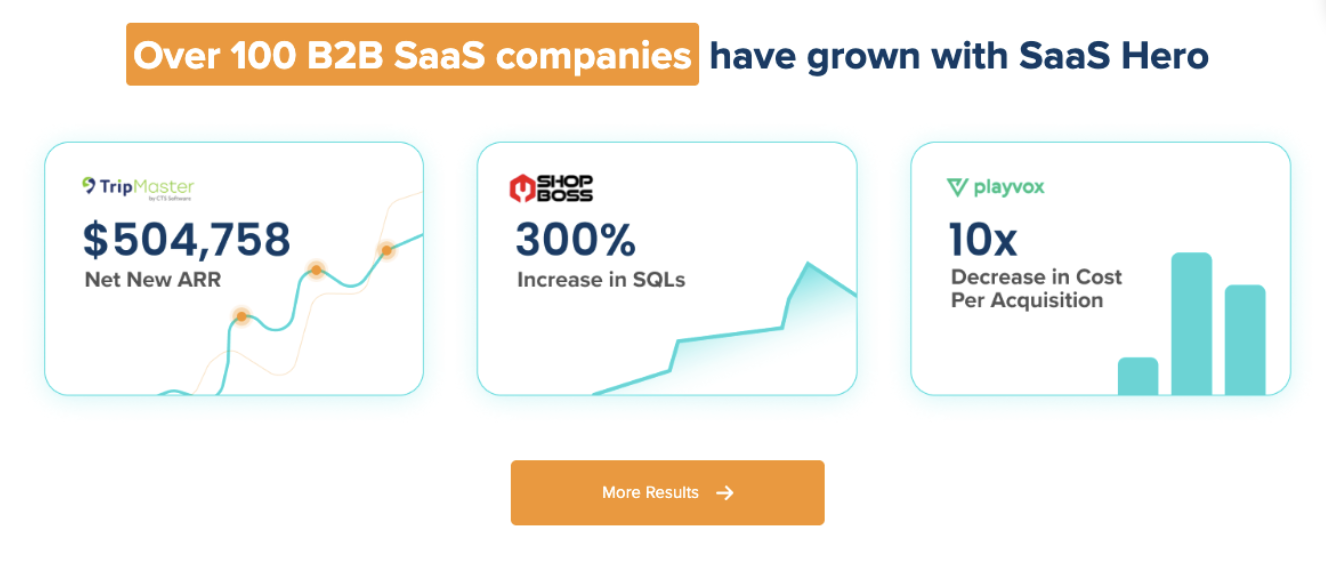
To illustrate this standard in practice, SaaSHero connects ad click data directly to CRM pipeline. Reporting focuses on Net New ARR and pipeline value instead of form fills. Their TripMaster case study produced $504,758 in Net New ARR in 12 months, drawn from closed revenue records rather than lead counts.

The attribution depth checklist for agency evaluation:
- Can the agency name the specific multi-touch model they use (W-shaped, full-path, or data-driven)?
- Do they import offline conversions from your CRM into ad platforms on a weekly or daily cadence?
- Can they map keyword or campaign performance to opportunity stage within seven days of a deal closing?
- Do they reconcile self-reported attribution (“How did you hear about us?”) against CRM-tracked touchpoints to capture dark-funnel demand?
- Is closed-won ARR the primary decision signal, or do they still focus on form submissions?
Red flag: Reporting stops at form fills. The Starr Conspiracy states that attribution rigor is insufficient if reporting stops at form fills instead of CRM-sourced closed revenue, because most leads never become opportunities and most opportunities never close.
2. Pricing Model Incentive Alignment
Pricing model incentive alignment describes how closely an agency’s revenue model matches the way its client generates closed-won ARR. Flat-fee retainers achieve this alignment, while percent-of-spend models structurally cannot.
The percent-of-spend model, typically 10–20% of monthly ad budget per HawkSEM’s April 2026 PPC pricing guide, ties agency revenue directly to client costs. An agency earning 15% of a $50,000 monthly budget makes $7,500. If that agency recommends cutting waste and reducing spend to $30,000, it takes a $3,000 monthly pay cut. The financial incentive to recommend budget increases exists even when the data does not support scaling. As one flat-fee agency founder notes, an agency that earns more when you spend more has no incentive to say your budget is already at the right level.
Flat-fee retainers decouple agency revenue from spend volume, which changes the incentive structure. When SaaSHero operates within a spend band, such as $25,000–$50,000 per month, the agency fee remains fixed whether the client spends $27,000 or $48,000. This decoupling means a recommendation to increase budget carries no financial benefit to the agency. The recommendation rests on performance data instead of revenue goals. 78% of digital agencies now use retainer pricing as their primary model, up from 64% in 2023, which confirms that flat-fee structures have become the market standard for credible performance partners.
The pricing model checklist:
- Is the agency fee fixed within spend bands, or does it scale linearly with every dollar of budget increase?
- Does the agency earn more if you spend more, creating a structural conflict on budget recommendations?
- Are setup fees and creative costs itemized separately, or bundled into an opaque retainer?
- Is there a prepay discount that rewards commitment without forcing a long-term contract?
- Does the pricing structure appear in a public, transparent rate card?
Red flag: The agency charges a percentage of ad spend with no spend-band caps. At $50,000 monthly spend, a 15% fee costs $7,500 per month, which exceeds SaaSHero’s highest-tier full marketing team retainer for the same spend level.
| Monthly Ad Spend Band | Percent-of-Spend Cost (15% rate) | Flat-Fee Range (industry specialist tier) | Effective Rate at Flat Fee |
|---|---|---|---|
| $10,000–$25,000 | $1,500–$3,750 | $4,000–$8,000/mo | 16%–80% (varies by spend) |
| $25,000–$50,000 | $3,750–$7,500 | $4,000–$8,000/mo | 8%–32% (varies by spend) |
| $50,000+ | $7,500+ (uncapped) | $4,000–$8,000/mo (capped) | Under 16% and declining |
Revenue leaders at $5M–$50M ARR who want to understand whether their current agency model supports CAC payback goals should request a pricing model comparison from SaaSHero to benchmark their current spend structure against flat-fee alternatives.
3. Contract Flexibility and Risk Allocation
Contract flexibility shows how much performance risk an agency absorbs through short-term or month-to-month agreements instead of shifting that risk to the client through long lock-in terms.
A 6-to-12-month agency contract with no performance off-ramp guarantees agency revenue regardless of outcomes. A 12-month contract with no off-ramp and three months paid upfront signals an agency retention model built to trap clients rather than prove value. The psychological impact is equally damaging. An agency that cannot be terminated for 12 months has little structural urgency to deliver results in months one through six. A mismatched agency retainer for mid-market companies averages $15,000–$25,000 per month with 6-month minimum commitments, producing $90,000–$150,000 in sunk costs plus $200,000–$400,000 in total switching and opportunity costs.
Month-to-month agreements act as a forcing function for agency performance by requiring the agency to re-earn the client relationship every 30 days. This structure aligns the agency’s survival with the client’s revenue outcomes, mirroring the alignment that flat-fee pricing creates on the budget side. The best agencies use a 90-day review gate where either side can walk if the diagnostic did not pan out. This approach combines short-term accountability with enough runway for campaigns to generate statistically meaningful data.
The contract flexibility checklist:
- Is the initial contract month-to-month, or does it require a 6–12-month minimum commitment?
- Is there a 90-day review gate with defined exit criteria for both parties?
- Are setup fees and onboarding costs itemized separately from the ongoing retainer?
- Does the agency offer a prepay discount as an incentive rather than a requirement?
- Can the client scale spend up or down within a band without triggering a contract renegotiation?
Red flag: The agency requires payment for three or more months upfront before campaigns launch. This structure transfers all performance risk to the client before the agency has demonstrated a single result.
4. 2025–2026 ARR Case Evidence and Pipeline Velocity
ARR case evidence provides documented proof that an agency has generated measurable Net New ARR and shortened CAC payback periods for named clients at comparable ARR stages within the past 18 months.
OpenView Partners SaaS Benchmarks 2025 (n=519 private SaaS companies) reports median CAC payback of 12–15 months for SMB SaaS and 18–24 months for mid-market SaaS, with top-quartile companies recovering CAC 35–40% faster than the median. KeyBanc Capital Markets SaaS Survey 2025 identifies CAC payback under 12 months as an investor gold standard, while payback above 24 months produces valuation discounts at Series A and B. These benchmarks define the performance bar that agency case evidence must clear.
SaaSHero’s documented outcomes include $504,758 in Net New ARR for TripMaster in 12 months, an 80-day CAC payback period for TestGorilla (which supported a $70M Series A), and a 10x reduction in cost per lead for Playvox alongside a 163% increase in lead volume. ChartMogul SaaS Benchmarks 2025 (n=1,200+ subscription companies) shows companies above $5M ARR recover CAC in a median 14 months, so TestGorilla’s 80-day payback sits in the top percentile of that benchmark set.

The ARR case evidence checklist:
- Does the agency provide case studies with named clients, specific Net New ARR figures, and defined time windows?
- Are the case study clients at a comparable ARR stage ($5M–$50M) and in a comparable vertical?
- Does the agency report CAC payback period as a primary outcome metric, or only lead volume and CPL?
- Are the results dated within the past 18 months, reflecting 2025–2026 market conditions?
- Can the agency provide stage-matched references, not just industry-matched, from clients at a similar growth phase?
Red flag: Case studies report only impressions, CTR, or MQL volume without connecting outcomes to pipeline value or closed-won ARR. The Starr Conspiracy notes that most agencies optimize for MQL volume because it is easy to count rather than for pipeline velocity and SQO-to-close rates.
Revenue leaders who must defend agency spend to their board with ARR-linked evidence should review SaaSHero’s case studies to see documented outcomes at comparable ARR stages.
5. Vertical Specialization and Senior-Led Execution
Vertical specialization reflects how tightly an agency’s team, methodology, and case evidence focus on B2B SaaS instead of spreading across unrelated verticals that dilute domain expertise.
B2B SaaS demand generation requires fluency in concepts such as churn, MRR, CAC payback, sales-qualified opportunities, and onboarding activation. Generalist agencies encounter these dynamics only occasionally. An agency signals weak SaaS commercial understanding if it does not ask about churn, LTV, CAC, or sales velocity during initial discussions. Agencies that serve e-commerce, local services, and B2B SaaS at the same time cannot build the pattern recognition that comes from managing many SaaS accounts through similar funnel dynamics. Stage-matched references deliver three times more useful insights than industry-matched references when evaluating agency fit for mid-market SaaS companies.
Senior-led execution strengthens this specialization advantage. The industry’s common bait-and-switch pattern, where senior strategists close the deal and junior account managers run the account, depends on high client-to-manager ratios. SaaSHero caps client-to-manager ratios at 8–10 clients per strategist and maintains hands-on senior involvement throughout the engagement. Strong proposals name the strategist, specialist, and PM with time allocation per role. Vague team allocation is a documented red flag for agencies that cannot guarantee senior attention after signature.
SaaSHero operates exclusively in B2B SaaS and technology. The team has documented vertical depth across HR Tech, Cybersecurity, Marketing Tech, Healthcare, Construction, and Transportation and Logistics. This focus means every campaign architecture, competitor conquesting strategy, and landing page heuristic is calibrated for the buying dynamics of enterprise software procurement.
The vertical specialization checklist:
- Does the agency serve only B2B SaaS and technology, or does it also manage e-commerce, local, or consumer accounts?
- Can the agency name the strategist, specialist, and PM who will work on the account before the contract is signed?
- What is the maximum client-to-manager ratio, and is it contractually defined?
- Does the agency demonstrate fluency in SaaS-specific metrics (CAC, LTV, churn, MRR, payback) in the first sales conversation?
- Are case studies drawn from the client’s specific vertical, not just the broader SaaS category?
| Agency | Attribution Depth | Contract Flexibility | 2025–2026 ARR Case Evidence |
|---|---|---|---|
| SaaSHero | CRM-synced multi-touch, GCLID-to-closed-won, weekly offline conversion import, Looker Studio plus HubSpot reporting | Month-to-month, optional 6-month prepay at ~20% discount, no lock-in | $504,758 Net New ARR (TripMaster); 80-day CAC payback (TestGorilla); 10x CPL reduction (Playvox) |
| Directive Consulting | HubSpot and Salesforce offline conversion import, stage-mapping document, Customer Generation methodology | $8,000–$20,000+/month, contract terms not publicly disclosed | Enterprise SaaS clients including Cisco, financial model-driven CAC, LTV, and payback reporting |
| Refine Labs | Pipeline and revenue metrics focus, demand creation methodology, multi-touch model not publicly specified | $10,000–$20,000+/month, contract terms not publicly disclosed | B2B SaaS clients including Clari, pipeline-over-MQL reporting framework |
| EpicSlope Partners | Warehouse-grade attribution and revenue modeling, 45–60-day onboarding for clean CRM data | Performance-based pricing components, requires $30K+/month spend, Series B+ focus | Revenue modeling outputs, specific ARR case figures not publicly disclosed |
Frequently Asked Questions
How Net New ARR Attribution Differs from Pipeline Attribution
Pipeline attribution assigns credit to marketing touchpoints when a deal enters the pipeline as an open opportunity. Net New ARR attribution goes further and connects those same touchpoints to deals that have closed and converted into contracted recurring revenue. Pipeline attribution acts as a leading indicator. Net New ARR attribution provides the lagging confirmation that marketing spend produced real business value. For board reporting and CAC payback calculations, only closed-won ARR attribution provides the data required to defend marketing investment with financial precision.
Timeline for CRM-Synced Multi-Touch Attribution
A basic implementation that connects Google Ads GCLIDs to HubSpot or Salesforce opportunity records typically takes two to four weeks, assuming clean CRM data and existing conversion tracking. A full multi-touch attribution setup, including offline conversion imports, W-shaped or full-path model configuration, Looker Studio dashboards, and sales team feedback loops, generally requires four to eight weeks. The onboarding period is also when the agency maps campaign structures to CRM opportunity stages. This mapping forms the foundation for reporting on closed-won revenue rather than form fills. Companies with fragmented CRM data or inconsistent contact role assignment on opportunities should expect timelines at the longer end of that range.
Ownership of Ad Accounts, Creative Assets, and Integrations
The client should own all ad accounts, creative assets, tracking infrastructure, and CRM integrations from day one. This requirement is non-negotiable in any performance-focused engagement. Agencies that retain ownership of ad accounts as a retention mechanism operate against client interests, because the historical data in those accounts, including conversion history, audience signals, and negative keyword lists, carries significant economic value for future campaign performance. SaaSHero uses a model where clients retain full ownership of all assets and data. This approach aligns with the month-to-month contract structure that requires the agency to re-earn the relationship instead of holding infrastructure hostage.
ARR Stage for Hiring a Performance-Focused B2B SaaS Agency
The ideal entry point arrives when a company has validated product-market fit, defined its ICP, and achieved an LTV to CAC ratio of at least 3:1. Below that threshold, the constraint usually reflects a unit economics problem rather than a marketing distribution problem, so agency spend will not solve it. For most B2B SaaS companies, this point corresponds to the $2M–$5M ARR range for founder-led teams beginning to formalize paid acquisition, and the $5M–$15M ARR range for companies ready to scale a full paid media program across multiple channels. SaaSHero’s tiered pricing structure, starting at $1,250 per month for up to $10,000 in managed spend, is designed to make professional performance management accessible at the earlier end of this range.
Presenting Agency ROI to the Board with CAC Payback
The most defensible board presentation connects agency retainer cost plus managed ad spend to Net New ARR generated within a defined attribution window, then expresses the result as a CAC payback period in months. The formula is total marketing spend (retainer plus ad spend) divided by gross margin percentage, then divided by monthly Net New MRR attributed to that spend. A result under 12 months for SMB-focused SaaS and under 18 months for mid-market SaaS meets investor gold standard benchmarks. The critical requirement is that the ARR figure comes from CRM-sourced closed-won data, not platform-reported conversions, because boards and investors apply the same scrutiny to marketing attribution that they apply to revenue recognition.
Selecting the Right Performance Partner in 2026
The five criteria in this framework, which include attribution depth to closed-won revenue, pricing model incentive alignment, contract flexibility, 2025–2026 ARR case evidence, and vertical specialization with senior-led execution, form a complete evaluation scorecard for revenue leaders at $5M–$50M ARR B2B SaaS companies. 68% of B2B marketing RFPs now require prospective agencies to describe a named pipeline-attribution methodology before advancing to shortlist, up from 41% in 2023, which confirms that the market has moved toward revenue accountability as the baseline standard. Agencies that cannot clear all five criteria prioritize their own operational convenience over your CAC payback period and your next funding round.
SaaSHero’s model, which combines flat-fee retainers, month-to-month contracts, CRM-synced closed-won attribution, B2B SaaS-only vertical focus, and the documented outcomes detailed in Section 4, is built to satisfy every criterion in this framework. The agency has managed over $30 million in B2B SaaS ad spend, holds Google Premier Partner status (top 3%), and carries G2 High Performer recognition. As the benchmarks in Section 4 demonstrate, the difference between a performance-aligned agency and a vanity-metric vendor is measurable in months of payback and millions in enterprise value. To identify the fastest path to board-defensible Net New ARR, schedule a consultation with SaaSHero and benchmark your current attribution setup against the five criteria above.