




Last updated: February 28, 2026
Key Takeaways
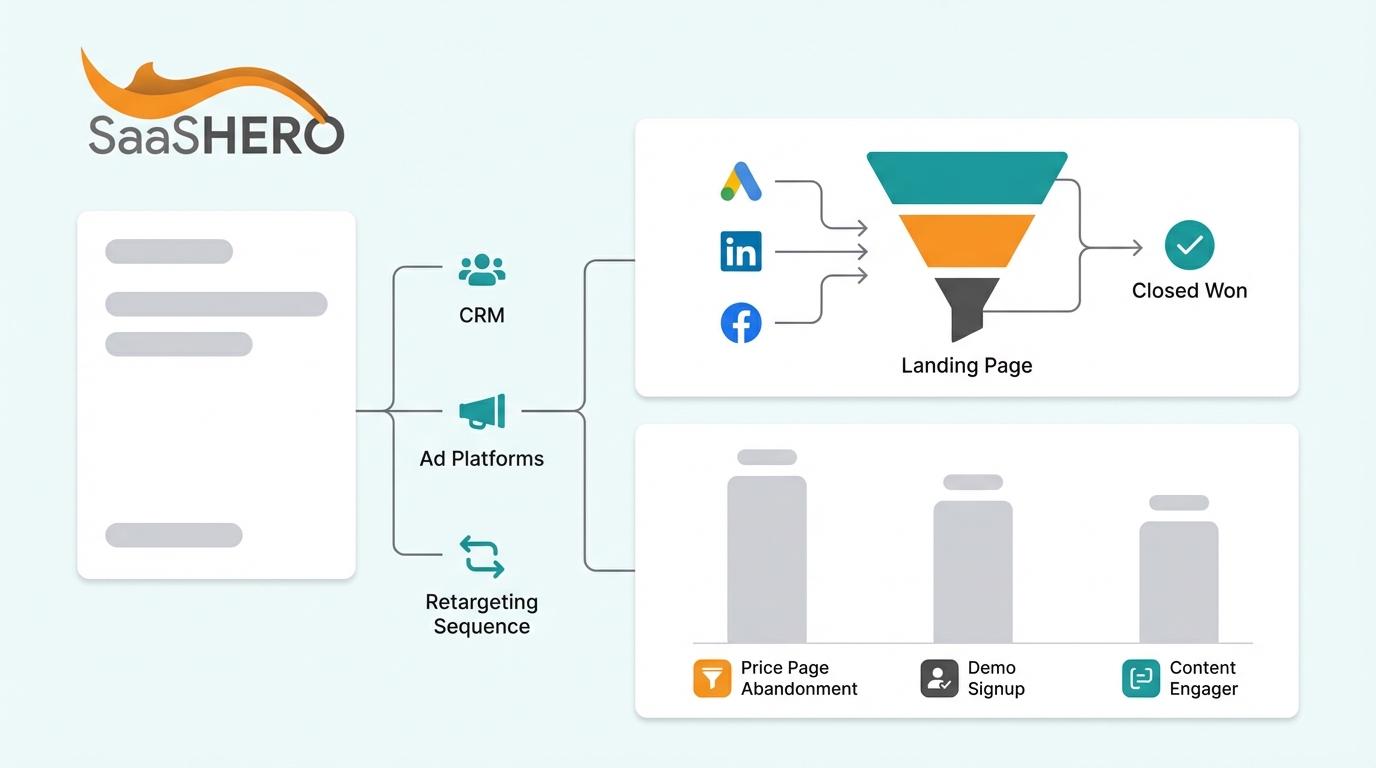
- Price and demo abandonment sequences focus on high-intent visitors and often deliver 3-5x ROAS with 7-14 day messaging.
- Buyer enablement nurtures content engagers with staged value, often reaching 15-25% email opens and 2-4% demo bookings.
- Review and validation retargeting uses social proof for review site visitors and usually converts 2-3x better than cold audiences.
- ABM account retargeting personalizes by account and role, driving 40-60% higher engagement and stronger pipeline quality.
- Teams can implement these structures with SaaSHero’s support via a discovery call to grow ARR in a measurable way.
1. Price and Demo Abandonment Sequence for High-Intent Visitors
The price and demo abandonment sequence targets the most valuable non-converting visitors. Roughly 98% of B2B visitors do not convert on their first visit, so this audience holds major upside. This structure focuses on users who show clear purchase intent by viewing pricing pages for 30 seconds or more or by starting but not completing demo requests.
Campaign Structure:
- Triggers: Pricing page visits 30+ seconds, demo form abandonment, calculator interactions
- Platforms: LinkedIn Sponsored Content, Google Display Network, first-party email sequences
- Window: 7-14 day retargeting period for strongest performance
- CRM Integration: HubSpot or Salesforce pixel tracking with GCLID-to-revenue attribution
|
Sequence Day |
Ad Type |
Copy Example |
Expected CTR |
|
Day 1-3 |
Reminder |
“Saw our pricing? Let’s show you the ROI in a 15-min demo” |
1.2-1.8% |
|
Day 4-7 |
Objection Handling |
“ROI proof: TripMaster achieved 650% returns in 12 months” |
0.9-1.4% |
|
Day 8-14 |
Urgency |
“Limited Q1 implementation slots – secure your demo today” |
0.7-1.1% |
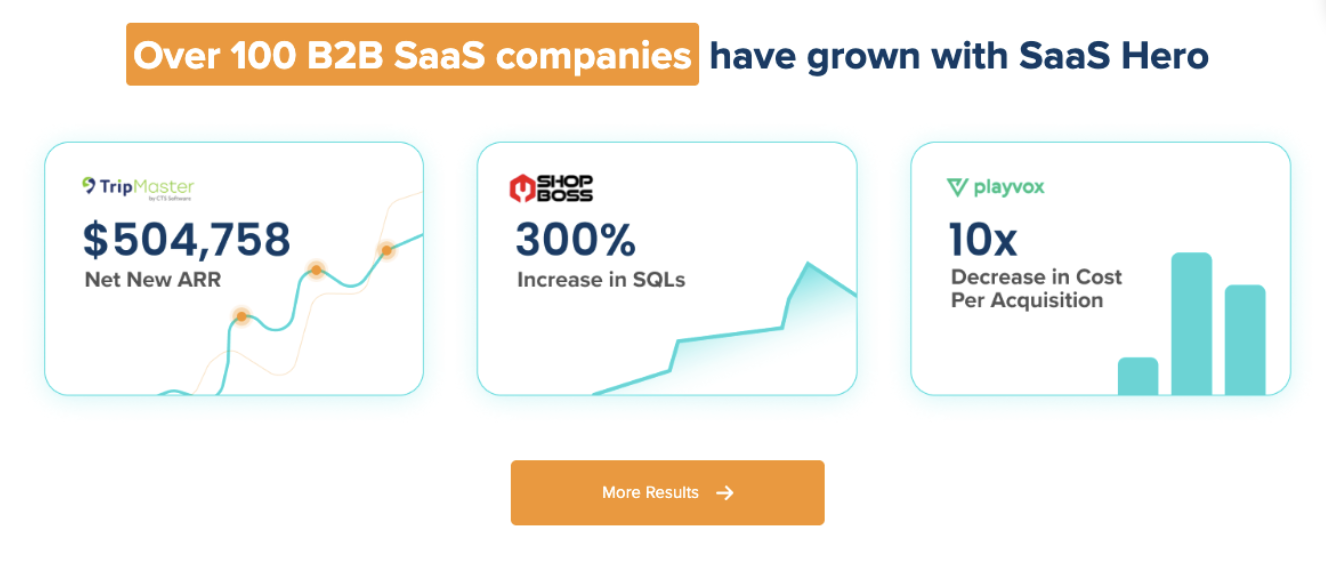
Teams should segment audiences by specific page visits, build dynamic landing pages that mirror ad messaging, and add negative keywords to filter out navigational searches. SaaSHero’s TripMaster case study shows the upside, with 650% ROI and a 20% conversion rate from retargeted pricing page visitors. Typical results include 3-5x ROAS and 20%+ conversion rates, although creative fatigue often appears after 14 days without fresh assets.
2. Buyer Enablement Nurture for Research-Driven Prospects
The buyer enablement structure re-engages users who consume educational content but have not yet requested a demo. B2B buyers usually complete extensive research before talking with sales, so content engagement signals meaningful intent. This sequence turns that early interest into pipeline by reinforcing value and then introducing social proof and offers.
Campaign Structure:
- Triggers: Webinar attendance, whitepaper downloads, blog post engagement 60+ seconds
- Platforms: LinkedIn video ads, Google Display with custom audiences
- CRM Events: Content scoring in HubSpot, progressive profiling
- Attribution: 30-day click windows for longer B2B consideration cycles
|
Sequence Day |
Ad Type |
Copy Example |
Expected Engagement |
|
Day 1-3 |
Value Reinforcement |
“Enjoyed our ROI guide? See how TestGorilla cut payback to 80 days” |
2.1-3.2% |
|
Day 4-7 |
Case Study |
“From guide to growth: 3 SaaS companies that 10x’d their pipeline” |
1.8-2.7% |
|
Day 8-14 |
Demo CTA |
“Ready to implement? Book your strategy session” |
1.4-2.1% |
This structure uses progressive disclosure, moving from educational content to case studies and then to direct demo calls to action. SaaSHero’s work with TestGorilla illustrates the impact, supporting an 80-day payback period that contributed to their $70M Series A raise. Teams often see 15-25% email open rates and 2-4% demo booking rates from these retargeted content audiences. Scale your buyer enablement campaigns with SaaSHero’s proven $1,250/month retainer model.

3. Review and Validation Retargeting for Social Proof Seekers
Review and validation retargeting focuses on prospects in the consideration phase who visit third-party review sites or comparison pages. These users actively look for social proof and risk reduction, so they respond well to testimonial-heavy and trust-focused messaging. This audience often converts faster because they already understand the category.
Campaign Structure:
- Triggers: G2 or Capterra page visits, competitor comparison views, review site engagement
- Platforms: Google Display Network with placement targeting, LinkedIn Sponsored Content
- First-party data: Review site pixel integration, comparison page tracking
- Messaging: Social proof emphasis and risk reduction focus
|
Sequence Day |
Ad Type |
Copy Example |
Expected Performance |
|
Day 1-5 |
Testimonial Focus |
“Join 500+ SaaS companies achieving 4x ROAS with our platform” |
0.8-1.3% CTR |
|
Day 6-10 |
Comparison |
“See why we’re rated #1 vs [Competitor] on G2” |
0.6-1.1% CTR |
|
Day 11-14 |
Risk Mitigation |
“30-day money-back guarantee + free migration” |
0.9-1.5% CTR |
This structure works best for SaaS companies with strong review profiles and clear competitive strengths. Teams must handle legal compliance carefully when referencing competitors and should highlight trust signals such as security badges, awards, and recognizable customer logos. Campaigns often deliver 2-3x higher conversion rates than cold audiences and 25-40% lower cost per acquisition.

4. ABM Account Retargeting for Enterprise Buying Groups
Account-based retargeting blends behavioral triggers with firmographic data to create tailored campaigns for target accounts. This structure fits enterprise SaaS with long sales cycles and multiple decision-makers. It keeps your brand in front of each stakeholder with messaging that matches their role and priorities.
Campaign Structure:
- Triggers: Target account visits, specific IP ranges, ZoomInfo integration
- Platforms: LinkedIn Account Targeting, Google Customer Match
- CRM Sync: Salesforce account scoring and buying group identification
- Personalization: Industry-specific messaging and role-based content
|
Job Title |
Messaging Focus |
CTA Strategy |
Conversion Rate |
|
CFO/Finance |
“Reduce costs by 30% while scaling revenue” |
ROI Calculator |
3.2-4.8% |
|
VP Marketing |
“Cut CAC in half with proven attribution” |
Strategy Audit |
2.8-4.1% |
|
CEO/Founder |
“From $1M to $10M ARR: The growth blueprint” |
Executive Demo |
4.1-6.2% |
ABM retargeting needs careful audience layering that combines job titles, company size, industry, and on-site behavior. Teams see the best results when they pair account-specific landing pages with coordinated sales outreach. Performance usually includes 40-60% higher engagement and 2-3x better pipeline quality than broad retargeting.
5. Competitor Conquest Hybrid for Switching Intent
The competitor conquest hybrid connects search intent with retargeting behavior to capture users who research alternatives or feel unhappy with current tools. This structure can displace competitors at key decision moments when buyers compare pricing, features, or support. Teams must execute carefully to respect trademarks while still winning comparison traffic.
Campaign Structure:
- Triggers: Competitor search terms, pricing comparison visits, “alternatives” searches
- Platforms: Google Search with competitor keywords, LinkedIn competitive targeting
- Landing Pages: Dedicated comparison pages and switching incentives
- Legal Compliance: Factual comparisons only and clear advertiser identification
|
Intent Type |
Ad Copy |
Landing Page Focus |
Conversion Lift |
|
Pricing Research |
“Tired of [Competitor] price hikes? Switch and save 40%” |
TCO Calculator |
25-35% |
|
Support Issues |
“[Competitor] support letting you down? We respond in 2 hours” |
Support Comparison |
30-45% |
|
Feature Gaps |
“Get the features [Competitor] doesn’t offer” |
Feature Matrix |
20-30% |
This structure helped SaaSHero guide TripMaster to $504,758 in net new ARR by capturing competitor traffic and converting it with targeted messaging and switching offers. Implementation requires strong negative keyword management to avoid trademark conflicts and disciplined message testing to stay compliant. Scale your competitive conquest campaigns with SaaSHero’s specialized expertise.

2026 Cookie-Less Retargeting and First-Party Data
The loss of third-party cookies has shifted B2B SaaS retargeting toward first-party data and server-side tracking. Modern setups connect ad platforms with CRM systems using GCLID-to-ARR attribution so teams can optimize for revenue instead of clicks. First-party data strategies now deliver 150-200% conversion improvements compared to cookie-dependent tactics.
SaaSHero’s revenue tracking methodology links upstream ad impressions to downstream CRM data in a privacy-first way. This structure supports decisions based on actual customer acquisition instead of proxy metrics and improves budget allocation. Teams see higher-quality leads and more predictable ARR growth when they adopt this approach.
Frequently Asked Questions
Ideal Retargeting Windows for B2B SaaS High-Intent Leads
The ideal retargeting window for B2B SaaS high-intent audiences usually falls between 7 and 14 days. This range covers demo and pricing page visitors while their intent remains strong and avoids lower-conversion periods. For broader content engagement, 30-day windows fit better because research cycles run longer. Teams should cap frequency at 5-12 impressions per user per week to limit fatigue while staying visible.
Measuring B2B SaaS Retargeting ROI Beyond Clicks
Effective B2B SaaS retargeting measurement centers on revenue outcomes instead of surface-level metrics. Key indicators include net new ARR, customer acquisition cost reduction, and shorter payback periods. CRM integration allows tracking from first ad click through closed-won revenue, which enables accurate ROI calculations. Advanced attribution models then connect retargeting touchpoints to pipeline velocity and deal size so leaders see impact on growth, not just engagement.
Best Practices for Cookie-Less Retargeting in 2026
Cookie-less retargeting in 2026 depends on first-party data collection through progressive profiling, email capture, and CRM syncing. Server-side tracking preserves attribution accuracy while staying compliant with privacy rules. Contextual targeting based on content themes and intent signals replaces traditional behavioral cookies. Customer data platforms unify interactions across channels and support personalized retargeting without third-party audiences. Success comes from investing in owned media and direct relationships instead of relying on platform data alone.
When B2B SaaS Teams Should Hire a Specialized Retargeting Agency
B2B SaaS companies should consider a specialized retargeting agency once monthly ad spend passes $10,000 or when internal teams lack attribution expertise. Brands with strong traffic but weak conversion rates, long sales cycles, or intense competition gain the most from expert support. Multi-touch attribution, CRM integration, and compliance management often exceed the capacity of lean in-house teams. At that stage, professional management usually produces better performance and more reliable reporting.
How ABM and Retargeting Work Together for Enterprise SaaS
ABM and retargeting reinforce each other for enterprise SaaS by pairing account-level focus with behavioral signals. Retargeting identifies engaged individuals inside target accounts and then delivers follow-up campaigns based on the pages and content they viewed. This method supports multi-stakeholder deals by serving role-specific messaging to each decision-maker. Integration with sales intelligence tools adds account-level insights that guide creative, sequencing, and timing, which raises engagement and speeds up deals.
Conclusion: Turning Retargeting Structures into ARR Growth
These five retargeting structures form a practical framework for capturing and converting high-intent B2B SaaS leads in a privacy-first world. Teams can start with the price and demo abandonment sequence for quick wins, then add buyer enablement, review validation, ABM, and competitive conquest as programs mature. Consistent success depends on accurate tracking, personalized messaging, and decisions driven by revenue metrics instead of vanity numbers.
SaaSHero’s track record includes more than $500,000 in net new ARR for clients using these exact approaches. Engagements run on transparent flat-fee retainers starting at $1,250 per month with no long-term contracts. The revenue-first model ensures every retargeting dollar supports measurable business growth instead of empty engagement. Book a discovery call to roll out these proven retargeting structures for your SaaS growth.