





Last updated: February 6, 2026
Key Takeaways
- Early-stage SaaS startups gain more control and predictability with fractional CMOs on flat monthly retainers ($3k-10k) instead of percentage-of-spend agency models with long lock-ins.
- Founders should prioritize B2B SaaS specialists like SaaSHero, Kalungi, and GrowTal that prove ROI through Net New ARR, CAC reduction, and short payback periods.
- Strong vetting criteria include month-to-month contracts, CRM-based revenue attribution, and competitor conquesting expertise while avoiding vanity-metric reporting.
- Top agencies pair senior-led execution with clear outcomes, such as SaaSHero’s $504k Net New ARR wins, Kalungi’s 135% pipeline growth, and GrowTal’s 7x revenue scaling.
- Founders can schedule a discovery call with SaaSHero for a tailored GTM plan and measurable CAC reduction without full-time CMO overhead.
How Early-Stage SaaS Founders Should Choose a Fractional CMO
Early-stage SaaS founders make better decisions when they understand how legacy agencies differ from modern revenue-aligned fractional CMOs. Traditional agencies often rely on percentage-of-spend billing, which rewards higher ad budgets even when performance stalls. Fractional CMOs usually work on flat retainers, so their fees stay independent from ad spend and align more closely with outcomes.
|
Model |
Pricing |
Contract Terms |
Key Metrics |
|
Traditional Agency |
10-20% of ad spend |
6-12 month lock-ins |
Impressions, CTR, clicks |
|
Fractional CMO |
$3k-10k flat retainer |
Month-to-month flexibility |
Net New ARR, CAC, LTV |
Founders should look for B2B SaaS-exclusive focus, CRM integration for revenue attribution, and competitor conquesting experience. Red flags include generalist positioning, vanity metrics in reports, and rigid long-term contracts. Average fractional CMO pricing ranges from $6k-20k monthly, while most early-stage companies invest $3k-10k for meaningful strategic support.

Book a discovery call to clarify your fractional CMO needs and confirm budget fit.
Top 9 Fractional CMO Agencies for SaaS Startups in 2026
1. SaaSHero – Revenue-First B2B SaaS Specialists
SaaSHero focuses exclusively on B2B SaaS and leads with revenue attribution instead of surface-level metrics. Their tiered flat-fee retainer model ($1,250-$7k monthly based on ad spend bands) removes percentage-of-spend incentives, and month-to-month contracts keep performance pressure high.
Their embedded team model connects directly to client Slack workspaces and CRM systems, which supports real-time collaboration and transparent revenue reporting. Their competitor conquesting approach targets high-intent search traffic with campaigns segmented by pricing intent, problem or complaint intent, and review or validation intent, so they reach buyers already comparing options.
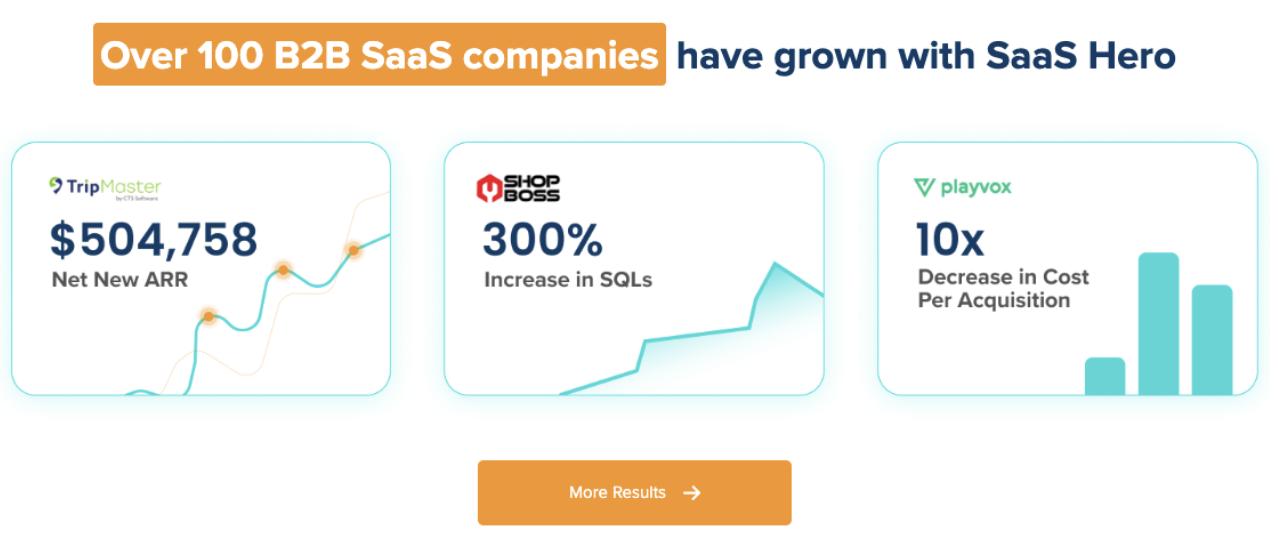
Case studies show clear revenue gains. TripMaster generated $504,758 in Net New ARR with 650% ROI and 20% conversion rates from paid search. TestGorilla secured a $70M Series A with an 80-day payback period, a key validation metric for many VCs. Playvox cut Cost Per Lead by 10x while increasing lead volume by 163%.

Pros: No percentage-of-spend billing, revenue-focused reporting, month-to-month flexibility, senior-led execution. Cons: B2B SaaS-only focus may not fit other industries.

2. Kalungi – T2D3 Playbook for Funded Scale-Ups
Kalungi serves VC-backed B2B SaaS companies using its T2D3 growth framework, which stands for Triple, Triple, Double, Double, Double. Their SocialLadder case study reports a 135% sales-pipeline increase and 130% more qualified opportunities in two quarters. The firm combines fractional CMO leadership with execution teams for campaigns, content, SEO, and demand generation.
Pros: Proven T2D3 methodology, full execution team, HubSpot Diamond Partner. Cons: Higher minimum engagement around $25k projects, focus on funded scale-ups rather than bootstrapped teams.
3. GrowTal – Seed to Series C Growth Support
GrowTal reports 7x revenue growth, 62% salary savings, and 1-week hiring timelines for seed through Series C SaaS companies. Their model gives founders fast access to senior marketing leadership without the cost and delay of full-time executive searches.
Pros: Rapid deployment, meaningful cost savings, strong fit for growth-stage teams. Cons: Limited publicly available case study depth.
4. NoGood – High-Velocity Testing and CRO
NoGood works with AI, SaaS, and FinTech brands using data-driven experimentation and conversion rate optimization. They are Clutch-verified with execution teams that support fractional CMO strategy, and they emphasize rapid testing cycles and performance improvements.
Pros: Strong CRO capabilities, fast experimentation, technology-focused client base. Cons: May focus more on testing than long-range strategic planning.
5. Marketri – Momentum Model for Mid-Market B2B
Marketri’s work with Epoch Solutions Group produced 70% more unique visitors using its Momentum Model for mid-market B2B companies. Their approach centers on predictable growth systems and scalable demand generation programs.
Pros: Systematic methodology, mid-market focus, emphasis on predictable outcomes. Cons: Less aligned with very early-stage or pre-product-market-fit startups.
6. 310 Creative – Systems for Long-Term Growth
310 Creative builds B2B marketing systems aimed at sustainable long-term growth, with a focus on process improvement and scalable frameworks instead of quick wins.
Pros: Systems-first mindset, long-term orientation. Cons: May feel slow for founders who need rapid growth within a short runway.
7. CMOx – KPI-Driven Marketing Frameworks
CMOx uses KPI-driven frameworks for tech startups, centering decisions on measurable outcomes and data across channels.
Pros: Metrics-focused approach, clear frameworks. Cons: Fewer industry-specific SaaS case studies in the public domain.
8. NinjaPromo – FinTech and Crypto Growth Partner
NinjaPromo’s FinTech and Crypto clients have raised $195M, which highlights their ability to support high-growth technology brands in complex regulatory spaces.
Pros: Deep vertical expertise, strong fundraising track record. Cons: Narrower focus on specific high-growth verticals.
9. Right Side Up – Hybrid B2B Engagement Model
Right Side Up’s hybrid model features examples like Workrise fractional talent solutions and Dipsea’s 635% podcast ad scaling, which gives B2B companies flexible engagement options.
Pros: Flexible hybrid structure, wide range of case studies. Cons: Less concentrated focus on SaaS-only businesses.
|
Agency |
Min Investment |
Key Services |
Standout ROI |
|
SaaSHero |
$1,250/mo |
Competitor conquesting, CRO |
$504k Net New ARR |
|
Kalungi |
$25k project |
T2D3 playbook, full team |
135% pipeline increase |
|
GrowTal |
Undisclosed |
Rapid deployment |
7x revenue growth |
|
NoGood |
Undisclosed |
CRO, experimentation |
Data-driven optimization |
Book a discovery call to compare these options and find the best fit for your current SaaS growth stage.
2026 Revenue Trends and Early-Stage SaaS Pitfalls
The 2026 marketing landscape centers on revenue attribution and tight RevOps integration. Fractional CRO and CMO bundles are gaining traction, with single partners owning both pipeline creation and revenue execution against bookings quotas. AI-powered attribution and scaled competitor conquesting now shape many strategic roadmaps.
Micro-SaaS founders often stumble by treating agencies as simple vendors, ignoring dark funnel influence, and chasing vanity metrics instead of revenue. Fractional CMOs underperform when they lack real integration into leadership teams and regular executive access.
SaaSHero fits this new environment with embedded team integration, revenue-first reporting, and tracking that connects ad impressions to CRM revenue data, which helps avoid the integration failures common with traditional agencies.
Next Steps for SaaS Founders Evaluating Fractional CMOs
The flexible fractional model gives early-stage SaaS founders a capital-efficient alternative to bloated agencies and full-time executive hires. By choosing partners that prioritize revenue attribution, flexible contracts, and B2B SaaS specialization, founders can bring order to GTM chaos and restart stalled growth.
Founders should begin by auditing current marketing spend efficiency, mapping attribution gaps, and setting clear revenue targets. Avoid vanity metrics and percentage-of-spend billing that misalign incentives with your growth goals.
Book a discovery call with SaaSHero to explore a month-to-month, revenue-focused partnership without long-term risk.
FAQs
What is a fractional CMO for SaaS startups?
A fractional CMO is a senior marketing leader who works part-time, usually 20-60 hours per month, to guide SaaS growth. Unlike pure consultants who mainly advise, fractional CMOs embed with your team, execute GTM strategy, manage campaigns, and own revenue outcomes. They bridge the gap between expensive full-time CMOs and unreliable or misaligned agencies.
How does a fractional CMO differ from a traditional marketing agency?
A fractional CMO joins your leadership team and participates in strategic decisions, while agencies typically act as external vendors on defined projects. Fractional CMOs own the full growth roadmap and can hire, replace, or restructure other marketing resources. They usually work on flat retainers, unlike agencies that often use percentage-of-spend pricing, which can reward higher ad spend instead of better performance.
What does a fractional CMO cost for early-stage startups?
Most early-stage startups under $1M ARR pay $3,000-$10,000 per month for fractional CMO support. This range often represents 40-60% savings compared with full-time CMO salaries of $250k or more per year. Pricing varies based on time commitment, strategic complexity, and execution scope, and month-to-month contracts keep the engagement flexible.
Which fractional CMO model works best for micro-SaaS companies?
Micro-SaaS companies usually benefit from revenue-aligned fractional CMOs that offer month-to-month contracts, flat retainers, and strong B2B SaaS case studies. The best fits integrate with your CRM for attribution tracking, specialize in competitor conquesting, and report on Net New ARR instead of impressions or clicks.
How do I avoid common fractional CMO hiring mistakes?
Founders avoid common mistakes by looking beyond price, defining clear success metrics, and treating fractional CMOs as strategic partners. Confirm cultural fit, agree on specific KPIs before kickoff, and verify B2B SaaS experience through case studies. Require regular access to your leadership team and maintain open communication channels to capture full strategic value.