




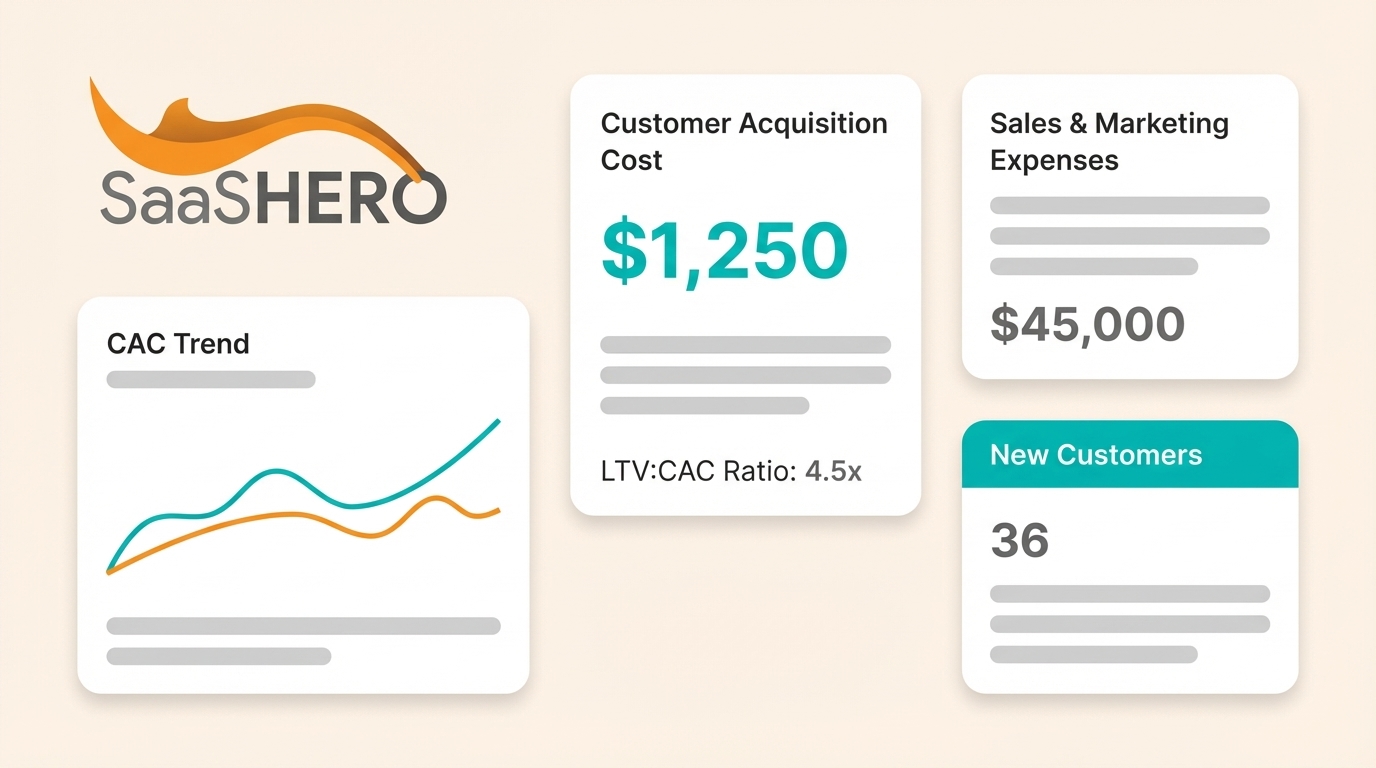
Key Takeaways
- B2B SaaS CAC calculation aggregates all sales and marketing costs, including 1.3x salary multipliers, then divides by new ARR-generating customers, aligned to 60-90+ day sales cycles with cohort analysis.
- The core framework covers cost aggregation, counting paying customers only, aligning timeframes for sales lags, and segmenting by channel and customer type to uncover efficiency gains.
- 2026 benchmarks show SMB CAC at $3K-$8K, mid-market at $8K-$20K, and enterprise at $20K-$50K, with targets of 3:1+ LTV:CAC and payback periods under 12 months.
- Specific tactics such as negative keywords, competitor conquesting, and landing page improvements can cut CAC by 20-30%, as shown by client results like 10x reductions in cost per lead.
- Teams ready to improve CAC can book a discovery call with SaaSHero for a free audit and move toward best-in-class unit economics.
Data Foundations for Accurate B2B SaaS CAC
Accurate CAC measurement starts with a reliable data infrastructure across your CRM, ad platforms, and billing tools. You need access to systems like HubSpot or Salesforce, Google Ads, and LinkedIn, plus your billing platform for ARR and MRR tracking. Most teams can complete the initial setup in 1-2 hours, then maintain it with monthly reviews focused on CAC performance.
The core CAC formula is simple: CAC = Total Sales & Marketing Costs ÷ New Customers Acquired. B2B SaaS companies must adjust this formula for 60-90+ day sales cycles, which differ from instant B2C purchases. Multiple stakeholders and long evaluations create a delay between marketing spend and closed revenue.
This timing gap requires alignment between cost periods and acquisition periods through cohort analysis. For example, Q1 marketing spend may generate customers that close in Q3, so you must match those periods to calculate CAC correctly.
B2B SaaS CAC Framework in Four Steps
The B2B SaaS CAC framework uses four steps that keep calculations accurate and actionable.
|
Step |
Action |
Key Consideration |
Common Pitfall |
|
1 |
Aggregate all acquisition costs |
Include salary multipliers (1.3x) |
Excluding tools and overhead |
|
2 |
Count new paying customers |
Focus on ARR-generating accounts |
Including free trial users |
|
3 |
Align timeframes properly |
Account for 60-90 day lags |
Using the same-period data |
|
4 |
Calculate and segment CAC |
Break down by channel/size |
Only reporting blended CAC |
This framework supports the target 3:1 LTV:CAC ratio with payback periods under 12 months. Companies that hit these ranges usually show healthy unit economics and can scale with confidence.
Step-by-Step B2B SaaS CAC Calculation
Step 1: Aggregate All Sales and Marketing Costs
Begin by listing every expense tied to acquiring new customers. Include ad spend, salaries for marketing and sales teams multiplied by 1.3 for benefits and overhead, agency fees, marketing tools, and content production. Exclude customer support, product development, and general administrative costs that do not drive new acquisitions.
Here is a simple example of monthly acquisition costs.
|
Cost Category |
Amount |
Notes |
|
Paid advertising |
$10,000 |
Google Ads + LinkedIn |
|
Marketing salaries |
$10,400 |
$8,000 × 1.3 multiplier |
|
Sales tools |
$2,000 |
CRM, email, prospecting |
|
Total Monthly Spend |
$22,400 |
Ready for CAC calculation |
Step 2: Count New Paying Customers
Use only customers who generate ARR as the basis for CAC, not free trials or demo requests. For pipeline views, you can track CAC to Sales Qualified Leads, although the primary CAC metric should reflect closed, revenue-generating accounts.
In the example, if 5 new ARR customers close in the measurement period, that number becomes your denominator. Define “new” customers clearly as first-time purchasers who were not previously paying customers in your system.
Step 3: Align Timeframes for Sales Cycle Lags
Timeframe alignment prevents misleading CAC numbers for longer sales cycles. B2B companies with buyer journeys exceeding 60 days should calculate CAC over a minimum timeframe matching the average time to revenue plus 1-2 months, which often means 12-month windows.
Cohort analysis connects marketing spend in one period to customers who close later. If your average sales cycle is 90 days, January spend should be compared with customers who close in April. This approach avoids attributing quick wins to current spend while ignoring the delayed impact of earlier campaigns.
Step 4: Calculate and Segment Your CAC
Apply the formula using the example numbers: CAC = $22,400 ÷ 5 customers = $4,480 per customer. Treat this blended CAC as a starting point, then break it down by customer size, acquisition channel, and campaign.
Useful segmentation examples:
- SMB customers: $3,000-$8,000 CAC
- Enterprise customers: $20,000-$50,000 CAC
- Paid search: Often lower CAC due to high intent
- LinkedIn ads: Higher CAC with stronger enterprise alignment
Channel-specific CAC prevents misleading averages. A blended $4,480 CAC might hide LinkedIn campaigns that generate $8,000 CAC enterprise customers with 5x LTV, while Google Ads delivers $2,000 CAC SMB customers with 2x LTV.
Companies like Playvox have achieved 10x reductions in cost per lead through segmentation and negative keyword strategies. Book a discovery call to see how SaaSHero applies these tactics to improve CAC across your channels.
2026 CAC Benchmarks and Validation Checks
Benchmarks help you validate CAC calculations and highlight where to improve. The overall B2B SaaS average CAC is $1,200 per customer, up 14% through 2025, with wide variation by segment and industry.
|
Segment |
CAC Range |
Payback Period |
LTV:CAC Ratio |
|
SMB ($5K-$25K ACV) |
$3,000-$8,000 |
6-9 months |
3:1-4:1 |
|
Mid-Market ($25K-$100K ACV) |
$8,000-$20,000 |
9-15 months |
4:1-5:1 |
|
Enterprise ($100K+ ACV) |
$20,000-$50,000 |
12-24 months |
5:1-7:1 |
Industry benchmarks show additional spread. Fintech averages $1,450 CAC while eCommerce tools average $274 CAC, reflecting different deal sizes and complexity.
Healthy CAC profiles usually show payback periods under 12 months and LTV:CAC ratios of at least 3:1. 76% of SaaS companies achieve CAC payback under 12 months, with a median of 6.8 months overall. If your metrics sit outside these ranges, review attribution quality and channel efficiency.
Advanced CAC Adjustments and Optimization Plays
Adjust CAC for Long Sales Cycles
Long sales cycles require rolling cohort analysis to keep CAC accurate. Track marketing spend by month, then connect it to customers who close 3-6 months later. This method reveals the real link between investment and acquisition and avoids under-crediting early-stage campaigns.
Build monthly cohort tables that map spend to closed deals. For example, January’s $20,000 spend might generate 2 customers in April and 3 in May, which calls for more advanced tracking to maintain accuracy over time.
LTV:CAC Improvement Strategies
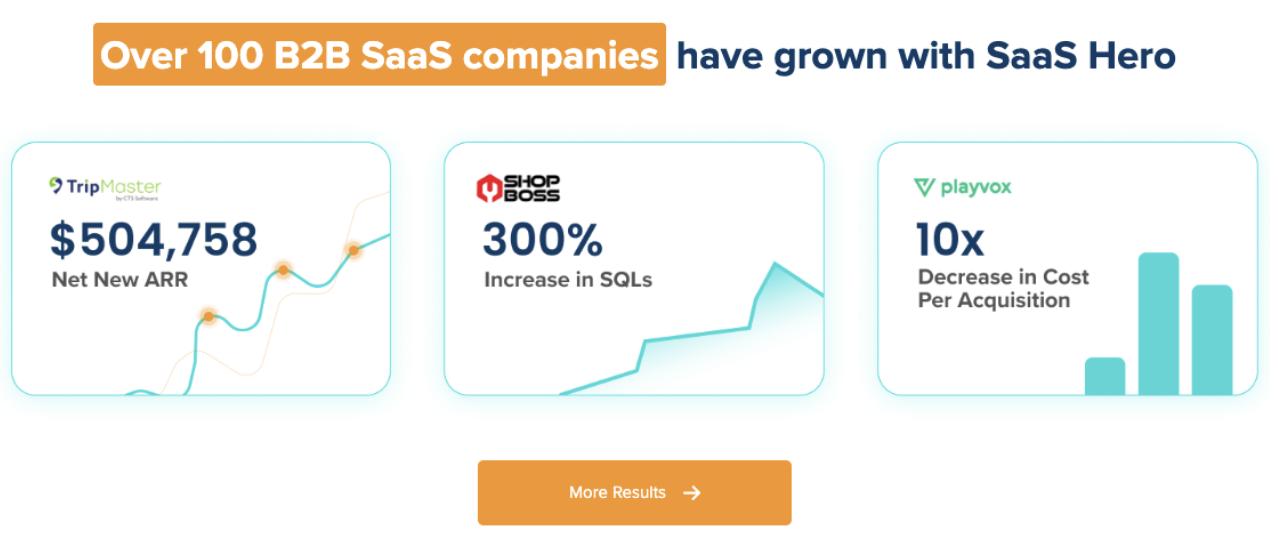
Reducing CAC by 20-30% comes from targeted channel improvements and sharper competitive positioning. Competitor conquesting campaigns often deliver strong returns when structured around pricing and alternative searches. SaaSHero generated 650% ROI for TripMaster with this approach and added $504,000 in Net New ARR.

High-impact optimization tactics include:
- Negative keyword lists that remove irrelevant and low-intent traffic
- Landing page improvements focused on conversion rate lifts
- Competitor comparison pages that capture high-intent searchers
- Account-based marketing programs for enterprise accounts

SaaSHero uses a flat retainer model between $1,250 and $7,000 per month instead of percentage-of-spend fees, which keeps recommendations focused on efficiency rather than higher budgets. This structure has supported outcomes such as TestGorilla’s 80-day payback period and Playvox’s 10x reduction in cost per lead.
Partner with SaaSHero to roll out these strategies and move your CAC toward best-in-class performance.

Action Plan and Next Steps
Effective CAC measurement in B2B SaaS depends on accurate cost aggregation, clear customer counting, correct timeframe alignment, and detailed segmentation. Use the four-step framework to build your baseline, then refine performance through channel analysis and competitive campaigns. Aim for at least a 3:1 LTV:CAC ratio with payback periods under 12 months to support sustainable growth.
Next, set up reliable tracking, calculate segmented CAC by channel and customer size, and flag the largest gaps for improvement. Focus on competitive positioning and conversion rate gains to reduce CAC while protecting deal quality.
Frequently Asked Questions
What is a good CAC for B2B SaaS in 2026?
A good CAC depends on the customer segment and industry. SMB-focused SaaS companies should aim for $3,000-$8,000 CAC with 6-9 month payback periods. Enterprise-focused companies can sustain $20,000-$50,000 CAC when LTV supports that spend. The most important rule is maintaining an LTV:CAC ratio of 3:1 or higher, regardless of the absolute CAC value.
How should I handle 90+ day sales cycles in CAC calculations?
Use cohort analysis that tracks marketing spend in one period against customers who close 3-6 months later. Calculate CAC on 12-month rolling periods instead of monthly snapshots to capture the full impact of early-stage campaigns. This approach prevents under-attribution of efforts that build awareness before deals close.
What tools work best for CAC tracking?
Core tools include your CRM, such as HubSpot or Salesforce, for customer data, plus ad platforms for spend tracking. Analytics tools like Looker Studio help you visualize CAC and related metrics. Add UTM parameters and conversion tracking so you can connect ad clicks to closed deals. Many teams also use tools like Baremetrics or ChartMogul to automate CAC calculations across multiple data sources.
Should sales salaries be included in CAC?
Sales salaries should be included in CAC and multiplied by 1.3 to cover benefits and overhead. Separate new customer acquisition work from expansion and renewal activities. Only include the portion of sales costs that directly support new customer acquisition so CAC reflects true acquisition efficiency.
How does SaaSHero approach CAC optimization differently from traditional agencies?
SaaSHero uses flat monthly retainers instead of percentage-of-spend pricing, which removes incentives to push higher ad budgets. The team focuses on Net New ARR instead of vanity metrics such as clicks or impressions, with results that include 80-day payback periods and 10x cost-per-lead reductions. Month-to-month contracts keep performance accountable and avoid long-term lock-ins that reduce urgency.