




Written by: Aaron Rovner, Founder, Saas Hero
Key Takeaways
- The 2026 capital efficiency crunch requires revenue-first SaaS messaging that speaks to outcomes, not feature lists, to combat rising CAC and drive Net New ARR.
- SaaSHero’s 7-step framework, from ICP definition and VoC research through testing and ARR measurement, turns generic value propositions into consistent conversion drivers.
- Teams define uncomfortably specific ICPs from closed-won data, uncover Jobs-to-be-Done from reviews, and write outcome-focused value propositions using proven formulas.
- Funnel-specific messaging hierarchies, competitor conquesting, and Wynter A/B tests with clarity scores under 40% keep positioning sharp and conversion-focused.
- Use CAC payback and LTV:CAC as your proof points, then book a discovery call with SaaSHero to tighten messaging for $1-10M ARR growth.
Foundations You Need Before Using This SaaS Messaging Framework
Set up a few core tools before working through the 7-step framework. Use testing platforms like Wynter or Bay Leaf for message validation, Google Sheets for ICP canvases, G2 and Capterra for Voice of Customer research, and HubSpot or Salesforce to track ARR impact.
Build a foundation of key concepts that connect into one workflow. Develop an uncomfortably specific Ideal Customer Profile, which then guides your Jobs-to-be-Done research by clarifying whose problems to study. Use those insights to build TOFU, MOFU, and BOFU messaging hierarchies so each funnel stage speaks to the right pain points. Finally, tie those value propositions to CAC and LTV metrics so you can prove business impact. The typical timeline spans 2-4 weeks for initial development with quarterly iterations.
The biggest risk comes from feature vomit, which means listing capabilities instead of outcomes. With CAC rising 14% through 2025, messaging must speak directly to buyer pain points and quantify business impact so you can justify premium pricing and shorten sales cycles.
7-Step Framework Overview: From ICP to ARR Impact
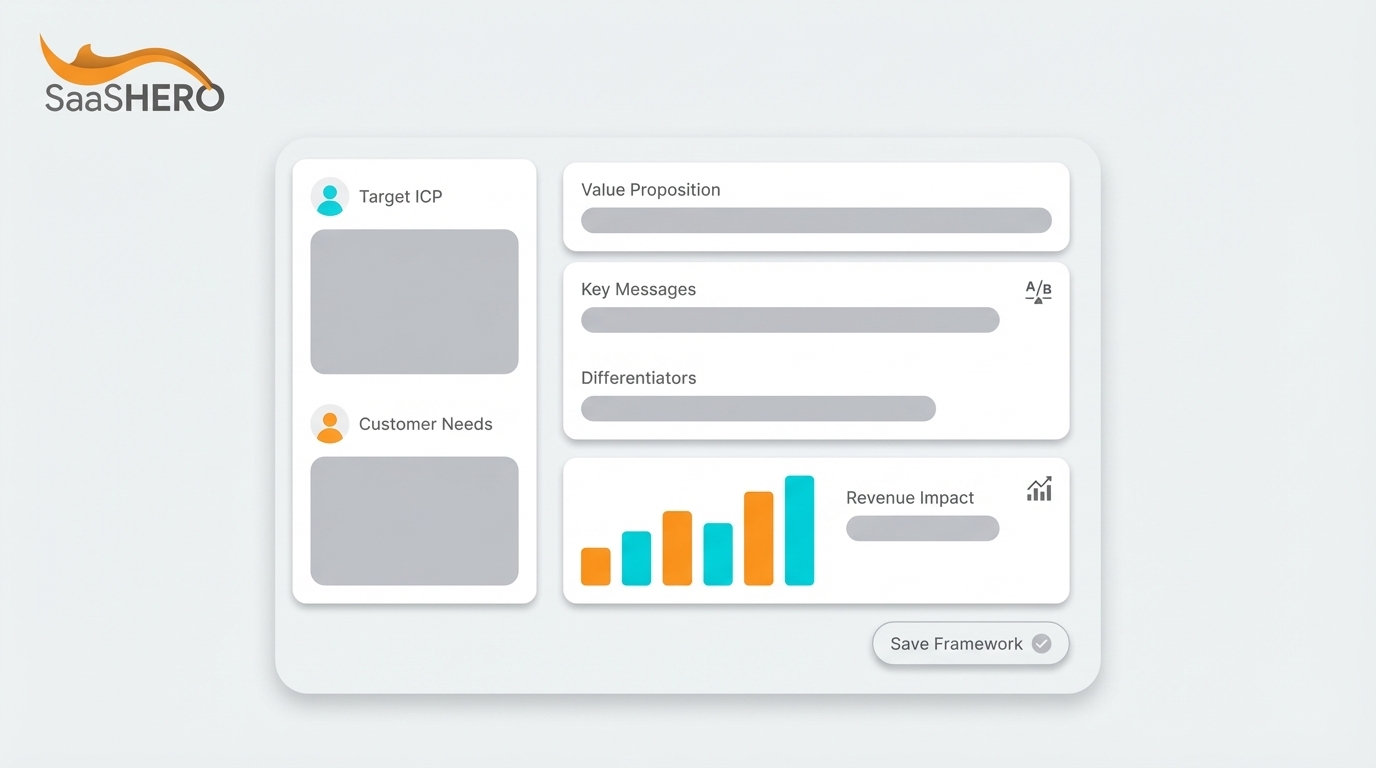
The SaaSHero value proposition framework follows seven sequential steps that mirror the modern B2B buyer journey.
1. Define ICP for SaaS – Create uncomfortably specific customer profiles based on firmographics, technographics, and behavioral patterns.
2. Gather VoC and Uncover Jobs-to-be-Done – Capture buyer language and motivations from reviews, interviews, and support data.
3. Craft Your SaaS Value Proposition Formula – Turn insights into clear, structured statements using proven frameworks.
4. Build SaaS Messaging Hierarchy – Develop funnel-specific messages for awareness, consideration, and decision stages.
5. Differentiate via Competitor Conquesting – Position against alternatives using honest comparison frameworks.
6. Test with Wynter and A/B – Validate messaging clarity and conversion impact with real buyers.
7. Measure and Iterate for ARR – Track revenue metrics and refine based on performance data.
This framework connects upstream messaging decisions to downstream CRM revenue data. Teams then improve campaigns based on closed-won deals instead of vanity metrics like clicks or impressions.
Step 1: Define ICP for SaaS with Precise, Real-World Criteria
Survey your last 20-30 closed-won customers to identify statistically significant patterns in firmographics, technographics, and behavioral attributes. Focus on customers with high lifetime value, low churn, and fast sales cycles.
Effective SaaS ICPs use sharp criteria such as “HR VPs at 500+ employee companies struggling with manual candidate screening processes” instead of broad labels like “HR professionals.” Companies with clearly defined ICPs experience up to 68% higher account win rates. The following table breaks down four essential ICP components, the criteria to capture, and where to source that data.
| ICP Component | Example Criteria | Data Source |
|---|---|---|
| Firmographics | HR Tech, 200-500 employees, $10M-50M ARR | CRM analysis |
| Technographics | Uses Salesforce, needs ATS integration | Customer interviews |
| Pain Points | Manual screening wastes 15+ hours/week | Support tickets, G2 reviews |
| Buying Triggers | Hiring surge, compliance requirements | Win-loss interviews |
Step 2: Gather VoC and Uncover SaaS Jobs-to-be-Done
Pull authentic buyer language from G2 reviews, customer interviews, and support conversations. Analyze at least 50 competitor reviews to identify niche patterns and recurring pain points.
Center your analysis on Jobs-to-be-Done statements such as “replace manual spreadsheet processes,” which reflects TestGorilla’s core job. Treat feature requests as secondary. The language customers use to describe their challenges becomes marketing gold for positioning, website copy, and sales scripts.
Run 8-12 customer interviews and ask direct questions such as “What was the trigger that made you start looking for a solution?” and “What almost stopped you from buying?” These conversations reveal both emotional and functional motivations behind purchase decisions.
Step 3: Craft Your SaaS Value Proposition Formula
Strong value propositions answer three critical questions in under 30 seconds: What do you do, for whom, and why you instead of alternatives? Use a simple base formula: “We help [ICP] achieve [benefit] so they [outcome].”
SaaSHero’s value proposition follows this structure: “We help B2B SaaS companies scale ARR without agency waste through revenue-first marketing that drives Net New growth, not vanity metrics.” Choose the formula structure that fits your differentiation strategy. The table below shows four proven approaches with examples.
| Formula Type | Structure | Example |
|---|---|---|
| Outcome-Focused | We help [ICP] achieve [outcome] | Reduce support costs by 40% while improving response times |
| Problem-Solution | For [ICP] struggling with [problem], we provide [solution] | For e-commerce brands drowning in support tickets, we provide AI automation |
| Transformation | Transform [current state] into [desired state] | Transform manual screening into automated candidate qualification |
| Comparison | Unlike [alternative], we [differentiation] | Unlike generic chatbots, we integrate natively with Shopify workflows |
Step 4: Build a SaaS Messaging Hierarchy and Canvas
Design funnel-specific messaging that guides prospects from awareness to decision. TOFU messaging covers category education, MOFU agitates specific pain points, and BOFU focuses on differentiation and risk reduction.
Create a messaging canvas that maps key messages to buyer journey stages. For example, TOFU might emphasize “Why automate customer support?” while BOFU highlights “60-day guaranteed ROI” and “Free migration from existing tools.”
| Funnel Stage | Message Focus | Example Message |
|---|---|---|
| TOFU (Awareness) | Category education, problem identification | Manual support processes limit growth scalability |
| MOFU (Consideration) | Solution benefits, social proof | Leading e-commerce brands reduce support costs 40% |
| BOFU (Decision) | Differentiation, risk reduction | Native Shopify integration, 60-day ROI guarantee |
Step 5: Differentiate SaaS Messaging with Competitor Conquesting
Build comparison pages that target high-intent searches such as “[Competitor] pricing” and “[Competitor] alternatives.” Focus on three intent buckets: pricing for cost-sensitive users, problems for frustrated current users, and validation for risk-averse evaluators.
Create honest feature comparisons that highlight your unique selling propositions. Lead with clear cost breakdowns for pricing intent. Address known competitor weaknesses for problem intent. Showcase G2 ratings and customer testimonials for validation intent.
Use negative keywords to filter out navigational searches from users looking for login pages. Concentrate ad spend on evaluative modifiers that signal purchase intent.

Step 6: Test SaaS Value Proposition with Wynter and A/B Experiments
Test 2-3 landing page variations with different value propositions to identify winning positioning. Use Wynter polls that target your ICP and aim for clarity benchmarks under 40%.
Run A/B tests on ad copy, landing page headlines, and email subject lines. Track metrics that correlate with revenue, such as demo requests, trial signups, and sales qualified leads, instead of clicks or impressions.
SaaSHero conducts regular message testing audits so value propositions keep their clarity and conversion strength as markets evolve and competitors adjust positioning.
Step 7: Measure, Iterate, and Track to ARR and CAC
Once you validate messaging clarity through testing, connect those insights to business outcomes. Track revenue-correlated metrics including Net New ARR, pipeline value, and sales qualified leads. Use the CAC and LTV benchmarks mentioned earlier to evaluate whether messaging improvements create real efficiency gains.
Avoid common pitfalls that undermine measurement accuracy. Feature vomit, which means listing capabilities instead of outcomes, makes impact tracking difficult because features do not map cleanly to revenue. This pattern often leads to generic positioning that fails to stand out from alternatives. Teams then drift toward vanity metric optimization and focus on traffic over conversions because they cannot prove real value.
Struggling to connect messaging to revenue metrics? SaaSHero’s revenue-first approach ensures every messaging decision supports measurable ARR growth. Book a discovery call to implement systematic tracking and ongoing optimization.
Measurement and Validation: Proving SaaS Messaging ROI
Effective SaaS messaging produces clear business outcomes such as Net New ARR growth, faster CAC payback, and higher conversion rates throughout the funnel. Use tools like Looker Studio and HubSpot to visualize marketing impact across the entire buyer journey.
Track dark funnel attribution by connecting ad clicks, including GCLID, through landing pages into CRM systems. This approach supports optimization based on closed-won revenue instead of last-click attribution that undervalues awareness activities.
Validate messaging effectiveness each quarter by analyzing win rates, deal sizes, and sales cycle lengths for ICP-fit prospects versus non-ideal customers. Strong messaging should create clear performance gaps between target and non-target segments.
SaaSHero: Revenue-First Partner for Your SaaS Value Proposition
SaaSHero specializes in executing revenue-first messaging frameworks for B2B SaaS companies. The senior-led team has delivered results such as TripMaster’s $504k Net New ARR and Playvox’s 10x CPL reduction through systematic value proposition development and testing.

Flat monthly retainers keep incentives aligned with your growth objectives. Unlike percentage-of-spend agencies that profit from budget inflation, SaaSHero operates month-to-month and re-earns your business every 30 days through measurable ARR impact.

| Monthly Ad Spend | 1 Channel (Dedicated Manager, Month-to-Month) | 2 Channels (Dedicated Manager, Month-to-Month) |
|---|---|---|
| Up to $10k | $1,250 | $2,500 |
| $10k – $25k | $1,750 | $3,000 |
| $25k – $50k | $2,250 | $3,500 |
| $50k+ | $3,250 | $4,500 |
Ready to transform messaging into measurable ARR growth? Book a discovery call to discuss your value proposition optimization strategy.
2026 SaaS Value Proposition Examples, Tools, and Advanced Tips
TestGorilla’s messaging focuses on “80-day payback” instead of feature lists, which speaks directly to CFO concerns about marketing ROI. TripMaster emphasizes “504k Net New ARR” to show concrete revenue impact for investor presentations.
Advanced tools for 2026 include Wynter for message testing with ICP-specific audiences, Claude AI for generating value proposition variations, and competitor conquesting campaigns that capture high-intent traffic from alternative evaluations.
Lovable grew from $0 to $10M ARR in 2 months through community-driven messaging that resonated with founder pain points around technical complexity and development speed.
Emerging trends include AI-powered personalization at scale, behavioral trigger messaging based on product usage patterns, and dark funnel attribution that helps teams optimize for revenue instead of last-click conversions.
Summary and Next Steps for SaaS Messaging
Effective SaaS value propositions come from systematic execution across seven steps: ICP definition, VoC research, formula crafting, messaging hierarchy, competitor differentiation, testing validation, and revenue measurement.
Begin by analyzing your best customers to identify ICP patterns, then pull authentic buyer language from reviews and interviews. Test messaging variations on Wynter and refine based on ARR impact instead of vanity metrics.
This framework turns feature-focused messaging into revenue-driving value propositions that shorten sales cycles, improve conversion rates, and support premium pricing in competitive markets.
FAQ: SaaS Value Proposition and Messaging
How long does it take to develop an effective SaaS value proposition?
The initial development typically takes 2-4 weeks, covering ICP analysis, customer interviews, message crafting, and initial testing. Value proposition optimization then continues as an ongoing process with quarterly reviews and iterations based on market feedback, competitive changes, and business evolution. Companies should treat messaging as a living asset rather than a one-time project.
What are the best tools to test SaaS value propositions in 2026?
Wynter leads for message clarity testing with ICP-specific audiences and works well when you target clarity scores under 40%. A/B testing platforms like Google Optimize or Unbounce support landing page variations, while tools like Hotjar provide behavioral insights. For B2B SaaS, prioritize testing with actual buyers instead of general audiences so results stay relevant and accurate.
How do you define an Ideal Customer Profile for SaaS companies?
Use the closed-won customer analysis approach described in Step 1, focusing on high LTV, low churn, and fast sales cycles. Include firmographics such as company size, industry, and revenue, along with technographics, behavioral attributes, and pain points. Keep the ICP specific enough to guide targeting while broad enough to represent a viable market segment.
How often should SaaS companies iterate their value proposition?
Review and update value propositions each quarter, with major revisions annually or when significant market changes occur. Monitor performance metrics such as conversion rates, sales cycle length, and win rates to spot signals that messaging needs adjustment. Successful companies align value proposition updates with business milestones, competitive shifts, or customer feedback that indicates misalignment.
What metrics prove SaaS value proposition effectiveness?
Focus on revenue-correlated metrics including Net New ARR growth, efficiency ratios, and sales qualified lead conversion rates. Track messaging performance through the entire funnel from ad click to closed-won revenue, and avoid vanity metrics like impressions or raw clicks that do not correlate with business outcomes. Strong value propositions should also show measurable improvements in deal velocity and win rates.
Ready to implement a revenue-driving value proposition framework? Book a discovery call with SaaSHero today to turn your messaging into measurable ARR growth.