




Last updated: January 28, 2026
Key Takeaways
- Percentage-of-spend Google Ads agencies often miss B2B SaaS revenue goals. Their fees grow with ad budget, not with ARR, which keeps ROAS stuck below 2x.
- Revenue-first management uses flat retainers, CRM integration, and senior-led accounts with 8-10 clients per manager. This structure supports 5x ROAS and 80-day payback periods.
- Competitor conquesting focuses on pricing, complaints, and review searches. This approach cuts CPL by up to 10x when paired with strict negative keyword controls.
- SaaSHero runs month-to-month flat fees ($1,250-$7,000) and delivers enterprise results, including $504k Net New ARR and 650% ROI in documented case studies.
- Book a discovery call with SaaSHero to benchmark your Google Ads against 2026 standards and roll out revenue-aligned management.
The Misalignment Behind Traditional Google Ads Agencies
The percentage-of-spend pricing model pushes agencies to grow budgets instead of revenue. When agencies charge 10-20% of ad spend, they earn more from higher budgets, even if ROAS falls. A $50,000 monthly budget can generate $7,500 in agency fees, which rewards budget bloat and punishes efficiency. This structure often produces ROAS below 78% for B2B search campaigns, which sits far below breakeven for most SaaS models.
|
Pricing Model |
Core Incentive |
B2B SaaS Impact |
|
% of Spend (10-20%) |
Inflate budgets |
Bloated CAC, ROAS <2x |
|
Flat Retainer |
Scale efficiency |
80-day payback, 5x ROAS |
The bait-and-switch account model deepens this misalignment. Senior strategists often run sales calls, then pass accounts to junior managers handling 30 or more clients. Between 30% and 50% of agency initiatives miss expectations because of weak processes and limited B2B SaaS expertise. Junior teams rarely understand metrics like MRR, churn, or sales cycle velocity at the depth enterprise SaaS requires.
Book a discovery call to move away from percentage-based fees and overloaded junior account management.
Revenue-First Google Ads for Enterprise B2B SaaS
Revenue-first Google Ads management keeps Net New ARR as the primary success metric. This approach combines specialized SaaS expertise, flat retainers, and CRM integration to guide every decision. Well-run SaaS campaigns reach conversion rates near 5% with precise targeting, compared to the 2.4% industry average.
|
Feature |
Description |
2026 Benchmark |
Revenue Benefit |
|
CRM Integration |
GCLID passed into Salesforce or HubSpot |
Multi-touch ROI +15-25% |
Accurate ARR attribution |
|
Conquesting |
Pricing, complaint, and review intent |
CPA $200-500 |
Up to 10x CPL reduction |
|
Senior Management |
8-10 clients per strategist |
2.9x higher ROAS |
Deeper strategic improvements |
|
Flat Fee Structure |
Month-to-month alignment |
5x ROAS minimum |
Incentives tied to efficiency |
Google Ads becomes a core revenue channel for B2B SaaS when managed with this structure. Google Ads captures 65% of quick conversions for short sales cycles, while LinkedIn captures 35%. This performance makes Google Ads essential for enterprise SaaS with defined buying committees and clear intent signals.
Book a discovery call to roll out revenue-first Google Ads management with CRM-based attribution.
Revenue Frameworks That Build Predictable Pipeline
Flat Fees That Align Incentives With ARR
Enterprise Google Ads management works best when agency revenue grows with client ARR, not with ad spend. Flat retainers remove the financial reward for inflating budgets and support honest recommendations about scaling or cutting spend. SaaS-focused agencies cut CAC by about 34% by pairing this pricing with deep platform expertise.
SaaS-Only Focus and Tight Account Ratios
B2B SaaS performance depends on understanding MRR, churn, expansion, and sales cycle length. Generalist agencies that split attention across e-commerce, local services, and SaaS rarely track these metrics correctly. Senior-led teams that manage a maximum of 8-10 clients per strategist can review pipeline quality, sales feedback, and ARR impact every month.
ARR Dashboards Connected to Google Ads
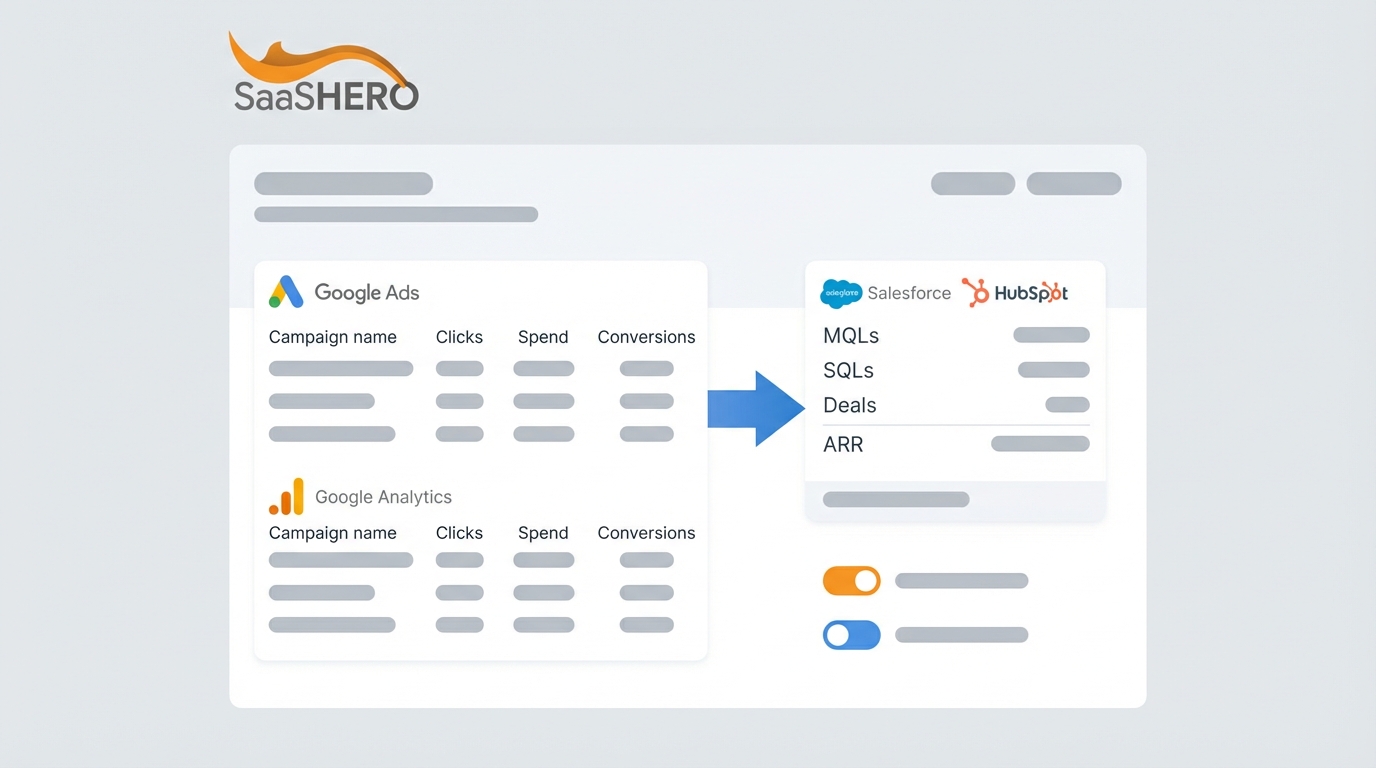
Revenue-first teams connect Google Ads to CRM data with GCLID tracking and multi-touch attribution. This setup links each click to pipeline, Net New ARR, and lifetime value. Teams then shift focus away from click-through rate and cost-per-click and toward payback period, deal size, and sales velocity.
Competitor Conquesting for High-Intent Searches
Competitor conquesting targets three clear intent groups: pricing research, problem or complaint searches, and review validation. Searches like “[Competitor] pricing” show purchase readiness and price sensitivity. Queries such as “[Competitor] alternatives” reveal dissatisfaction with current tools. Review searches signal active comparison across vendors.
Negative keyword controls protect budgets from low-intent navigational traffic. Blocking pure brand terms like “Salesforce” filters users who want login pages or support portals. Keeping modifiers such as “Salesforce pricing” or “Salesforce alternatives” preserves high-intent traffic that often converts to pipeline.
Book a discovery call to launch competitor conquesting built around psychological intent segments.
Book a discovery call to work with senior Google Ads strategists on a transparent flat-fee model.
SaaSHero’s Revenue-Driven Google Ads Model
SaaSHero runs month-to-month agreements, senior-led account management, and clear flat-fee pricing. Each strategist manages 8-10 accounts, which allows weekly performance reviews and structured testing. Pricing ranges from $1,250 to $7,000 per month by ad spend band, which removes percentage-based conflicts and keeps focus on ARR.

|
Ad Spend |
1 Channel (M2M) |
2 Channels (M2M) |
Case Proof |
|
$25k-50k |
$2,250 |
$3,500 |
650% ROI |
|
$50k+ |
$3,250 |
$4,500 |
80-day payback |
Case studies validate this revenue-first approach. TripMaster generated $504,758 in Net New ARR from Google Ads. TestGorilla supported a $70M Series A with 80-day payback periods across campaigns. Playvox cut cost-per-lead by 10x after a full account restructure and improved negative keyword strategy. These results highlight the impact of SaaS specialization and incentive alignment.

Book a discovery call to access proven enterprise Google Ads management with month-to-month flexibility.
Enterprise Rollout Plan, Risk Controls, and 2026 Targets
Enterprise Google Ads launches follow three phases: account audit, tracking and CRM integration, and conversion rate optimization. The audit phase uncovers wasted spend from weak negative keyword lists and poor mobile experiences. Tracking work connects GCLID data into Salesforce or HubSpot, which enables revenue reporting by campaign and keyword. CRO efforts then improve landing page conversion rates through heuristic reviews and structured A/B tests.
Two risks appear most often in enterprise accounts. Inadequate negative keyword coverage wastes budget on irrelevant or navigational queries. Weak mobile experiences block conversions even when intent is strong. In-house teams often cost one-fifth of agency fees but usually lack the depth to manage these risks at enterprise scale.
Key 2026 benchmarks for enterprise B2B SaaS include CPA ranges of $200-500 and minimum 5x ROAS targets. Median conversion rates sit near 2.91% for qualified traffic. Top performers reach 80-day payback periods and pipeline ROI above 8x when CRM data guides optimization.
Book a discovery call to align your enterprise Google Ads program with 2026 performance benchmarks.
Frequently Asked Questions: Enterprise Google Ads for B2B SaaS Teams
Does Google Ads work for B2B SaaS companies?
Google Ads works well for B2B SaaS when campaigns focus on high-intent keywords and competitor conquesting. Search campaigns capture bottom-funnel demand from prospects who already research solutions, which speeds up lead conversion compared to awareness channels. Well-run campaigns reach conversion rates near 5% with precise targeting and strong landing pages.
Is $500 per month enough for enterprise Google Ads management?
Enterprise B2B SaaS usually needs $1,250 to $7,000 per month in management fees, depending on spend and channel mix. Single-channel management for about $25,000 in monthly spend typically requires a $2,250 retainer. Multi-channel enterprise programs often need $4,500 or more to fund strategy, testing, and reporting.
Why choose flat-fee pricing over percentage-of-spend models?
Flat retainers align agency incentives with revenue outcomes because fees stay stable as budgets change. Percentage-based pricing rewards higher ad spend even when ROAS declines. Flat fees support honest recommendations that focus on ROI, payback period, and Net New ARR instead of budget growth.
How does attribution work for enterprise B2B SaaS revenue tracking?
Attribution connects Google Ads clicks to closed-won deals through GCLID tracking that flows into Salesforce or HubSpot. Multi-touch models then account for long buying journeys with many stakeholders and touchpoints. This structure lets teams optimize campaigns based on revenue and pipeline, not just click metrics.
What budget levels qualify as enterprise Google Ads management?
Enterprise Google Ads management usually starts around $25,000 per month in combined paid search and paid social spend. This level supports advanced targeting, robust negative keyword lists, and dedicated strategic management. Lower budgets can still perform, but often rely on simpler setups and lighter testing.
Conclusion: Turn Google Ads Into a Net New ARR Engine
Traditional agencies drain enterprise budgets through misaligned incentives and vanity metrics. Revenue-first Google Ads management focuses on Net New ARR with SaaS specialists, flat-fee pricing, and CRM integration. Teams that adopt this model reach 80-day payback periods and healthier unit economics across their funnel.
Book a discovery call to shift your Google Ads program from cost center to predictable revenue engine.