




Key Takeaways
- The 70/20/10 framework allocates 70% of budget to high-intent retargeting, 20% to ABM prospecting, and 10% to testing to drive 3x or higher ROI in B2B SaaS.
- Use CBO, CRM integration through CAPI, and message-match strategies to hit CPQL under $237 with 80-120 day sales cycles.
- Audit performance with the (LTV × Conversion Rate – CAC) ÷ Ad Spend formula and prioritize SQLs and Net New ARR over vanity metrics like clicks.
- Review performance daily, scale winners 20% weekly, pause underperformers at 2x CPQL threshold, and cap frequency at 1-2 impressions to reduce fatigue.
- SaaSHero has delivered results such as $504k in Net New ARR for clients; schedule a discovery call with SaaSHero for expert implementation.
Core Requirements Before You Use the 70/20/10 Budget Plan
Set up a solid foundation before you roll out the 70/20/10 framework. You need Meta Ads Manager access, at least $10k in monthly budget, CRM integration such as HubSpot or Salesforce, and baseline LTV and CAC metrics. B2B SaaS averages $237 per qualified lead with 80-120 day sales cycles, which requires accurate attribution.
The dark funnel complicates Facebook attribution because prospects see ads, research on their own, then convert through direct or branded search. Meta’s 2026 Andromeda AI update needs a 2-4 week learning phase for stable delivery. Aim for at least a 3:1 LTV to CAC ratio for sustainable growth, with CPQL targets between $150 and $237 depending on your average contract value.
How the 70/20/10 Facebook Budget Framework Works
The 70/20/10 allocation improves ROI by balancing proven performance with structured testing. This framework uses Meta’s AI-powered delivery system while keeping strict control over budget across different audience maturity levels.
|
Allocation |
Focus |
Audience Type |
ROI Target |
Example ($10k Budget) |
|
70% Performance |
Retargeting and High-Intent |
Demo abandoners, competitor engagers |
4x+ |
$7,000 |
|
20% Prospecting |
ABM Job Titles |
CRM lookalikes, decision-makers |
3x |
$2,000 |
|
10% Testing |
New Creatives and Audiences |
Advantage+ experiments |
2x+ |
$1,000 |
This allocation reflects that sophisticated retargeting can shorten sales cycles from 60 to 38 days by serving objection-handling content to high-intent prospects. The 70% performance budget captures the most value from warm audiences, and the 10% testing budget supplies future winning concepts for performance campaigns.
Step-by-Step Guide to Launch the 70/20/10 Plan
Step 1: Audit Current Facebook Ad Performance
Start with a clear baseline ROI using the formula (LTV × Conversion Rate – CAC) ÷ Ad Spend. Connect Facebook ads to CRM data with GCLID tracking and Looker Studio dashboards. Separate campaigns that generate SQLs from those that only drive MQLs, because Meta ads often underperform standalone B2B lead generation with 87% ROI below break-even when attribution is weak.
Step 2: Configure Campaign Budget Optimization
Turn on CBO at the campaign level in Meta Ads Manager by navigating to Campaigns, then Create, then Campaign Budget Optimization. Set up 70/20/10 splits with budget rules inside each campaign. Meta’s Andromeda update recommends broad targeting with CBO, where interests act as signals instead of strict filters.
Step 3: Build Audience Segments for Each Budget Tier
Create three audience tiers that match the 70/20/10 split. Use 70% of the budget for high-intent audiences in Meta Audiences under Custom, including demo abandoners, pricing page visitors, and users who show competitor research behavior. Use 20% of the budget for ABM lookalikes based on your best customers and job title targeting. Reserve 10% of the budget to test new Advantage+ audiences with daily limits between $20 and $50 for learning.
Step 4: Launch Ads with Strong Message Match
Write pain-agitate-solution copy that aligns with each audience tier. Use negative keywords to avoid spending on navigational or irrelevant searches. Lead forms can increase volume 3x by reducing friction compared to landing page conversions. Match ad copy closely to landing page headlines so prospects see consistent messaging from click to conversion.
Step 5: Monitor Performance and Adjust Daily
Increase budgets for winning ad sets by 20% when CPQL remains below the $237 target. Pause or kill campaigns that reach 2x your target CPQL. Set frequency caps at 1-2 impressions per day to limit ad fatigue. Track assisted conversions and view-through attribution to understand performance across long sales cycles.
Step 6: Connect CRM and Attribution with CAPI
Use the Conversions API to track dark funnel activity more accurately. Map GCLID data to pipeline stages inside your CRM. Combining Pixel and Conversions API can deliver 30% better ROAS because Meta receives real conversion data instead of only click events.
For faster execution and fewer mistakes, book a discovery call with SaaSHero for hands-on setup and ongoing management.
ROI Calculator and Revenue Measurement Framework
Focus on revenue metrics instead of surface-level engagement. Use the following calculation framework.
|
Input Metric |
Target Value |
Calculation |
|
Monthly Ad Spend |
$10,000 |
Fixed Budget |
|
CPQL Target |
$237 |
Industry Benchmark |
|
SQL to ARR Rate |
20% |
Historical Conversion |
|
Average LTV |
$10,000 |
Customer Value |
|
Projected Monthly ARR |
$8,438 |
($10k ÷ $237) × 20% × $10k |
Key success metrics include 3x or higher ROAS, payback periods under 90 days, and SQL conversion rates above 10%. Reduce dark funnel blind spots by using CAPI and tracking assisted conversions. Build Looker Studio dashboards that connect ad spend directly to closed-won revenue for clear board-level reporting.
Real SaaSHero Results and Pricing Structure
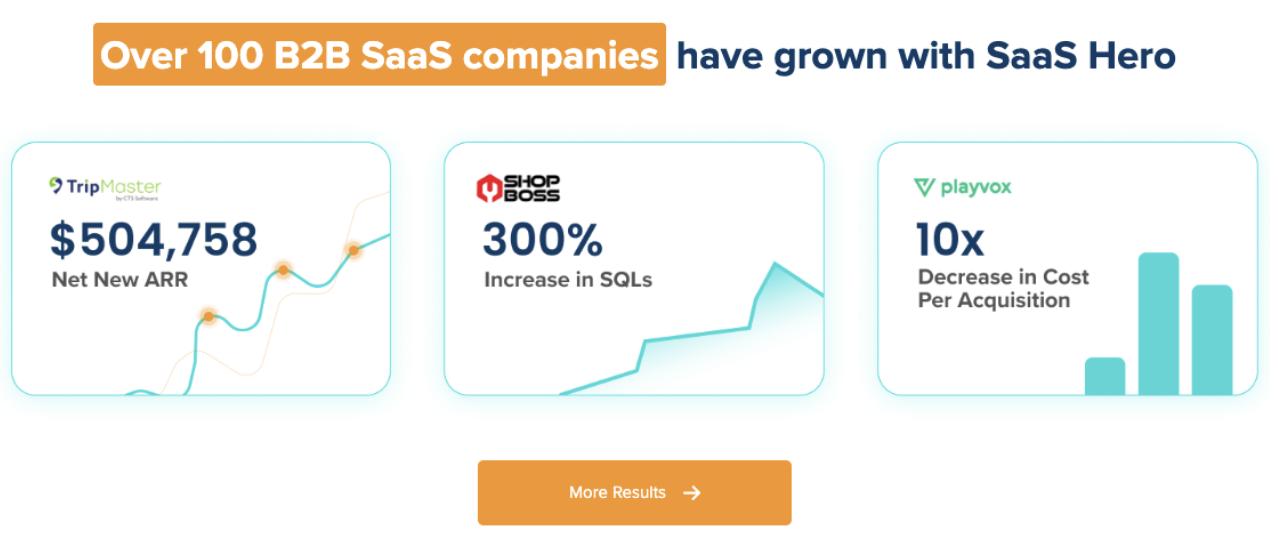
SaaSHero has delivered $504,758 in Net New ARR for TripMaster, a $70M Series A for TestGorilla, and a 10x CPL reduction for Playvox using focused B2B SaaS paid media strategies.

SaaSHero avoids percentage-of-spend pricing and uses flat monthly retainers that align with your performance goals.
|
Monthly Ad Spend |
1 Channel (Month-to-Month) |
2+ Channels |
|
Up to $10k |
$1,250 |
$2,500 |
|
$10k-$25k |
$1,750 |
$3,000 |
|
$25k-$50k |
$2,250 |
$3,500 |
This pricing model removes incentives to waste budget and supports senior-led execution with month-to-month flexibility. Get a SaaSHero audit and book a discovery call to roll out these systems.
Advanced Scaling and Cross-Channel Optimization
Budgets above $50k per month benefit from more advanced scaling tactics. Use Meta’s Generative Ads Recommendation Model (GEM) for a 5% conversion lift and rotate creative every 14 days to limit fatigue. Coordinate Facebook with LinkedIn for full-funnel coverage, using Facebook for awareness and retargeting while LinkedIn focuses on direct response.
Scale winning ad sets by 10-20% weekly while they remain profitable and pause the bottom 25% of performers after a 7-day test window. For accurate performance views, connect view-through conversions to pipeline influence instead of relying only on last-click attribution.
Summary and Quick Implementation Checklist
The 70/20/10 Facebook budget framework increases B2B SaaS ROI by sending 70% of spend to proven high-intent retargeting, 20% to qualified prospecting, and 10% to structured testing. Strong CRM integration, clean attribution, and revenue-focused decisions are essential for success.
Implementation checklist: Audit current performance, enable CBO with budget rules, build three audience tiers, launch message-match campaigns, monitor CPQL and frequency, integrate CAPI attribution, and scale profitable segments every week.
To accelerate results and avoid trial-and-error, book a discovery call with SaaSHero for expert implementation.
Frequently Asked Questions
How long does it take to see ROI from the 70/20/10 Facebook budget framework?
Most B2B SaaS companies see early performance gains within 4-6 weeks and reach full optimization by weeks 8-12. The exact timing depends on Meta’s 2-4 week Andromeda AI learning phase, your 80-120 day sales cycle, and the quality of your attribution setup. High-intent retargeting campaigns that receive 70% of the budget usually show results first. Prospecting campaigns need longer learning periods, and companies with strong CRM and CAPI integration see faster attribution and optimization.
Can I adapt the 70/20/10 framework for smaller budgets under $10k monthly?
You can adjust the allocation to 50/30/20 for budgets between $5k and $10k per month. For budgets below $5k, focus 80% on retargeting and 20% on testing, and delay cold prospecting until you have enough budget for meaningful audience sizes. Smaller budgets should favor lead forms over landing page conversions to increase volume and focus on one primary channel before expanding. The main goal is to keep enough budget in each segment so Meta’s algorithm can optimize effectively.
How does SaaSHero’s approach differ from traditional percentage-of-spend agencies?
SaaSHero uses flat monthly retainers instead of percentage-of-spend billing, which removes incentives to overspend. Traditional agencies often earn more when you increase spend, even if performance stalls. SaaSHero offers month-to-month contracts and senior-led execution for stronger accountability. Their B2B SaaS focus means they understand CPQL, LTV to CAC, and Net New ARR, and they plug directly into your CRM and communication tools as an extension of your team instead of a vendor that reports vanity metrics.

What attribution challenges should I expect with Facebook ads for B2B SaaS?
The dark funnel creates attribution gaps because prospects often see Facebook ads, then convert later through direct or branded search. Multi-stakeholder buying means the person who clicks an ad may not be the final decision maker. Long 80-120 day sales cycles also make last-click attribution unreliable. Address these challenges by using the Conversions API for better data quality, tracking assisted and view-through conversions, connecting GCLID data to CRM pipeline stages, and measuring influenced pipeline instead of only direct attribution.
How do I prevent ad fatigue while scaling Facebook campaigns?
Control frequency at 1-2 impressions per day and refresh creative every 14 days for high-spend campaigns. Build 10-20 unique creatives so Meta’s AI can test variations automatically and rotate messages across pain points, features, and social proof. Use broad targeting with CBO so Meta can find new audience pockets as you scale. Increase budgets on winning ad sets by 10-20% per week instead of large jumps that reset learning. Run a consistent creative testing schedule with new variants each week to maintain performance while you expand reach.