




Written by: Aaron Rovner, Founder, Saas Hero | Last updated: August 10, 2026
Key Takeaways
- Most B2B SaaS teams waste ad spend by launching paid campaigns before validating ICP, positioning, or payback period, which inflates CAC and stalls pipeline.
- The six-phase GTM framework addresses 2026 realities such as AI search interception, privacy-driven attribution gaps, and the dark funnel by separating internal validation (Phases 1–3) from paid acquisition and scaling (Phases 4–6).
- Each phase includes explicit inputs, outputs, decision criteria, and the specific SaaS unit-economics metric it directly influences, so every step stays revenue accountable.
- Prerequisites such as CRM visibility, baseline CAC data, a working ICP hypothesis, and cross-team agreement on definitions are mandatory before Phase 1 begins; missing any one corrupts later metrics.
- Ready to put a revenue-accountable team on Phases 4–6? Book a discovery call with SaaSHero.
Core Prerequisites Before Phase 1
Four prerequisites must be in place before you enter Phase 1, or your later metrics will mislead you.
- CRM visibility. HubSpot or Salesforce must pass GCLID data from ad click through to closed-won opportunity. Without this, you default to click-level optimization instead of revenue-based decisions.
- Baseline CAC data. Pull the last 90 days of total sales-and-marketing spend divided by new customers acquired. This becomes your pre-framework CAC benchmark. B2B SaaS CAC ranges from $300 to $15,000 depending on target segment, so the number matters less than having a documented baseline to beat.
- ICP hypothesis. Write a working definition of your best-fit account by industry, company size, tech stack, and triggering event. You will validate this in Phase 2, but it must exist before Phase 1 fieldwork starts.
- Stakeholder sign-off on definitions. Sales, marketing, and RevOps must agree on what constitutes a Sales Qualified Lead (SQL), how payback period is calculated (gross margin CAC recovery, not revenue), and which attribution model governs reporting. Google Ads, GA4, your CRM, and Stripe will report different conversion numbers, so reconciliation logic must be agreed upon before launch, not after.
Six-Phase GTM Framework at a Glance
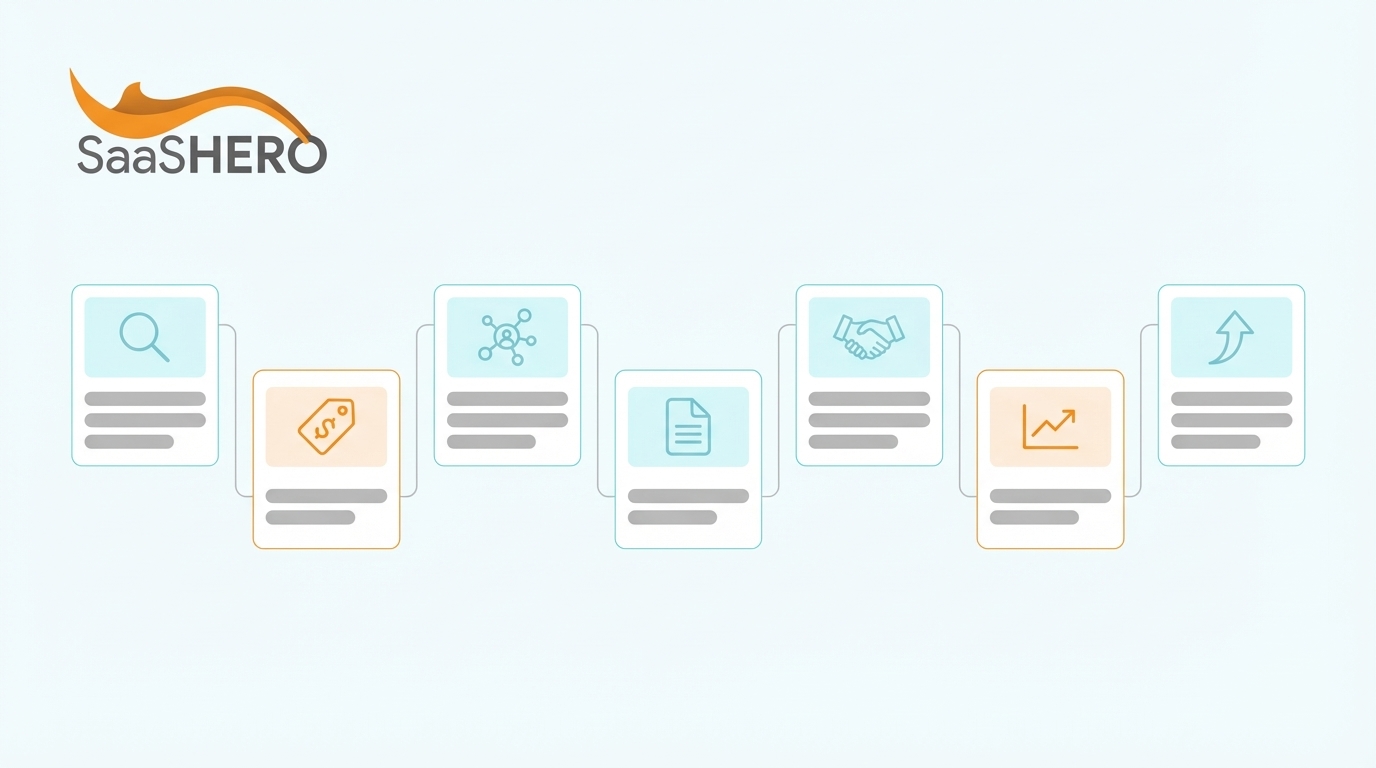
With these prerequisites in place, the six-phase framework unfolds as shown below.

| Phase | Name | Primary Output | SaaS Metric Influenced |
|---|---|---|---|
| 1 | Market Discovery & Analysis | TAM/SAM/SOM map + competitive gap matrix | Pipeline quality, SQL-to-close rate |
| 2 | ICP Definition & Validation | Tiered ICP document with exclusion criteria | CAC, win rate, churn rate |
| 3 | Positioning & Messaging | Positioning canvas + persona talk tracks | Conversion rate, sales cycle length |
| 4 | Channel Strategy & Paid Acquisition Setup | Channel plan + tracking architecture | CAC payback period, cost per SQL |
| 5 | Execution & Pipeline Generation | Live campaigns + CRM-tracked pipeline | Net New ARR, pipeline velocity |
| 6 | Measurement, Iteration & Revenue Scaling | Revenue dashboard + scaling decision log | Magic Number, NRR, Rule of 40 |
Phase 1: Market Discovery & Analysis
Purpose: Identify where your product can realistically win before you commit budget to any channel.
Inputs: Existing customer revenue data, competitor pricing pages, analyst category definitions.
Actions:
- Calculate TAM, SAM, and SOM using bottom-up account counts from LinkedIn Sales Navigator or Apollo.
- Map five to seven direct competitors across execution quality, regional focus, pricing model, and speed-to-value to surface exploitable gaps.
- Document where competitors are absent or weak. These gaps become the targeting logic for Phase 4 competitor-conquest campaigns.
Output: A competitive gap matrix that highlights two to three segments where your product has a defensible advantage.

Decision criteria: Proceed to Phase 2 only when at least one segment shows a meaningful gap and a bottom-up addressable account count of 500–5,000 accounts. Fewer than 500 accounts usually signals a niche too narrow to sustain paid acquisition at scale.
Validation checklist:
- TAM/SAM/SOM documented with source data
- Five to seven competitors mapped with gap annotations
- At least one segment with 500+ addressable accounts identified
- Competitive gaps logged for Phase 4 conquest campaign briefs
Phase 2: ICP Definition & Validation
Purpose: Narrow the addressable market to the accounts most likely to buy, retain, and expand.
Inputs: Closed-won CRM data, churned account list, Phase 1 competitive gap matrix.
Actions:
- Pull the top 20% of customers by revenue and retention, then identify shared firmographic, technographic, and trigger-event attributes.
- Cross-reference against churned accounts to separate correlation from causation.
- Define a negative ICP with explicit exclusion criteria that disqualify accounts before they enter the pipeline. The most common ICP failure is defining it by who you want to sell to rather than who actually succeeds with the product.
- Tier accounts into Tier 1 (full criteria match plus high-value trigger), Tier 2 (firmographic match without strong behavioral signals), and Tier 3 (automated nurture only).
Output: A one-page ICP document with hard filters, soft signals, and a negative ICP profile. Companies with well-defined ICPs achieve 68% higher account engagement and 33% higher conversion rates.
Decision criteria: Consider the ICP validated when it explains 60–80% of existing closed-won revenue and when win-rate data confirms that matching accounts close faster than non-matching accounts.
Validation checklist:
- ICP explains 60–80% of closed-won revenue
- Negative ICP criteria documented with at least three disqualifiers
- Account tiers assigned in CRM
- ICP shared with and approved by Sales, Marketing, and RevOps
Phase 3: Positioning & Messaging
Purpose: Turn ICP insights into a differentiated market position and channel-ready messaging.
Inputs: Phase 2 ICP document, 20–25 customer interviews, competitive gap matrix from Phase 1.
Actions:
- Conduct 20–25 interviews with ICP-matching customers to surface the top three pain triggers and decision criteria. Success is defined when 80% of interviews surface the same top three triggers and decision makers.
- Build a positioning canvas that covers category, target segment, primary pain, differentiated mechanism, and proof point.
- Write persona-specific talk tracks for the Economic Buyer (ROI model), Champion (internal talking points), and Technical Evaluator (security and integration documentation).
- Test messaging on five to ten warm prospects before you lock copy for paid channels.
Output: A positioning canvas, a one-paragraph master messaging document, and three persona talk tracks. A Series A DevTools company that followed this process shifted positioning from “modern observability for cloud-native” to “all-you-need OpenTelemetry observability at one-tenth the Datadog cost” after 22 customer interviews revealed the core pain point of Datadog billing at scale, which directly reduced CAC by sharpening ad targeting.
Decision criteria: Sales can deliver a consistent pitch without referring to notes, and messaging test win-rate on warm prospects exceeds baseline by at least 15%.
Validation checklist:
- Positioning canvas completed and approved
- Three persona talk tracks written and reviewed by Sales
- Messaging tested on a minimum of five warm prospects
- Ad headline variants drafted from the positioning canvas
Phases 1–3 complete? Book a discovery call to scope Phases 4–6 with SaaSHero.
Phase 4: Channel Strategy & Paid Acquisition Setup
Purpose: Choose the two to three channels where validated ICPs make buying decisions and build tracking before you spend.
Inputs: Phase 3 positioning canvas, ICP technographic data, CRM attribution configuration from prerequisites.
Actions:
- Select channels based on where your ICP actively engages. Seventy percent of budget should flow to channels where the ICP actively engages, not where impressions are cheapest.
- For Google Ads, target buyer-intent and competitor-adjacent keywords such as pricing, alternatives, and comparison terms. Build dedicated per-channel landing pages. Per-channel landing pages with message-match often convert better than homepages used as landing pages.
- For LinkedIn Ads, upload Tier 1 account lists and target by job title. Lead with thought leadership content before you push demo requests. Video generates three times more engagement than static ads on LinkedIn.
- Configure GCLID passthrough from ad click to CRM opportunity. Set up a Looker Studio or HubSpot revenue dashboard that reports on pipeline value and won ARR, not impressions or CTR.
Output: A channel strategy document with budget allocation, a tracking architecture diagram, and per-channel landing pages live in staging.

Decision criteria: Do not activate spend until GCLID tracking is verified end-to-end in the CRM and at least one dedicated landing page per channel is live.
SaaSHero owns Phase 4 execution on a flat monthly retainer, with no percentage-of-spend billing and no 12-month lock-in. The fee structure is fixed within spend bands, which keeps budget recommendations tied to data instead of agency revenue incentives.
Phase 5: Execution & Pipeline Generation
Purpose: Generate CRM-tracked pipeline from ICP-matched accounts and iterate on creative and targeting every week.
Inputs: Live campaigns from Phase 4, CRM with SQL definition configured, competitor gap matrix from Phase 1.
Actions:
- Launch competitor-conquest campaigns that target pricing, alternatives, and complaint-intent keywords for the top two to three competitors identified in Phase 1. Build dedicated comparison pages that address known competitor weaknesses with switching resources and social proof.
- Apply negative keyword hygiene to filter navigational intent, such as users searching only the competitor brand name to find a login page, and focus spend on evaluative modifiers only.
- Track activation rate by source. A 35% overall activation rate can hide 60% activation from one channel and 5–8% from another, so split the data by source before you make scaling decisions.
- Log every SQL in the CRM with source, campaign, and ad group so you can see which sources produce the fastest-moving deals. Pipeline velocity, measured as days from SQL to closed-won, then becomes the leading indicator of whether messaging resonates with the right segment.
Output: CRM-tracked pipeline with source attribution, a weekly creative performance log, and a competitor-conquest landing page for each primary competitor.
Decision criteria: Scale spend on a channel only when its activation rate and SQL-to-close rate both sit above baseline. Pause channels where cost per SQL exceeds the CAC target implied by your payback period goal.
Phase 6: Measurement, Iteration & Revenue Scaling
Purpose: Turn pipeline data into a repeatable scaling framework tied to Net New ARR and the SaaS Magic Number.
Inputs: Sixty to ninety days of CRM-tracked closed-won data, CAC by channel, and payback period by segment.
Actions:
- Calculate the SaaS Magic Number, defined as net-new ARR divided by prior-period sales-and-marketing spend, targeting above 1.0 for efficient scaling and treating anything below 0.75 as a signal to re-examine spend before you add budget.
- Run a 30/60/90 retrospective that covers what closed, what stalled, which channels produced the lowest CAC payback, and which ICP tier converted fastest.
- Revisit positioning at month six against fresh data from won deals. As mentioned in Phase 2, revisit your ICP when retention or win-rate patterns shift, typically at the six-month mark and at least annually thereafter.
- Scale budget on channels where Magic Number exceeds 1.0 and CAC payback sits inside your target threshold. Reallocate away from channels that fail those tests.
Output: A revenue scaling decision log, updated channel budget allocation, and a positioning refresh brief if win-rate data signals ICP drift.

Measurement & Validation Metrics
Four core metrics govern framework success, and each one maps to a specific phase output.
- CAC by channel: Total sales-and-marketing spend on a channel divided by new customers acquired from it. Median CAC payback periods for B2B SaaS often exceed 12 months. A sub-90-day payback is achievable for high-velocity SMB motions with tight ICP targeting.
- Payback period: CAC divided by monthly gross margin per customer. Investors use this metric to evaluate capital efficiency. SaaSHero achieved an 80-day payback period for TestGorilla, which directly supported their $70M Series A raise.
- Net New ARR: Closed-won new logo ARR in the period. This metric cannot be gamed by attribution model selection, so report it from CRM, not from ad platform conversion data.
- Pipeline velocity: Average deal value multiplied by win rate, divided by average sales cycle length. Declining velocity in Phase 5 signals a messaging or ICP mismatch before it appears in final revenue.
Attribution in long B2B cycles requires reconciling data across Google Ads, GA4, CRM, and billing systems. No single tool is authoritative, so the reconciliation logic agreed upon in prerequisites governs which number you report to leadership.
Advanced 2026 GTM Variations
Three execution layers extend the framework for teams operating in 2026’s changed acquisition environment.
Competitor-conquest scaling. Once Phase 5 conquest campaigns generate SQLs, expand the keyword set to review-intent and validation-intent terms. Build a review-focused landing page that aggregates G2 badges, Capterra ratings, and switched-customer testimonials. Use competitor names only in factual comparisons and avoid competitor logos to stay within legal safe practices.
LinkedIn and Google layering. Run Google Ads on high-intent and competitor-adjacent keywords for bottom-of-funnel capture. Run LinkedIn Ads on Tier 1 account lists for top-of-funnel warming. The two channels serve different psychological intent states and should not share creative or landing pages. Inbound-led outbound converts at 14.6% versus pure outbound’s 1.7%, and LinkedIn warming of named accounts before outbound sequences drives that delta.
AI search visibility. Ninety-four percent of B2B buyers now use LLMs like ChatGPT, Perplexity, and Claude in their purchase journey. Audit whether your product appears in AI-generated responses to the top buyer questions in your category. A citation rate of four or more out of 20 top buyer-question prompts is the 2026 benchmark for adequate AI visibility. This creates a content and authority challenge, not a paid media challenge, but it shapes the quality of traffic that paid campaigns eventually convert.
Recap Checklist & Next Steps by Team Maturity
Use the checklist below to locate your current position in the framework and identify the phase that needs attention next.
- Pre-Phase 1: CRM attribution configured, baseline CAC documented, ICP hypothesis written, SQL definition agreed upon by Sales and Marketing.
- Phase 1 complete: Competitive gap matrix built, at least one segment with 500+ addressable accounts identified.
- Phase 2 complete: ICP explains 60–80% of closed-won revenue, negative ICP documented, account tiers in CRM.
- Phase 3 complete: Positioning canvas approved, three persona talk tracks written, messaging tested on warm prospects.
- Phase 4 complete: GCLID tracking verified end-to-end, per-channel landing pages live, channel budget allocation documented.
- Phase 5 complete: Competitor-conquest campaigns live, activation rate tracked by source, pipeline velocity logged in CRM.
- Phase 6 active: Magic Number calculated, 30/60/90 retrospective completed, scaling decisions logged against data.
Founder-led teams usually complete Phases 1–3 internally and need execution support starting at Phase 4. Series A–B teams with a VP of Marketing often have Phases 1–3 partially complete but lack the paid media infrastructure and CRM tracking architecture to execute Phases 4–6 with revenue accountability.
Frequently Asked Questions
How long does it take to complete all six phases?
Most teams complete Phases 1–3 in four to six weeks when CRM data and a working ICP hypothesis already exist. Phase 4 setup usually takes one to two weeks once positioning is locked. Phases 5 and 6 run continuously, with Phase 5 generating pipeline from week one of campaign activation and Phase 6 producing actionable scaling decisions after 60–90 days of closed-won data. The full framework from kickoff to first revenue-scaling decision typically runs 90–120 days for most Series A–B teams.
What roles are required to run this framework?
Phases 1–3 require a product marketing or growth lead who can conduct customer interviews and write positioning. Phase 4 requires a paid media specialist with B2B SaaS experience and a RevOps or marketing ops resource to configure CRM tracking. Phases 5 and 6 require ongoing paid media management and a RevOps function that can pull pipeline velocity and CAC data from the CRM. Teams without in-house paid media expertise usually engage an external partner for Phases 4–6 rather than hiring, which activates faster and avoids the three-month ramp time of a new hire.
Can a smaller team run this framework with limited budget?
The framework scales to smaller budgets as long as tracking remains accurate. A team spending $10,000 per month on paid media can execute Phases 4–6 with one channel, typically Google Ads targeting competitor and category keywords, then layer LinkedIn in a second phase. The critical constraint is not budget size but tracking fidelity. A team spending $5,000 per month with clean CRM attribution will make better scaling decisions than a team spending $50,000 per month while optimizing to ad-platform conversion events that do not map to closed-won revenue.
How often should the framework be revisited?
Phase 6 includes a 30/60/90 retrospective cadence baked into the framework. ICP and positioning should be formally revisited at month six against fresh closed-won data and at minimum annually. Trigger an out-of-cycle review when win rate drops more than 10 percentage points, when a new competitor enters the market, or when a funding event changes your target segment. The Magic Number and CAC payback period act as leading indicators that signal when a framework refresh is needed before revenue impact becomes visible in ARR.
How is SaaSHero different from a standard paid media agency for Phases 4–6?
As noted in Phase 4, SaaSHero’s flat-retainer model removes the financial incentive to recommend budget increases that data does not support. Beyond pricing, the key differentiator is the operating model. Reporting anchors to Net New ARR, pipeline value, and CAC payback instead of impressions or CTR. The team integrates directly into client Slack channels and CRM instances, so it functions as an embedded growth partner rather than an external vendor. SaaSHero works exclusively with B2B SaaS and technology companies, which means every team member understands the unit economics, sales cycle dynamics, and CRM architecture specific to this segment.