





Key Takeaways
- Cross-functional GTM pods with shared KPIs prevent ARR leakage and support faster, more predictable revenue growth.
- Match structure to stage: founder-led under $1M ARR, specialized pods at $1M-$10M, and hybrid models at $10M+.
- Anchor your team around GTM Lead/CRO, Product Marketing, RevOps, Demand Gen, SDRs, AEs, CSMs, and GTM Engineers for AI workflows.
- Track concrete revenue KPIs such as LTV:CAC above 3:1, CAC payback under 80 days, NRR above 120%, 4x pipeline coverage, and SQL conversion above 15%.
- Shorten your learning curve with SaaSHero’s outsourced GTM expertise, and schedule a discovery call for a tailored team audit and roadmap.
Step 1: Define Core Roles & Functions in Your GTM Strategy Team
The foundation of any high-performing GTM strategy team structure starts with clearly defined roles and cross-functional alignment. Highspot identifies the core B2B go-to-market teams as Marketing, Enablement, and Sales, and modern SaaS companies now add specialized functions to stay competitive.
The table below maps eight essential GTM roles to their core functions, accountability metrics, and reporting lines so you can see how each role supports revenue.
| Role | Core Functions | Key KPIs | Reports To |
|---|---|---|---|
| GTM Lead/CRO | Strategy, alignment, revenue accountability | Net New ARR, Pipeline Coverage 4x | CEO |
| Product Marketing Manager | ICP definition, positioning, sales enablement | Win rate, competitive win rate | CMO |
| Revenue Operations | Data integrity, attribution, process optimization | Forecast accuracy, data quality | CRO |
| Demand Generation | Pipeline creation, channel execution | Pipeline created, CAC payback <80 days | CMO |
| Sales Development Rep | Lead qualification, outbound prospecting | SQL conversion rate, meetings booked | Sales Manager |
| Account Executive | Demo delivery, deal closing | Quota attainment, deal velocity | Sales Manager |
| Customer Success Manager | Onboarding, expansion, retention | NRR >120%, churn rate | VP Customer Success |
| GTM Engineer | Workflow automation, AI integration | Process efficiency, data accuracy | RevOps |
Cross-functional alignment eliminates the silos that kill revenue growth. Companies with mature GTM Ops frameworks reduce overhead by 30%, improve sales productivity by 10%, and increase marketing ROI by 100%. Shared KPIs, unified data models, and standardized operating cadences keep every function moving in the same direction.
Once you define these core roles, you need to decide how many of each role to hire and when, which depends on your current ARR stage.
Step 2: Build GTM Strategy Team Structure by SaaS Stage
Your GTM team structure must evolve with your ARR growth stage. Each phase requires different specialization levels, headcount ratios, and organizational complexity.
Startup Stage: Under $1M ARR
Startup GTM teams stay lean, with founders covering most functions and a few targeted hires supporting repeatable sales. The table below shows a practical mix of early roles, responsibilities, and hiring priority at this stage.
| Role | Headcount | Key Responsibilities | Hire Priority |
|---|---|---|---|
| Founder/CEO | 1 | Sales, strategy, customer development | N/A |
| Product Marketing | 0.5-1 | Messaging, positioning, content | High |
| Revenue Operations | 0.5 | CRM setup, basic reporting | Medium |
| Account Executive | 1 | Demo delivery, deal closing | High |
Growth Stage: $1M-$10M ARR
Growth-stage companies introduce specialization and pod structures as volume increases. Tom Tunguz recommends a structure of 2-3 Sales Development Reps per Account Executive for inside sales targeting $5K-$50K ACV deals.
The table below outlines typical headcount ranges and when to add each function as ARR scales through the growth stage.
| Function | Headcount | Structure | ARR Milestone |
|---|---|---|---|
| Sales Team | 5-10 AEs, 3-5 SDRs | Specialized by segment | $1M-$5M |
| Marketing | 3-5 specialists | Demand Gen, PMM, Content | $2M+ |
| Customer Success | 2-3 CSMs | Segmented by ARR | $3M+ |
| Revenue Operations | 1-2 specialists | Full-time dedicated | $5M+ |
Enterprise Stage: $10M+ ARR
Enterprise-stage companies rely on hybrid models with segment-specific teams and support for complex deal cycles. The table below shows how to structure teams by segment once you pass $10M ARR.
| Segment | Team Structure | Specialization | Typical ARR |
|---|---|---|---|
| SMB | Inside sales pods | High velocity, low touch | $10M-$20M |
| Mid-Market | Field sales + SE support | Consultative selling | $20M-$50M |
| Enterprise | Strategic account teams | Multi-threaded, long cycles | $50M+ |
Step 3: Choose Your GTM Team Model: Centralized, Pod, or Hybrid
Your organizational model shapes performance, collaboration, and scalability. Teams operating in intentionally cross-functional “pods” report 75% better GTM performance.
| Model | Best For | Pros | Cons |
|---|---|---|---|
| Centralized | Early stage, simple products | Clear hierarchy, easy coordination | Silos, slow decision-making |
| Pod | Growth stage, multiple segments | Agility, accountability, alignment | Resource duplication, coordination overhead |
| Hybrid | Enterprise, complex GTM motions | Flexibility, specialization | Complexity, role confusion |
The pod model organizes cross-functional teams around specific customer segments or products. A typical SaaS pod includes Demand Generation, SDR, AE, and CSM working together with shared revenue targets.
This structure reduces handoff friction and creates end-to-end accountability from first touch through renewal. For 2026, many scaling SaaS companies adopt hybrid models that centralize Product Marketing and RevOps while running pods for key segments, which balances efficiency with agility.
Step 4: Align for Revenue with KPIs, RACI Matrix & Tech Stack
Revenue alignment depends on clear ownership and shared metrics across teams. Grant Johnson’s CMO Marketing Operating System recommends six key marketing KPIs: Reach, Recognition, Engagement, Loyalty, Pipeline, and Progression.
The RACI matrix below clarifies who drives, approves, supports, and monitors the core GTM processes that affect revenue.
| Process | Responsible | Accountable | Consulted | Informed |
|---|---|---|---|---|
| Campaign Launch | Demand Gen | CMO | PMM, Sales | RevOps |
| Lead Qualification | SDR | Sales Manager | Marketing | RevOps |
| Deal Handoff | AE | Sales Manager | CSM | RevOps |
| Customer Expansion | CSM | VP Customer Success | AE, PMM | RevOps |
GTM teams also need a focused KPI set that connects daily work to revenue outcomes. Mid-market B2B companies typically deploy HubSpot + LinkedIn Ads + Google Analytics (28.5% adoption) as a common tech stack foundation that supports this measurement.
The table below groups KPIs by category so each owner knows which metric they are responsible for improving.
| KPI Category | Metric | Target | Owner |
|---|---|---|---|
| Efficiency | CAC Payback Period | <80 days | RevOps |
| Growth | Net New ARR | Stage-dependent | CRO |
| Retention | Net Revenue Retention | >120% | Customer Success |
| Quality | SQL Conversion Rate | >15% | Sales |
Step 5: Scale Fast with SaaSHero as Your Outsourced GTM Team
Building internal GTM teams takes months and requires significant capital investment that many growth-stage SaaS companies cannot spare. SaaSHero offers an immediate alternative as your outsourced GTM execution partner and removes both the long hiring timeline and ongoing salary commitments.
We focus exclusively on B2B SaaS and provide senior-led teams, flat-fee retainers from $1,250-$7,000 monthly, and month-to-month agreements that keep our incentives aligned with your results.
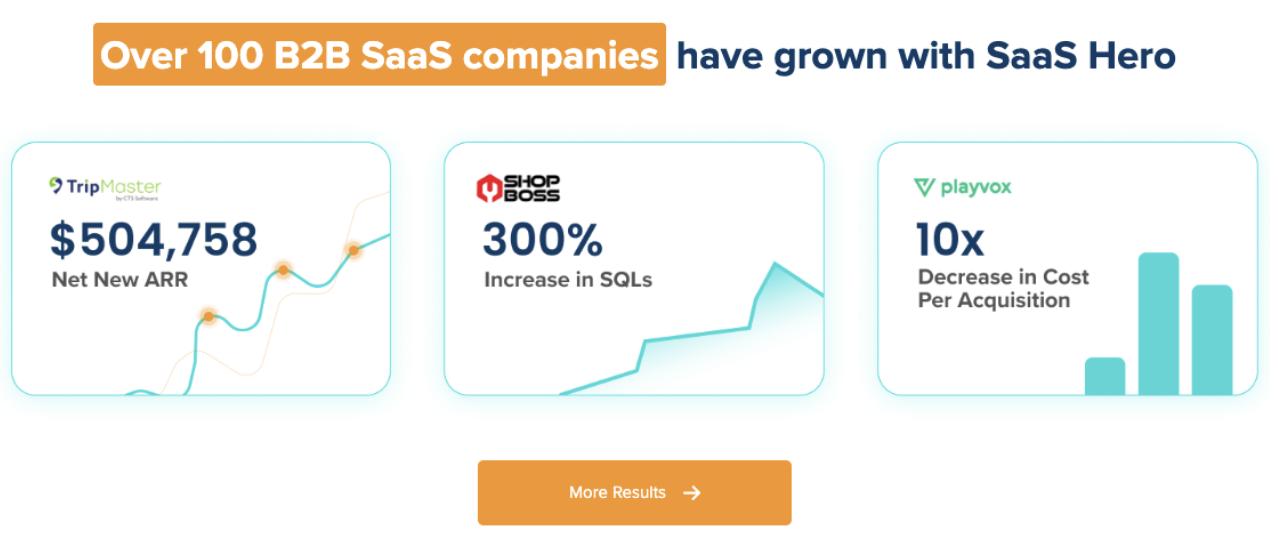
Our client outcomes illustrate the impact of this model. TripMaster achieved 650% ROI and $504,758 in Net New ARR, TestGorilla reached 80-day CAC payback that supported their $70M Series A, and Playvox reduced Cost Per Lead by 10x while increasing volume 163%.

We integrate as an extension of your team through dedicated Slack channels, weekly performance reviews, and bi-weekly strategy calls. You gain immediate access to expertise across paid search, LinkedIn ads, conversion improvements, and revenue operations without hiring multiple specialists.
Our flat-fee model avoids the misaligned incentives of percentage-based agencies and keeps every recommendation focused on your revenue growth. Book a discovery call to explore how SaaSHero can accelerate your GTM team performance.

Hiring & Implementation Checklist
Immediate Actions:
- Audit current GTM team silos and misalignment issues so you understand where revenue leaks occur.
- Hire RevOps early, ideally by $5M ARR, to standardize processes and reporting before complexity spikes.
- Implement pod structures that create cross-functional accountability for pipeline and ARR within each segment.
- Establish shared KPIs centered on revenue outcomes instead of vanity metrics such as raw lead volume.
- Evaluate a GTM Engineer role for 2026 to handle AI integration and workflow automation across your stack.
Common Pitfalls to Avoid:
- Delaying the RevOps hire until late in the growth cycle, which makes cleanup slower and more expensive.
- Maintaining departmental silos without cross-functional alignment on goals, data, and operating cadence.
- Chasing lead volume instead of focusing on revenue quality and conversion through the funnel.
- Underestimating the complexity of enterprise GTM motions and the need for segment-specific support.
- Overlooking emerging roles like GTM Engineers that can unlock AI-driven efficiency in 2026 and beyond.
FAQ
What should be included in a GTM strategy team structure template?
A comprehensive GTM strategy team structure template includes stage-specific org charts with reporting relationships, role definitions with clear responsibilities and KPIs, and RACI matrices for processes such as lead handoffs and campaign launches. It also covers headcount ratios for different growth stages and technology stack requirements. The template should evolve from founder-led structures under $1M ARR to specialized pods at $1M-$10M ARR and then to hybrid models for enterprise scale above $10M ARR.
What are the essential roles for a startup GTM team org chart?
For startups under $1M ARR, the essential GTM team structure stays founder-led with a few targeted specialists. Priority hires include a Product Marketing Manager for messaging and positioning, a part-time Revenue Operations specialist for CRM setup and basic reporting, and the first Account Executive once founders have closed at least ten customers and documented repeatable sales processes. The founder typically owns strategy, early sales, and customer development while adding specialized functions as ARR grows.
What are the pros and cons of the SaaS GTM pod model?
The SaaS GTM pod model delivers strong benefits such as 75% better performance through cross-functional alignment, faster decision-making with dedicated teams, end-to-end accountability for revenue outcomes, and less friction at handoffs between departments. The model also introduces challenges that include resource duplication across pods, coordination overhead between teams, potential role confusion, and higher management complexity. Growth-stage companies between $1M and $10M ARR with multiple segments or product lines usually gain the most from pods.
How does SaaSHero fit into a GTM strategy team structure?
SaaSHero integrates as an extension of your existing GTM team structure and provides specialized execution without full-time headcount. We work alongside internal marketing teams, join your communication channels through Slack, and align with your RevOps processes for unified reporting. Our senior-led approach gives you practitioners who understand B2B SaaS metrics such as CAC, LTV, and ARR, and our flat-fee model keeps recommendations focused on your growth rather than our revenue.

How long does it take to see ARR impact from GTM team structure changes?
GTM team structure improvements typically show initial impact within about 80 days, as demonstrated by our TestGorilla case study mentioned earlier. Full transformation usually takes 6-12 months depending on the scope of changes. Quick wins include removing obvious silos, implementing shared KPIs, and setting weekly cross-functional meetings. Deeper shifts such as pod implementation, new role integration, and process automation take longer but deliver durable revenue growth and operational efficiency.
Summary & Next Steps
Revenue-first GTM strategy team structures remove silos that drain ARR and create a foundation for scalable growth. The core moves include defining roles with shared KPIs, evolving structure by growth stage, choosing the right organizational model, and aligning teams through clear RACI matrices and integrated technology.
Start by auditing your current team structure against these frameworks and flagging gaps that slow revenue performance. Consider emerging roles like GTM Engineers for AI-driven workflows, and decide whether pod or hybrid models align better with your growth objectives.
Book a discovery call with SaaSHero to receive a custom GTM team audit, an implementation roadmap, and pricing for outsourced execution that accelerates your revenue growth.