




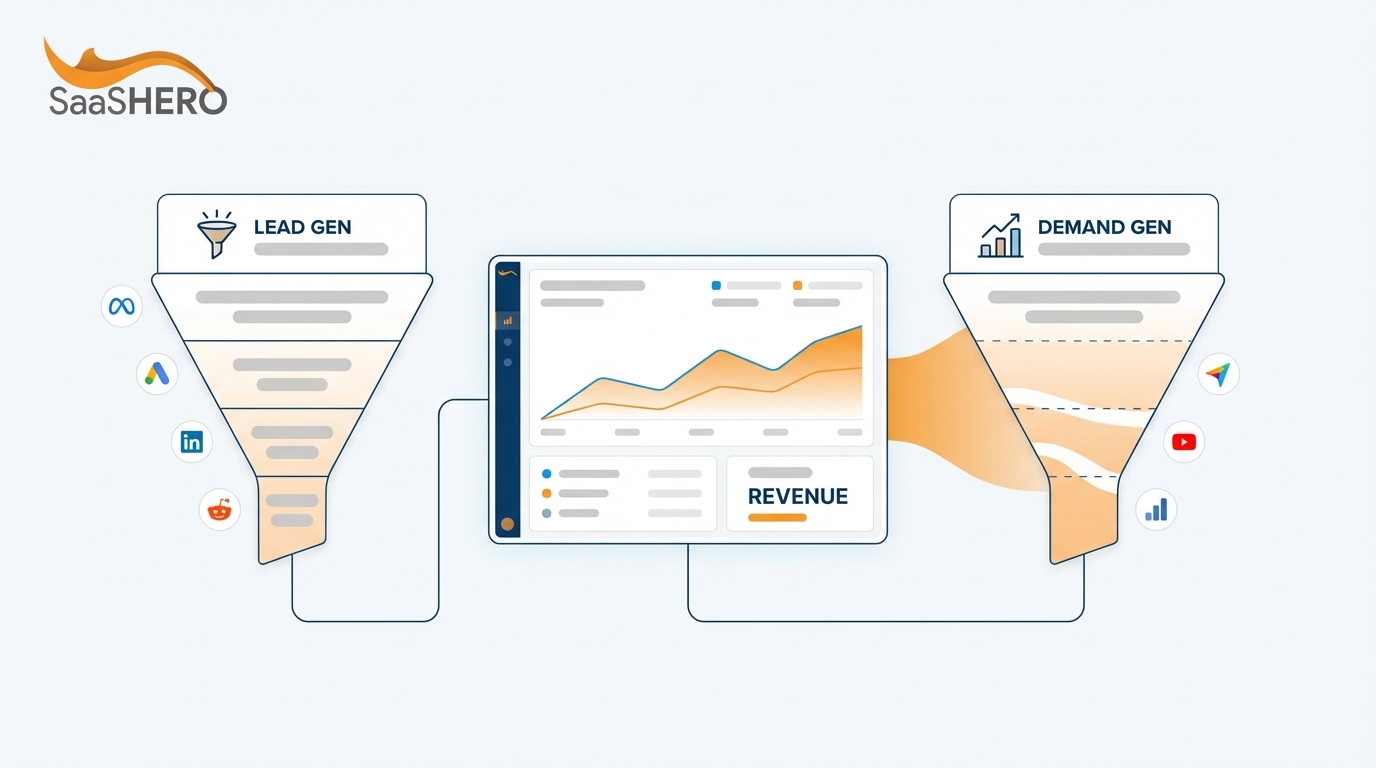
Key Takeaways
- B2B SaaS teams in 2026 need capital-efficient pipeline growth and clear revenue attribution across a complex buyer journey.
- Lead generation agencies specialize in capturing existing demand and can deliver fast lead volume, but often have limited visibility into downstream revenue quality.
- Demand generation strategies create and capture demand across the full funnel, and usually improve CAC and lead quality as programs mature.
- The right mix of lead generation and demand generation depends on company stage, growth objectives, and internal resources.
- SaaSHero helps B2B SaaS companies build revenue-first acquisition programs; schedule a discovery call to review your strategy.

The Shifting Landscape of B2B SaaS Customer Acquisition
B2B SaaS companies face higher customer acquisition costs, longer sales cycles, and buyers who complete much of their research before speaking with sales. A large share of the buying journey now happens in the dark funnel, where prospects evaluate vendors without filling out forms or booking demos.
Buying committees often include 6 to 10 stakeholders, each consuming content across multiple channels. Teams must decide how much to focus on capturing existing intent with lead generation versus creating and nurturing intent with demand generation.
This decision shapes growth trajectory, marketing efficiency, and payback periods. Misalignment often shows up as bloated lead lists, low opportunity conversion, and spend patterns that erode investor confidence.
Talk with SaaSHero about aligning acquisition strategy with revenue goals.
Unpacking Core Concepts: Lead Generation Agency vs. Demand Generation
What is a Lead Generation Agency?
Lead generation agencies focus on capturing existing demand through tactical campaigns. Their primary goal is to find prospects already in-market and convert them into marketing qualified leads or sales qualified leads. These agencies often target buyers who are searching, clicking ads, or completing forms, using channels like paid search, paid social, gated content, and outbound.
Many agencies use pricing models such as cost per lead, cost per meeting, or percentage of ad spend. These structures can reward lead volume over lead quality, or encourage higher budgets without clear revenue impact.
Lead generation is most effective when real intent already exists in the market and when the sales team can quickly work new contacts.
What is Demand Generation?
Demand generation is a full-funnel strategy that creates, nurtures, and captures interest across the entire buyer journey. It accounts for anonymous research in the dark funnel, where prospects learn, compare, and build preferences long before they speak with a vendor.
Demand generation programs use content marketing, SEO, thought leadership, events, communities, and product education to shape how buyers view a problem and its solutions. Success is measured with metrics like pipeline generated, CAC efficiency, and revenue attribution, not just the number of leads captured.
Effective demand generation requires consistent investment but compounds over time. Strong brands and authoritative content usually lead to better-fit opportunities, higher win rates, and more efficient acquisition.
See how SaaSHero structures revenue-focused demand generation for B2B SaaS teams.
Head-to-Head: Lead Generation Agencies vs. Demand Generation Strategies
The comparison below summarizes how each approach aligns with common B2B SaaS objectives.
|
Feature |
Lead Generation Agency |
Demand Generation Strategy |
|
Primary goal |
Capture existing demand and generate MQLs or SQLs |
Create and capture demand to build qualified pipeline and revenue |
|
Buyer journey focus |
Mid to bottom of funnel, where intent is visible |
Full funnel, from awareness to decision and expansion |
|
Key tactics |
Paid search, paid social, gated content, outbound |
Content, SEO, thought leadership, events, partner channels |
|
Core metrics |
Cost per lead, lead volume, meetings booked |
CAC, LTV, pipeline value, Net New ARR |
Lead generation can add contacts quickly but often struggles when demand is thin or when performance is judged only on volume metrics. Low cost per lead does not help if conversion from lead to opportunity and closed-won revenue remains low.
Demand generation usually ramps more slowly but can create durable advantages through stronger brand preference and higher-quality inbound interest. Many teams see improved win rates, better CAC, and faster payback once programs are established.
Request a performance review of your current mix of lead gen and demand gen.
Deep Dive: The Lead Generation Agency Model in 2026
Where Lead Generation Agencies Fit Best
Lead generation agencies work well when companies need fast, measurable volume and when the market already contains active buyers. They can spin up campaigns quickly, optimize forms and landing pages, and route contacts directly to sales.
This model is useful for testing new segments, supporting short-term campaigns, or filling shortfalls in near-term pipeline. High-intent keyword campaigns, retargeting visitors, and reaching prospects already engaging with competitor content are typical use cases.
Key Limitations for B2B SaaS
The model also has constraints for complex SaaS sales. Many programs emphasize volume over intent, which leads to shallow leads that rarely progress beyond qualification.
Percentage-of-spend pricing can encourage budget growth without proving revenue impact. Some agencies also fall into the pattern where senior staff close the deal and junior staff manage daily execution, creating gaps between strategy and delivery.
Teams that optimize only for clicks and form fills risk drifting toward vanity metrics. Focusing on surface metrics can hide weak opportunity and revenue performance, and can make CAC look better on paper than it is in practice.
Deep Dive: The Demand Generation Strategy in 2026
When Demand Generation Becomes Essential
Demand generation becomes critical as markets mature and cost per click rises. In many SaaS categories, rising CAC reduces the effectiveness of pure lead generation tactics, especially for teams that do not invest in brand and education.
Strong demand generation programs build market understanding of the problem, position the product as a credible solution, and support the sales team with educated, well-aligned buyers. Over time this tends to improve pipeline quality, win rates, and payback periods.
Challenges in Executing Demand Generation
Demand generation requires patience, coordination, and data discipline. Results often appear over months rather than weeks, and success depends on close alignment between marketing, sales, and RevOps.
Teams need integrated CRM and marketing automation to manage campaigns, scoring, nurturing, and attribution with enough detail to connect programs to revenue. Leadership also needs to support long-term investments in content, thought leadership, and brand that may not generate immediate pipeline spikes but strengthen performance over time.
Scenario-Based Recommendations for B2B SaaS Growth
Scenario 1: Early-Stage Startup (Pre-Seed or Seed)
Objective: Prove product-market fit and generate the first repeatable deals.
Recommendation: Use targeted lead generation to capture high-intent demand in clear niches, while building basic demand generation assets such as a clear positioning narrative, a focused website, and a small set of educational resources. Favor partners with transparent pricing and the ability to tie spend directly to closed-won deals.
Scenario 2: Mid-Market Scaling (Series A or B)
Objective: Accelerate predictable growth and improve CAC.
Recommendation: Shift emphasis toward integrated demand generation while keeping selective lead generation for near-term pipeline. Invest in thought leadership, systematic content, and SEO. Track metrics such as marketing-sourced pipeline share, opportunity quality, and payback period to guide budget allocation.
Scenario 3: Enterprise and Complex Deals
Objective: Educate multiple stakeholders, build trust, and shorten long sales cycles.
Recommendation: Lead with demand generation, especially account-based marketing, tailored content, and events for target accounts. Use lead generation tactically to convert engaged account stakeholders into formal opportunities. Ensure CRM and attribution can track influence across multiple contacts and touchpoints.
The SaaSHero Approach: Revenue-Focused Strategies for B2B SaaS
SaaSHero operates as a specialized partner for B2B SaaS companies that want acquisition programs tied directly to revenue. The team blends paid acquisition, intent-based landing pages, and competitive positioning tactics such as competitor campaigns on Google Ads with tailored SaaS landing pages.
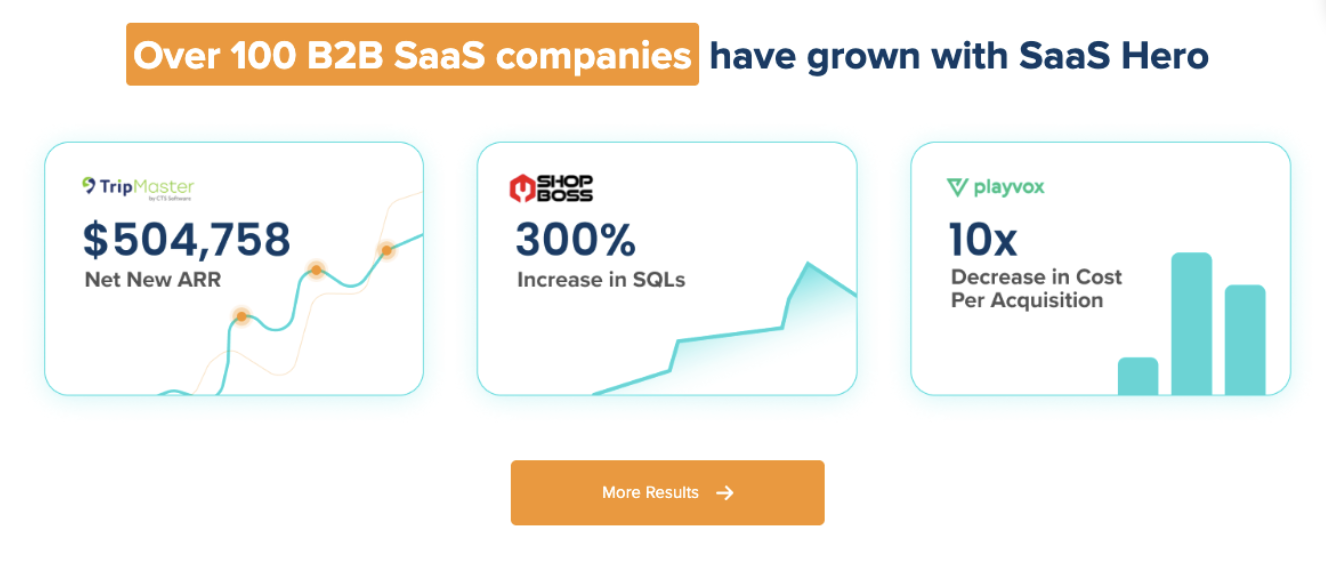
SaaSHero prioritizes Net New ARR, qualified pipeline, and efficient CAC over surface metrics. Client results include outcomes such as hundreds of thousands of dollars in Net New ARR and fast payback periods on paid media. The agency aligns incentives through flat-fee retainers and flexible agreements, avoiding percentage-of-spend models that can misalign interests.

Decision Framework: Choosing Your Path Forward
Use the checklist below to choose or refine your mix of lead generation and demand generation.
- Growth stage: Early-stage teams may lean on targeted lead gen, while scaling teams usually need stronger demand gen to sustain growth.
- Primary objective: Clarify whether the priority is near-term sales activity or durable, qualified pipeline and revenue efficiency.
- Internal capacity: Determine whether your team can own strategy, content, and operations, or whether you need a partner to provide these capabilities.
- Agency model: Favor partners that report on pipeline and revenue, avoid long lock-ins, and do not rely solely on percentage-of-spend pricing.
- Measurement: Require visibility from ad spend through to closed-won deals, including metrics like Net New ARR, CAC, and payback period.
Conclusion: Align Lead and Demand Generation Around Revenue
The choice is not strictly between a lead generation agency and a demand generation strategy. Most B2B SaaS companies benefit from a blend of both, with the balance shifting as the company matures, the category evolves, and growth targets change.
Teams that win in 2026 will treat demand creation and demand capture as parts of the same revenue system, judge programs by pipeline and ARR, and work with partners who share that focus. If you want to stress-test your current approach, schedule a discovery call with SaaSHero to review your funnel and growth plan.