




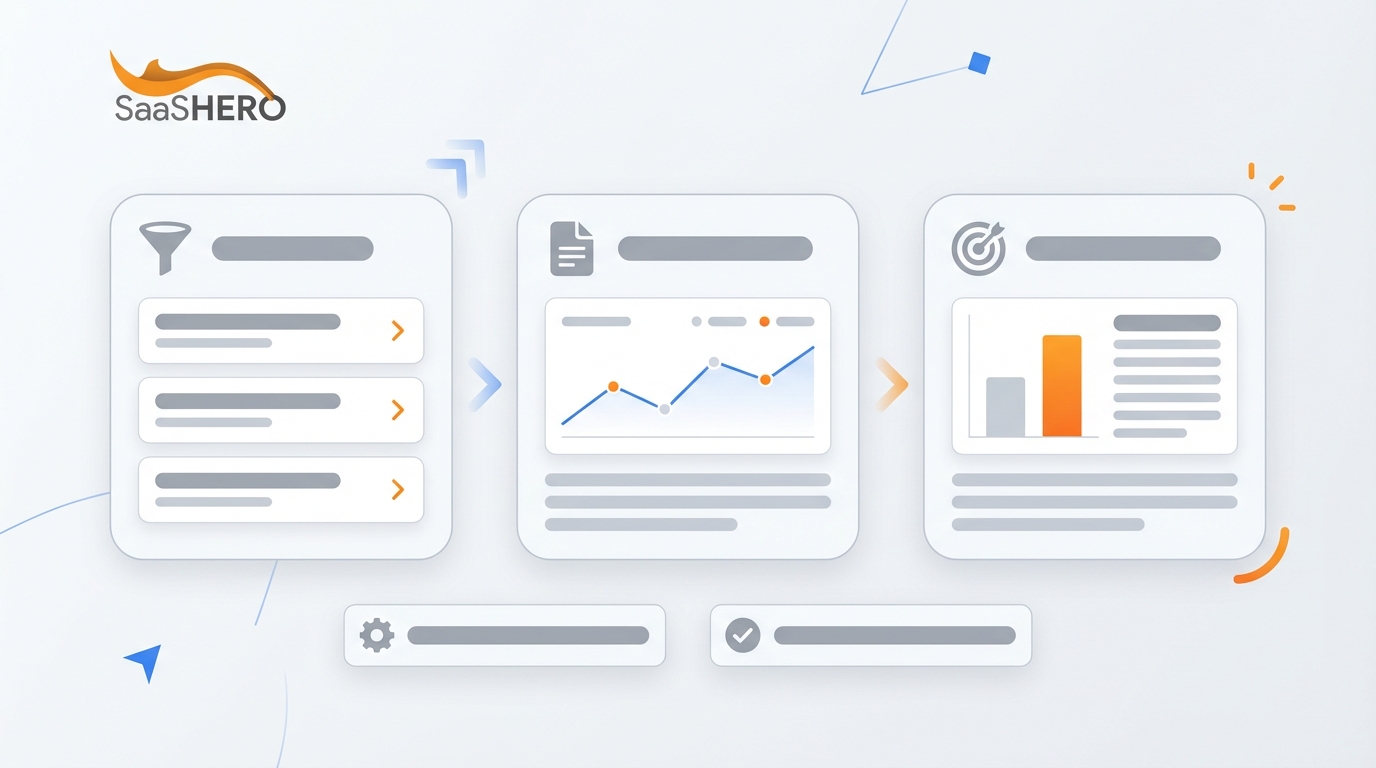
Key Takeaways for Multi-Stage SaaS Ad Messaging
- B2B SaaS CAC has risen to $2 per $1 ARR, and multi-stage ad messaging intercepts high-intent buyers across ToFu, MoFu, and BoFu for strong ROI.
- The 7-step framework, including journey mapping, intent segmentation, stage-specific messaging, retargeting, and testing, has delivered 650% ROI and $504K Net New ARR.
- Use ToFu ads for pain agitation, MoFu ads for social proof and case studies, and BoFu ads for urgency CTAs that match psychological intent buckets.
- Layer LinkedIn retargeting and competitor conquesting with AI tools and precise keywords to capture evaluation and purchase searches.
- Implement this framework with SaaSHero’s proven playbook via a discovery call and access enterprise-level execution from $1,250 per month.
Core Setup Before You Launch Multi-Stage SaaS Ads
Set up Google Ads, LinkedIn Ads, a CRM like HubSpot or Salesforce, and baseline performance metrics before you launch multi-stage B2B SaaS ad messaging. B2B SaaS PPC averages $619 CAC, so disciplined campaign structure protects profitability.
Know your funnel stages clearly. ToFu (Top of Funnel) covers awareness and problem identification. MoFu (Middle of Funnel) covers solution evaluation. BoFu (Bottom of Funnel) drives purchase decisions. LinkedIn’s AI-powered campaign optimization and Predictive Audiences use machine learning to improve targeting precision, which makes 2026 a strong moment to roll out sophisticated multi-stage campaigns.
7-Step Multi-Stage B2B SaaS Ad Messaging Framework
The 7-step framework for multi-stage B2B SaaS ad messaging follows this sequence.
- Map Buyer Journey Stages
- Segment Audiences by Intent
- Craft ToFu Awareness Messaging
- Build MoFu Credibility Content
- Design BoFu Urgency Campaigns
- Layer Retargeting and Conquesting
- Test and Optimize Continuously
|
Stage |
Messaging Focus |
Key Metric |
Intent Bucket |
|
ToFu |
Pain Identification |
Impressions to SQLs |
Problem Awareness |
|
MoFu |
Solution Proof |
Demo Requests |
Evaluation/Comparison |
|
BoFu |
Purchase Urgency |
Net New ARR |
Decision/Pricing |
Step 1: Map Your Buyer Journey Stages
Start by identifying the exact touchpoints where prospects consume information and make decisions, so you can target messages precisely and reduce CAC by up to 10x. Interview recent customers and document their research process. Capture which channels they used, which content influenced them, and how long each stage lasted. B2B buyers spend 62% of their time looking for solutions and 49% analyzing situations, so accurate journey mapping keeps your timing aligned with their behavior.
Create a journey map with three columns. Use Stage (Awareness, Consideration, Decision), Buyer Questions (“What problems do we have?”, “Which solutions work best?”, “Should we buy now?”), and Content Needs (Educational, Comparative, Proof-based). Keep this map visible for both marketing and sales teams.
Step 2: Segment Audiences by Psychological Intent
Segment audiences by psychological intent so your ads match what buyers are thinking, not just who they are. Move beyond demographic filters and build three intent categories. Use Problem Intent for people searching for solutions to pain points, Comparison Intent for people evaluating you against competitors, and Purchase Intent for people ready to buy and seeking pricing or demos.
Use keyword research and competitor analysis to uncover search patterns for each bucket. Problem Intent keywords include “how to solve [pain point]” and “best practices for [challenge]”. Comparison Intent focuses on “[competitor] vs [your solution]” and “[competitor] alternative”. Purchase Intent targets “[your brand] pricing” and “[your brand] demo”. Build audiences and campaigns around these patterns.
Step 3: Awareness Stage B2B SaaS Ad Copy Examples
Use ToFu ads to capture attention during the problem identification phase, when 71% of buyers are seeking new ideas. Focus on the pain and the cost of inaction, not your product interface or feature list. Speak to daily frustrations in clear, concrete language.
Create educational ad copy that names the pain and hints at a better path. Avoid a hard pitch in the first touch. Lead with problem agitation and value-driven headlines that feel relevant to the buyer’s role and context.
Use templates like these.
- “Struggling with [specific pain point]? Discover the [benefit] that [outcome].”
- “Why [common approach] fails: The [better method] that [result].”
- “[Industry] leaders are switching to [approach] for [specific benefit].”
Step 4: Build MoFu Credibility Through Social Proof
Use MoFu campaigns to prove your solution works with real customers and measurable results. Prospects at this stage compare options and look for validation from peers. Case studies, reviews, and recognizable logos carry more weight than generic benefit claims.
Develop case study-focused ad creative that highlights specific metrics, customer names or logos, and third-party validation. B2B SaaS enterprise advertisers using intent-based targeting achieve 40% MQL-to-SQL conversion rates when messaging includes clear credibility signals.
Use templates like these.
- “How [Customer Name] achieved [specific metric] in [timeframe] with [solution].”
- “Join [number]+ companies using [solution] to [outcome].”
- “G2 Leader in [category]: See why [customer type] choose [solution].”

MoFu LinkedIn Retargeting for Warmer SaaS Prospects
Use LinkedIn retargeting at MoFu to re-engage prospects who showed interest but did not convert. These visitors already know your brand, so you can move quickly into proof and offers. Build audiences from website visitors, video viewers, and lead magnet downloaders.
Set up LinkedIn retargeting campaigns that rely on platform intelligence. LinkedIn’s Predictive Audiences use machine learning to identify high-converting prospects, which improves retargeting precision and reduces wasted spend.
Create retargeting sequences with escalating value. Use the first touchpoint to offer additional resources. Use the second touchpoint to share case studies and proof. Use the third touchpoint to invite prospects to a demo with specific, tangible benefits.
BoFu SaaS Ad CTA Best Practices
Use BoFu campaigns to convert high-intent prospects into paying customers with clear urgency and strong value propositions. Buyers at this stage want reassurance about risk, implementation, and time to value. Address these concerns directly in your CTAs and supporting copy.
Design CTAs that remove final objections and create a reason to act now. Emphasize risk reduction, immediate value, and competitive advantages. B2B SaaS average CPL is $237 in 2026, so small conversion gains at BoFu can shift overall ROI significantly.
Use templates like these.
- “Switch from [Competitor] – Free Migration + 30-Day Trial.”
- “Get [specific outcome] in [timeframe] – Demo Available Today.”
- “Join [customer count]+ companies – Implementation starts this week.”
Step 6: Layer Retargeting and Competitor Conquesting
Combine retargeting and competitor conquesting to capture buyers who compare vendors and revisit your site. This layer often delivers the highest-intent traffic in your account. Treat it as a focused, premium segment, not a broad awareness play.
Build competitor conquesting campaigns around three intent buckets. Use pricing searches like “[competitor] pricing”, problem searches like “[competitor] alternatives”, and review searches like “[competitor] vs”. Create dedicated landing pages for each competitor and intent type so the message feels tailored.
Structure conquesting campaigns with negative keywords that filter out brand-only searches. Focus on modifier terms that signal evaluation intent. Use comparison tables, side-by-side feature breakdowns, and switching incentives on landing pages to make the decision feel safe and logical.
Step 7: Test and Optimize Based on Revenue Metrics
Run continuous testing that ties directly to revenue, not just clicks or impressions. Treat every campaign as a live experiment that can improve demo volume, trial sign-ups, and pipeline value. Companies using A/B testing grow revenue 1.5 to 2 times faster, which shows the impact of disciplined experimentation.
Test one variable at a time, such as headlines, CTAs, landing page copy, or audience segments. Prioritize metrics that correlate with revenue, including demo requests, trial sign-ups, SQL conversion, and pipeline value. Avoid chasing vanity metrics that do not connect to closed-won deals.
Run weekly tests with clear statistical significance thresholds. Compare messaging variations like “Start Free Trial” and “Get Premium Access”. Simple wording changes can double conversion rates when they highlight value, exclusivity, or reduced risk more clearly.
Measurement and Validation for Multi-Stage Campaigns
Define success metrics for multi-stage B2B SaaS ad messaging before you scale spend. Target 20% conversion rates from high-intent traffic and 80-day payback periods when campaigns mature. B2B SaaS paid search averages 1.5% conversion and can reach 3% or higher with high-intent keywords and tight ad-to-landing-page messaging.
Implement GCLID-to-CRM tracking so you can connect ad clicks to closed revenue. Use Looker Studio for attribution analysis and reporting. Focus on Net New ARR and payback period instead of impressions or click-through rate, which often mislead budget decisions.
Advanced AI and Channel Extensions for 2026
Use 2026 AI personalization features to scale winning messages across audiences and channels. LinkedIn’s “Draft with AI” feature generates ad copy based on existing content and brand voice, which speeds up creative testing and iteration.
Extend successful campaigns to additional channels like Meta retargeting and Capterra or G2 advertising. Consider multi-channel attribution models and advanced audience layering for enterprise accounts with longer cycles. Partner with SaaSHero for senior-led execution of advanced multi-stage campaigns. Book a discovery call.

Summary and Next Steps for Your SaaS Ad Strategy
Apply this 7-step framework to master multi-stage B2B SaaS ad messaging. Map buyer journeys, segment by intent, craft stage-specific messaging, layer retargeting and conquesting, and test continuously against revenue metrics. Start with audience research and competitor analysis, then build campaigns in a structured, measurable way.
FAQ
How long does it take to see results from multi-stage B2B SaaS ad messaging?
Most companies see initial improvements within 4 to 8 weeks after launching multi-stage messaging. The learning phase usually requires 2 to 4 weeks for ad platforms to stabilize delivery, followed by 2 to 4 weeks of performance data collection. Companies like TripMaster achieved $504,758 in Net New ARR within 12 months, and TestGorilla reached an 80-day payback period that supported their $70M Series A raise. Early indicators often include higher click-through rates and better demo request quality in the first month.

What team roles are needed to execute multi-stage ad messaging effectively?
Effective execution requires tight coordination between marketing, sales, and product teams. Marketing handles campaign creation, audience segmentation, creative production, and performance tracking. Sales provides buyer journey insights, objection data, and feedback on lead quality. Product teams contribute messaging about features, use cases, and competitive advantages. Companies without internal expertise can partner with specialists like SaaSHero, which offers dedicated campaign management from $1,250 monthly, including strategy, execution, and optimization across multiple channels.
How can startups with limited budgets adapt this framework?
Startups should focus on the highest-impact stages first, usually competitor conquesting and retargeting campaigns that reach high-intent prospects. Begin with one primary channel, such as Google Ads or LinkedIn, and one intent bucket, such as comparison or pricing searches. Use the $1,250 tier for professional management while founders stay close to positioning and strategy. Prioritize landing page conversion and tracking setup before scaling spend, because conversion rate gains create immediate ROI without higher ad budgets.
What is the difference between multi-stage messaging and traditional funnel marketing?
Multi-stage B2B SaaS ad messaging reflects the non-linear, complex buyer journey common in B2B sales cycles. Traditional funnels assume a simple linear progression, while this approach targets prospects based on psychological intent and current research behavior. It relies on sophisticated retargeting, competitor conquesting, and intent-based audience segmentation instead of broad demographic targeting. The framework emphasizes revenue metrics like Net New ARR and payback period, which requires deeper CRM integration and more accurate attribution than basic funnel models.
How do you measure the success of each funnel stage independently?
Measure each stage with metrics that match buyer behavior at that point in the journey. ToFu success metrics include impression share for target keywords, content engagement rates, and cost per initial conversion such as whitepaper downloads. MoFu metrics focus on demo request rates, sales qualified lead (SQL) conversion, and pipeline velocity. BoFu measurement emphasizes close rates, average contract value, and customer acquisition cost. Use multi-touch attribution models to understand how each stage contributes to final revenue, and avoid crediting only the last touchpoint before purchase.
Let SaaSHero industrialize your multi-stage B2B SaaS ad messaging growth. Book a discovery call.