





Key Takeaways
- Twilio’s usage-based pricing generated $1B+ ARR with 5x LTV:CAC by tying costs directly to customer value and usage growth.
- Atlassian’s land-and-expand model drives 60% of new ARR from existing customers through structured, repeatable expansion workflows.
- Slack’s PLG hybrid captures 20–40% product-market fit signals with a freemium experience that feeds enterprise sales motions.
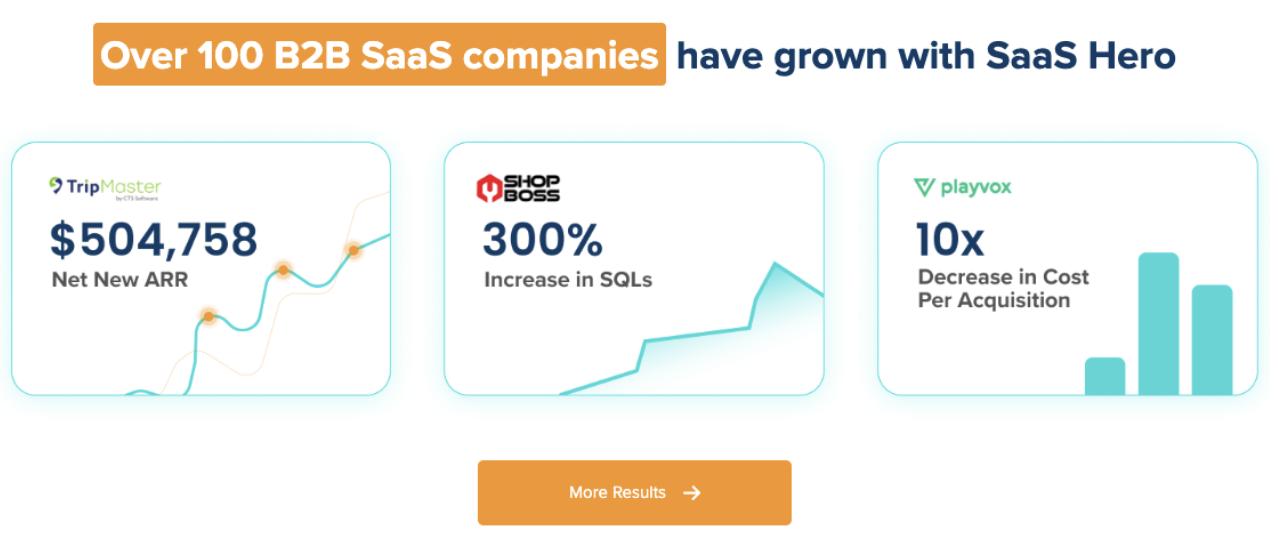
- Competitor conquesting delivered $504K net new ARR for TripMaster through tightly targeted Google Ads on high-intent competitor keywords.
- Apply these NNARR strategies with expert support. Schedule a discovery call with SaaSHero to benchmark your current growth performance.
7 Net New ARR-Focused SaaS GTM Examples That Delivered Real Growth
#1 Usage-Based Pricing Acceleration with Twilio’s Consumption Model
Usage-based pricing turns customer adoption into predictable revenue expansion. Twilio’s consumption model, which produced the results cited above, works by aligning pricing with clear customer success metrics.
Implementation Steps:
Start by identifying the core usage metrics that correlate with real value for your customers. These metrics form the foundation of your pricing structure and define how customers experience growth inside your product.
After you define those metrics, create tiered consumption brackets with volume discounts that reward higher usage. These brackets should feel intuitive to customers and make it easy for them to forecast costs as they scale.
With pricing tiers in place, implement real-time usage tracking and billing automation so customers always see what they are consuming and what they are paying. Transparent tracking reduces billing disputes and builds trust.
Finally, design clear overage alerts that notify customers before they exceed expected usage. These alerts prevent bill shock and give teams time to adjust usage or upgrade plans without frustration.
Where Usage-Based Pricing Often Fails: Teams frequently overcomplicate pricing tiers, rely on weak usage forecasting tools, or communicate overages poorly, which increases churn risk.
The table below summarizes how Twilio’s usage-based approach converts this pricing structure into concrete revenue and efficiency outcomes.
| Strategy | Example | NNARR Impact | ROI |
|---|---|---|---|
| Usage-Based | Twilio | $1B+ ARR | 5x LTV:CAC |
#2 Land-and-Expand Systematization with Atlassian’s Expansion Engine
The land-and-expand model turns existing customers into the primary source of new ARR. In companies over $50M ARR, this approach drives about 60% of new ARR from current accounts. Atlassian’s results come from disciplined expansion workflows instead of one-off upsell attempts.
Implementation Steps:
Begin by mapping clear expansion triggers based on usage patterns, team growth, and product adoption milestones. These triggers define when an account is ready for more seats, features, or products.
Once you know the triggers, build automated expansion campaigns that activate when those signals appear. These campaigns should guide customers toward seat additions or plan upgrades with helpful, timely messaging.
With expansion campaigns running, develop cross-sell playbooks for complementary products. These playbooks give sales and customer success teams a structured way to introduce adjacent solutions when accounts show relevant needs.
Round out the system with a customer health scoring model that measures expansion readiness. This score helps teams prioritize outreach and focus on accounts with the highest likelihood of positive response.
Where Land-and-Expand Often Fails: Teams push for expansion too early, operate without integrated usage data, or misalign customer success and sales, which weakens trust and slows growth.
The next strategy builds on this foundation by using the product itself as the primary driver of acquisition and expansion.
#3 Product-Led Growth Hybrid Using Slack’s Freemium Bridge
Product-led growth hybrids capture 20–40% product-market fit signals while still supporting complex enterprise deals. Slack’s freemium-to-enterprise bridge turns organic team adoption into large, contract-driven expansions.
Implementation Steps:
Start by defining freemium limits that encourage full team adoption without giving away your entire value. The free tier should showcase core use cases and create natural pressure to upgrade as usage deepens.
Next, build viral sharing features directly into the product. Simple invitations, shared channels, and collaborative workflows help users bring colleagues and external partners into the tool.
As usage grows, implement contextual upgrade prompts tied to specific behaviors, such as hitting message limits or needing advanced security. These prompts should feel like helpful guidance, not hard sells.
Finally, create clear handoff workflows from product signals to enterprise sales for large accounts. Sales teams should receive rich context on usage, champions, and pain points before outreach.
Where PLG Hybrids Often Fail: Companies give away too much value in free tiers, design weak conversion funnels, or blur the boundaries between sales and product, which confuses both teams and customers.
After establishing product-led and expansion motions, the next step is targeting high-value accounts with precision using intent data.
#4 Account-Based Marketing with Intent Data Following HubSpot’s Playbook
Intent-driven ABM increases pipeline and sales efficiency by focusing effort on accounts already in-market. This approach delivers 2.8x pipeline generation and about 20% higher sales productivity. HubSpot’s tiered ABM model segments accounts by revenue potential and buying signals.
Implementation Steps:
First, segment target accounts into strategic, scale, and programmatic tiers based on potential contract value and complexity. Each tier receives a different level of personalization and sales involvement.
Then deploy intent monitoring to track competitor research, solution evaluation, and category-level interest. These signals reveal when accounts move from awareness into active consideration.
With intent data flowing, create account-specific content and landing pages that address each segment’s priorities. Tailored messaging increases engagement and improves conversion rates across the funnel.
Finally, align sales and marketing on account scoring rules and handoff criteria. Clear definitions prevent missed opportunities and ensure that high-intent accounts receive timely outreach.
Where Intent-Led ABM Often Fails: Teams overspend on low-potential accounts, rely on weak intent data, or operate without tight sales and marketing alignment, which wastes budget and slows deals.
The first four strategies focus on pricing structures, expansion models, and targeted acquisition. The remaining three strategies shift toward tactical execution, including capturing competitor demand, improving conversion efficiency, and measuring performance with precision.
#5 Competitor Conquesting with SaaSHero and TripMaster
Competitor conquesting captures high-intent buyers who are actively comparing vendors. For TripMaster, this approach generated $504,758 in net new ARR through focused Google Ads campaigns on competitor evaluation keywords.

Implementation Steps:
Begin with detailed keyword research to create intent-based buckets such as pricing, alternatives, complaints, and reviews. These buckets reveal where prospects show the strongest replacement intent.

Use those insights to build competitor-specific landing pages that present direct feature and outcome comparisons. Clear side-by-side contrasts help prospects understand why switching creates a better result.

After your landing pages go live, implement a negative keyword strategy to filter out brand navigation searches and low-intent traffic. This step protects budgets and keeps spend focused on true evaluation queries.
Close the loop by offering switching incentives like migration support and contract buyouts. These offers reduce friction and make it easier for prospects to leave incumbent vendors.
Where Competitor Conquesting Often Fails: Teams risk trademark violations, miss the message-to-market fit, or ignore switching barriers, which limits both click quality and close rates.
#6 CRO-Heavy Paid Media for Playvox-Level Efficiency Gains
Conversion rate optimization turns existing paid traffic into more pipeline at a lower cost. For Playvox, this approach cut Cost Per Lead by 10x while increasing lead volume by 163%, creating a far more efficient paid engine.
Implementation Steps:
Start with a heuristic analysis of your current funnel to uncover conversion barriers. Review messaging clarity, visual hierarchy, page load speed, and trust signals across key pages.
Then set up structured A/B testing for landing pages and ad creative. Test one major variable at a time so you can attribute performance changes to specific elements.
Once testing is underway, refine form fields and remove friction points in the conversion path. Shorter forms, clearer microcopy, and fewer distractions usually increase completion rates.
Finally, deploy dynamic content personalization based on traffic source, campaign, or segment. Tailored headlines and offers help each visitor feel understood and increase the likelihood of conversion.
Where CRO-Heavy Paid Media Often Fails: Teams test too many variables at once, run experiments without enough traffic for valid results, or neglect mobile experiences, which undermines gains.
#7 Efficiency Dashboard Implementation Using TestGorilla’s Model
Efficiency dashboards connect marketing and sales activity directly to revenue outcomes. TestGorilla used this approach to reach an 80-day CAC payback period, which supported their $70M Series A raise. Real-time views of performance allowed the team to adjust spend quickly.
Implementation Steps:
Start by integrating CRM data with your advertising platforms so you can track closed revenue back to specific campaigns. This closed-loop attribution reveals which channels truly drive NNARR.
Next, build real-time dashboards that track CAC, LTV, payback periods, and pipeline coverage. These views give leadership a shared understanding of efficiency and growth quality.
With dashboards in place, configure automated alerts that trigger when efficiency metrics cross defined thresholds. These alerts prompt fast action when CAC rises or payback periods lengthen.
Finally, add cohort analysis to monitor long-term retention and expansion behavior. Cohort views show whether customers acquired through specific channels deliver durable value.
Where Efficiency Dashboards Often Fail: Teams rely only on last-click attribution, accept poor data quality, or lack cross-channel visibility, which leads to misleading conclusions.
The following table compares all seven strategies side by side. Use it to see how each approach performs across key efficiency metrics and to decide which frameworks best match your current stage and resources.
| Strategy | SaaS Example | Net New ARR | Burn Multiple |
|---|---|---|---|
| Usage-Based | Twilio | $1B+ | <2x |
| Land-Expand | Atlassian | 60% from expansion | <2x |
| PLG Hybrid | Slack | Viral growth | <2x |
| ABM + Intent | HubSpot | 2.8x pipeline | <2x |
| Competitor Conquest | TripMaster | $504K | 1.5x |
| CRO + Paid | Playvox | 10x efficiency | <2x |
| Efficiency Dashboard | TestGorilla | $70M raise | 80-day payback |
See how these strategies apply to your specific growth stage and market, and schedule a discovery call to build your custom NNARR implementation roadmap.

Net New ARR GTM FAQs
What is the net new ARR formula?
Net New ARR = New Customer ARR + Expansion ARR from existing customers – Churned ARR – Contracted ARR from downgrades. This formula gives the clearest view of real revenue growth because it includes every major ARR movement in a defined period.
Which GTM strategies deliver the highest NNARR for Series A companies?
Series A companies usually see the strongest NNARR impact from competitor conquesting and PLG hybrid models. These approaches keep upfront investment relatively low while capturing high-intent prospects during active evaluation. Land-and-expand becomes more powerful as the customer base grows and usage data improves.
What are common GTM mistakes that hurt net new ARR?
Major NNARR killers include chasing vanity metrics instead of closed revenue, running weak attribution that misallocates budget, neglecting customer success processes that prevent churn, and scaling spend before achieving product-market fit in target segments.
How do you measure NNARR contribution from paid channels?
Accurate NNARR measurement from paid channels requires closed-loop attribution that connects ad clicks to CRM revenue data. Track CAC payback period, LTV:CAC ratios, and cohort-based retention rates. Use UTM parameters consistently and integrate advertising platforms with your CRM to maintain reliable attribution.
What efficiency benchmarks should Series A companies target?
Series A companies should aim for CAC payback periods under 12 months, LTV:CAC ratios above 3x, and burn multiples below 2x. Net Dollar Retention above 100% signals strong expansion potential, while gross retention above 90% points to solid product-market fit.
Conclusion: Matching NNARR Strategies to Your Stage
The seven GTM strategies above provide practical frameworks for generating meaningful net new ARR in a capital-constrained 2026 environment. Usage-based pricing, land-and-expand programs, PLG hybrids, intent-led ABM, competitor conquesting, CRO-heavy paid media, and efficiency dashboards each address a different growth lever.
The optimal mix depends on your company stage and resources. If you run a bootstrapped startup with limited capital, strategies #5 (competitor conquesting) and #6 (CRO-heavy paid media) create fast impact with tight budgets. Growth-stage companies with a growing customer base should emphasize strategies #2 (land-and-expand) and #4 (ABM with intent data) to unlock expansion and focus sales on in-market accounts. Enterprise-focused organizations gain the most from strategies #1 (usage-based pricing) and #7 (efficiency dashboards), which align revenue with outcomes and keep efficiency visible.
Execution quality now matters more than novel ideas. Teams that apply these frameworks with disciplined tracking, regular iteration, and clear ownership will capture outsized market share while competitors stay stuck on vanity metrics and inefficient spend.
Start your NNARR transformation with a free strategy session where we will map your current metrics against these benchmarks and highlight your highest-leverage growth opportunities.