




Key Takeaways
- Segment customers by ACV and GTM motion (PLG for SMBs, sales-led for enterprises) to match pricing with value perception and acquisition costs.
- Adopt hybrid pricing models that combine subscriptions with usage-based charges, now used by 61% of SaaS companies for scalable revenue.
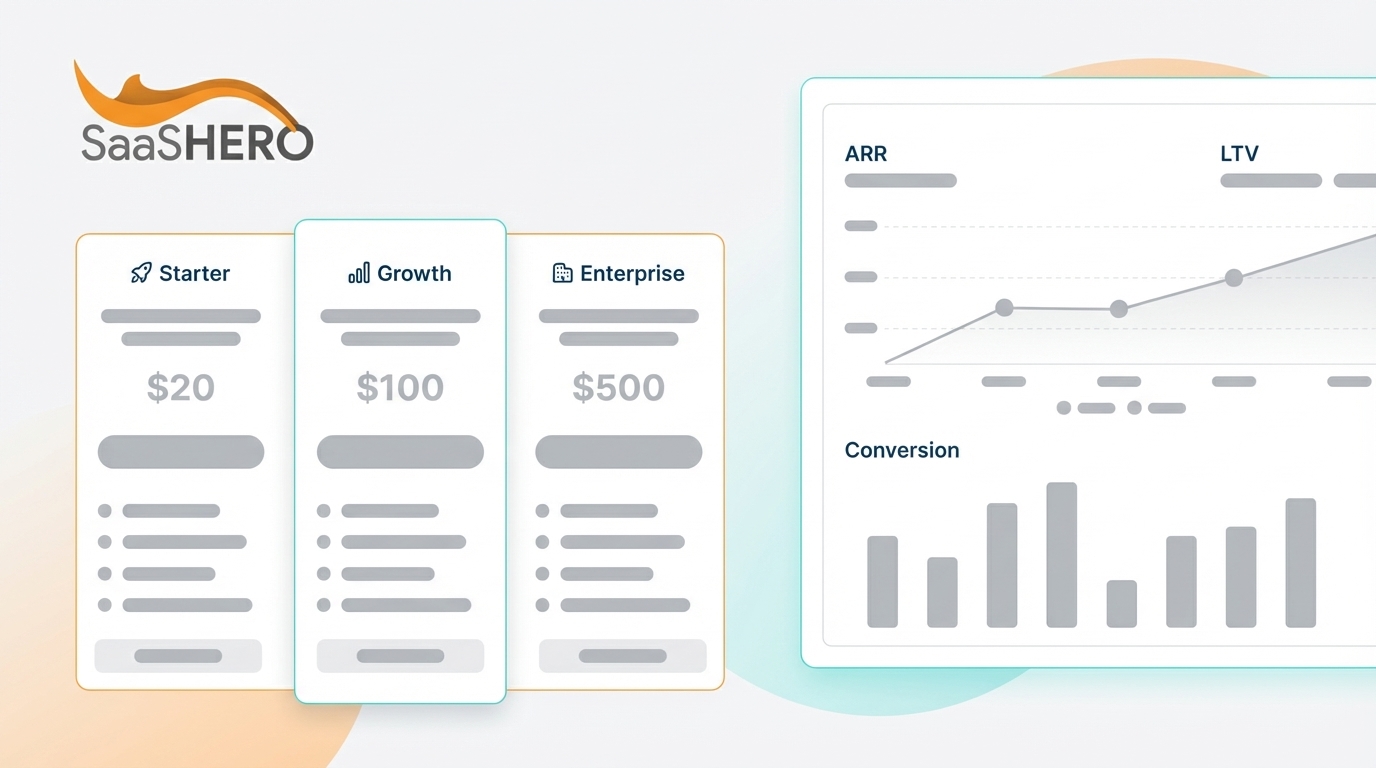
- Design 3-4 psychological pricing tiers using anchoring, with the middle tier as “most popular” to increase ARPU and conversions.
- Run A/B tests on pricing pages quarterly, achieving 12-18% conversion lifts per test and compounding gains across the year.
- Monitor metrics like ARPU, LTV, and churn post-launch, then schedule a pricing audit to uncover specific optimization opportunities in your current numbers.
Executive Summary: The SaaS GTM Pricing Framework
Successful B2B SaaS pricing in go-to-market relies on a repeatable system that balances customer value perception, competitive positioning, and revenue growth. The core framework includes:
- Customer segmentation and value mapping aligned to GTM motion
- Pricing model selection (tiered, usage-based, or hybrid)
- Psychological tier design with anchoring strategies
- A/B testing methodology for continuous improvement
- GTM alignment between PLG and sales-led approaches
Companies using this structured approach see 18-23% higher net revenue retention with usage-based pricing and 12-18% conversion improvements per pricing page test.
7 Steps to Optimize B2B SaaS Pricing in Go-to-Market
Step 1: Segment Customers and Map Value for GTM Alignment
Effective B2B SaaS pricing starts with clear customer segments and a view of their willingness to pay. Different GTM motions require different pricing approaches based on acquisition costs and sales complexity. The table below shows how ACV ranges guide the GTM motion and pricing approach that work best for each segment.
|
Customer Segment |
ACV Range |
GTM Motion |
Pricing Approach |
|
SMB/Startup |
<$5,000 |
PLG/Self-Serve |
Transparent, simple tiers |
|
Mid-Market |
$5,000-$50,000 |
Hybrid PLG/Sales |
Flexible, scalable pricing |
|
Enterprise |
$50,000+ |
Sales-Led |
Custom, value-based |
Map each segment’s core value drivers, pain points, and budget constraints. SMB customers prioritize cost predictability and self-service, while enterprise buyers focus on ROI, security, and customization. This segmentation shapes your pricing tiers and your go-to-market messaging.
Step 2: Choose Your Pricing Model for Maximum GTM Impact
The pricing model you select must match your go-to-market strategy and customer usage patterns. 61% of SaaS companies now use hybrid models combining subscriptions with usage-based charges, which reflects a strong shift toward value-aligned pricing.
Use the comparison below to match your GTM motion with the pricing model that balances revenue predictability with value alignment.
|
Pricing Model |
Best GTM Fit |
Pros |
Cons |
|
Tiered Subscription |
PLG with clear feature differentiation |
Predictable revenue, easy to understand |
May not scale with customer value |
|
Usage-Based |
High-volume, variable usage patterns |
Scales with customer success |
Revenue unpredictability |
|
Hybrid |
Most B2B SaaS scenarios |
Combines predictability with scalability |
More complex to implement |
Usage-based pricing delivers 34% faster land-and-expand motion and shows 2.1x better correlation between price and perceived value. For AI-enhanced products, 73% of SaaS vendors charge extra for AI capabilities at 60-70% premiums.
Step 3: Design Psychological Pricing Tiers
Strong tier design uses behavioral psychology to guide customers toward your target tier and increase revenue per account. The most effective structures usually include 3-4 tiers with clear value differences.
Use anchoring by labeling your target tier as the “most popular” or “recommended” option. The highest tier acts as an anchor that makes the middle tier feel more reasonable, while the lowest tier captures price-sensitive customers who might otherwise churn.
Once you have this tier structure in place, the next decision is how to differentiate features across tiers. Feature differentiation should focus on outcomes rather than capabilities. Instead of “10 integrations vs. 50 integrations,” frame it as “Essential workflows vs. Advanced automation.” This framing helps customers understand value instead of counting features.
Step 4: Build High-Converting Pricing Pages
Your pricing page often becomes the highest-traffic page on your site and the main conversion point for PLG motions. Optimize for clarity, trust, and action by creating a conversion flow that moves visitors from understanding value to taking action.
- Clear value proposition in the hero section explains why your product matters.
- Prominent social proof (customer logos, G2 badges) validates your claims and builds credibility.
- Feature comparison table with outcome-focused descriptions helps prospects choose the right tier.
- Strong, action-oriented CTAs for each tier turn interest into signups.
- Trust signals (security badges, testimonials) remove final objections before purchase.
Ensure full mobile responsiveness, because B2B research often starts on mobile even when purchases close on desktop.

Step 5: Implement A/B Testing Framework
Systematic A/B testing drives ongoing pricing improvements. As mentioned in the framework overview, structured testing delivers those 12-18% conversion lifts per pricing page test, and 5-6 tests per year can compound to 40-60% annual conversion growth.
Prioritize these high-impact variables:
- Pricing structure (tiered vs. usage-based)
- Recommended tier positioning
- CTA button colors and copy
- Feature descriptions (outcome vs. feature-focused)
- Trial length and terms
Run tests for at least 2-4 weeks to reach statistical significance. Document every result and update your highest-traffic pricing elements each quarter.
Step 6: Align Pricing with Your GTM Motion
Your pricing strategy must fit cleanly into your go-to-market approach. PLG motions need transparent, self-serve pricing with clear upgrade paths, while sales-led motions benefit from flexible, negotiable structures.
For PLG strategies, focus on trial-to-paid conversion, with shorter trials (≤7 days) increasing conversion 2.7x. Sales-led motions should emphasize value-based pricing conversations and custom enterprise tiers.
Hybrid approaches require tight coordination between self-serve and sales-assisted buying paths, often triggered by usage thresholds or feature needs. Once your pricing structure aligns with your GTM motion, the final step is to set up systems that track performance and guide future iterations.
Step 7: Launch, Monitor, and Optimize
Post-launch monitoring keeps your pricing strategy healthy. Track a focused set of metrics that reveal acquisition efficiency, customer value, and retention quality.
- Conversion rates by tier and traffic source show how well each segment converts.
- Average revenue per user (ARPU) trends reveal whether customers move into higher-value tiers.
- Customer lifetime value (LTV) by pricing tier highlights which tiers create durable revenue.
- Churn rates and reasons expose pricing or value gaps.
- Upgrade and downgrade patterns indicate whether customers outgrow tiers or feel overcharged.
Set automated alerts for sharp changes in conversion or pricing page performance. Review pricing performance monthly and run major optimization cycles each quarter.
B2B SaaS GTM Pricing Examples and Case Studies
The seven-step framework above produces measurable results when teams apply it consistently. The examples below show how companies used these pricing and conversion principles to grow ARR and strengthen unit economics.
A transportation software company generated $504,758 in net new ARR through SaaSHero’s paid search, paid social, and CRO strategies. These initiatives included competitor conquesting and landing page updates that aligned pricing and messaging with customer value perception.

An HR tech startup partnered with SaaSHero and achieved an 80-day payback period, which supported their $70M Series A funding round. Their improved marketing efficiency and pricing clarity demonstrated strong unit economics to investors.
These examples highlight how aligned pricing, GTM strategy, and conversion optimization support both revenue growth and fundraising outcomes. Request a growth and pricing review to see how similar changes could affect your ARR and funding potential.

Common Founder Pricing Mistakes to Avoid
Many B2B SaaS founders repeat the same pricing mistakes during GTM phases.
- Over-discounting: Heavy discounts erode margins and create bad expectations. 68% of companies discount in fewer than 25% of deals, which protects pricing integrity.
- Vanity tier proliferation: Too many tiers create decision paralysis. Stick with 3-4 clear options that each have a distinct value story.
- Ignoring the dark funnel: Buyers research extensively before talking to sales. Make sure pricing transparency supports this independent research.
- Copying competitors blindly: While 24% of SaaS organizations copy competitor pricing, value-based approaches usually perform better.
Avoid these pitfalls by centering on customer value, keeping pricing discipline, and testing changes instead of guessing.
Frequently Asked Questions
How should PLG companies price differently than sales-led SaaS?
PLG companies need transparent, self-serve pricing with clear value differences between tiers. Focus on simple, predictable pricing that customers can understand and purchase without sales help. Sales-led companies can use more complex, value-based pricing with custom enterprise tiers and negotiable elements. PLG pricing must be immediately clear and actionable, while sales-led pricing can be more consultative and flexible.
What are the 2026 benchmarks for usage-based pricing in B2B SaaS?
Usage-based pricing models continue to show strong performance in 2026. The benchmarks discussed in Step 2 still hold, with usage-based models outperforming traditional subscriptions on net revenue retention, expansion speed, and value perception. However, pure usage-based models can create revenue volatility, which is why 61% of companies now adopt hybrid models that combine base subscriptions with usage charges.
Which A/B testing tools work best for SaaS pricing optimization?
Effective SaaS pricing tests require tools that handle complex scenarios and integrate with your stack. Popular options include Optimizely for advanced testing, VWO for conversion-focused experiments, and Google Optimize for basic tests. Choose a platform that can segment users, track revenue impact instead of only conversion rates, and connect with your CRM to measure long-term value. Run tests for at least 2-4 weeks and change one variable at a time for clean attribution.
How often should B2B SaaS companies adjust their pricing?
B2B SaaS companies should review pricing every quarter but make major structural changes yearly or every two years. Smaller tweaks like CTA copy or feature descriptions can run continuously, while shifts to pricing models or tier architecture need planning and clear customer communication. Price increases work best when tied to visible product improvements, with existing customers getting advance notice and thoughtful grandfathering. Current benchmarks show companies implementing 8-12% annual price increases when they connect them to added value.
What’s the optimal number of pricing tiers for B2B SaaS GTM?
The optimal number of pricing tiers for B2B SaaS usually falls between three and four. This range offers enough choice without overwhelming buyers. A strong structure includes a basic tier for price-sensitive customers, a “most popular” middle tier that captures most accounts, and a premium tier that anchors pricing while serving high-value users. Some companies add a fourth enterprise tier for custom deals. More than four tiers often reduce conversion by creating confusion.
Execute Your Pricing Strategy with Expert Support
Winning B2B SaaS pricing in go-to-market comes from disciplined execution of these seven steps: customer segmentation, model selection, tier design, pricing page design, A/B testing, GTM alignment, and continuous monitoring. Companies that master this framework see higher conversion rates, stronger ARPU, and faster overall growth.
Execution quality and ongoing optimization usually separate pricing leaders from everyone else. Partner with specialists who understand B2B SaaS pricing psychology, testing methods, and market dynamics. Get your pricing strategy audit to uncover the 12-18% conversion improvements your competitors already capture through systematic optimization.