




Key Takeaways
- Performance-based pricing replaces flat retainers with outcome-based models like CPA ($200-$800/SQL), CPL ($50-$300/MQL), revenue share (5-15% ARR), and hybrids that align fees with results.
- Hybrid structures balance agency cash flow with client risk reduction and outperform percentage-of-spend models that reward higher ad budgets instead of better outcomes.
- Key benefits include capital-efficient growth, fast payback periods around 80 days, and ROI up to 650% as shown in SaaSHero case studies generating over $500k in Net New ARR.
- Effective rollout depends on reliable attribution, clear performance definitions, flexible month-to-month contracts, and weekly reporting that filters out unqualified leads.
- SaaSHero’s tiered flat retainers ($1,250-$7,000/month) keep costs predictable while supporting revenue growth; schedule a discovery call with SaaSHero to improve your marketing ROI.
Core Performance-Based Pricing Models for B2B SaaS
B2B SaaS teams use several performance-focused pricing structures, each matching different goals, risk levels, and growth stages. Clear understanding of these options helps leaders choose a model that fits their runway, sales cycle, and revenue targets.
Cost Per Acquisition (CPA) models tie agency fees to closed customers or qualified opportunities. Typical B2B SaaS CPA ranges from $200-$800 per SQL depending on deal size and sales cycle complexity. This structure aligns tightly with revenue outcomes and demands accurate, end-to-end attribution.
Cost Per Lead (CPL) structures pay agencies based on lead volume, usually $50-$300 per marketing qualified lead. Performance-based pricing ties fees to results like leads or sales, using structures such as base fee + performance bonus or pure performance. CPL works best when your lead-to-customer conversion rate is stable and well documented.
Revenue Share arrangements typically allocate 5-15% of generated ARR to the agency. This structure rewards long-term growth but can strain agency cash flow and often requires detailed legal language around attribution windows and renewal credit.
Hybrid Base + Performance models blend a predictable monthly retainer with outcome-based bonuses. Hybrid models for B2B appointment setting combine base fees ($2,000–$4,000/month) with performance bonuses ($150–$400 per qualified meeting). This mix supports agency stability while still rewarding measurable results.
SaaSHero uses a tiered flat monthly retainer model based on ad spend bands and channel count, with fees ranging from $1,250-$7,000. This fixed-fee structure removes percentage-of-spend conflicts and keeps costs predictable as campaigns scale. The table below shows how fees increase in clear steps across spend levels and channel combinations.
| Monthly Ad Spend | 1 Channel (Month-to-Month) | 2 Channels | 3+ Channels |
|---|---|---|---|
| Up to $10k | $1,250 | $2,500 | $3,750 |
| $10k – $25k | $1,750 | $3,000 | $4,250 |
| $25k – $50k | $2,250 | $3,500 | $4,750 |
| $50k+ | $3,250 | $4,500 | $5,750 |
Benefits and Tradeoffs of Performance Pricing
Performance-focused pricing gives B2B SaaS companies a more capital-efficient way to grow. Performance-based pricing aligns agency incentives with client success and lowers upfront risk for clients. This alignment pushes agencies toward high-converting channels and qualified pipeline instead of vanity metrics.
Risk reduction matters most for early-stage SaaS teams with tight budgets. Traditional retainers require large upfront bets with uncertain outcomes. Performance structures shift more risk to agencies that can prove results and manage complex attribution.
Implementation still presents challenges. Performance pricing is not suitable for all services like branding with less tangible results and requires accurate attribution tracking, with agencies potentially cherry-picking easy wins. Attribution in B2B SaaS often spans 3-12 month sales cycles and many touchpoints, so teams need strong CRM integration and multi-touch models.
The comparison below highlights how each model balances incentive alignment, predictability, and complexity so you can match structure to your internal capabilities.
| Model | Alignment Score | Predictability | Implementation Complexity |
|---|---|---|---|
| CPA | High | Low | High |
| CPL | Medium | Medium | Medium |
| Hybrid | High | High | Medium |
| Revenue Share | Very High | Low | Very High |
AI-driven attribution tools and dynamic pricing engines now reduce many of these hurdles. 2026 sees pricing architecture as the competitive weapon in B2B SaaS, shifting from static price pages to dynamic, model-driven systems that learn and adapt.
Rolling Out Performance-Based Pricing Step by Step
Teams that succeed with performance pricing follow a clear sequence, from data foundations to reporting. The steps below build on each other so pricing, tracking, and expectations stay aligned.
1. Audit Attribution Infrastructure – Performance-linked fees require trustworthy data that connects ad clicks to revenue. Start by implementing full tracking from ad click (GCLID) through CRM conversion. Confirm that HubSpot, Salesforce, or similar platforms capture the complete journey with correct UTM parameters and mapped form fields.
2. Define Performance Metrics – Once tracking works, align on what counts as success. Establish clear definitions for Marketing Qualified Leads (MQLs), Sales Qualified Leads (SQLs), and closed-won revenue. Document lead scoring rules, qualification thresholds, and attribution windows, often 30-90 days for B2B SaaS.
3. Structure Hybrid Agreements – With metrics defined, move to contract design. Start with hybrid models that combine base retainers ($2,000-$4,000) with performance bonuses ($200-$400 per SQL). This structure supports agency cash flow while keeping both sides focused on outcomes.
4. Implement Month-to-Month Contracts – After agreement structure, set terms that keep pressure on performance. Favor month-to-month contracts instead of long lock-ins. Short terms create ongoing accountability and allow quick adjustments as data comes in.
5. Establish Weekly Reporting Cadence – Finally, build a rhythm for review. Use real-time dashboards to show pipeline movement, cost per lead trends, and revenue attribution. Weekly check-ins enable fast course corrections and maintain transparency.
Sample contract language: “Agency fee structure: $3,000 base monthly retainer + $250 per Sales Qualified Lead (SQL) as defined by client’s lead scoring criteria. SQLs must meet minimum qualification standards: budget confirmed, decision-maker identified, timeline established within 90 days.”
Ready to audit your attribution setup and design a performance-aligned framework? Schedule a discovery call to get started.
Real-World Examples of Performance Pricing Results
SaaSHero case studies show how outcome-focused pricing and execution translate into revenue, efficiency gains, and fundraising milestones. These examples highlight consistent patterns across different B2B SaaS verticals.
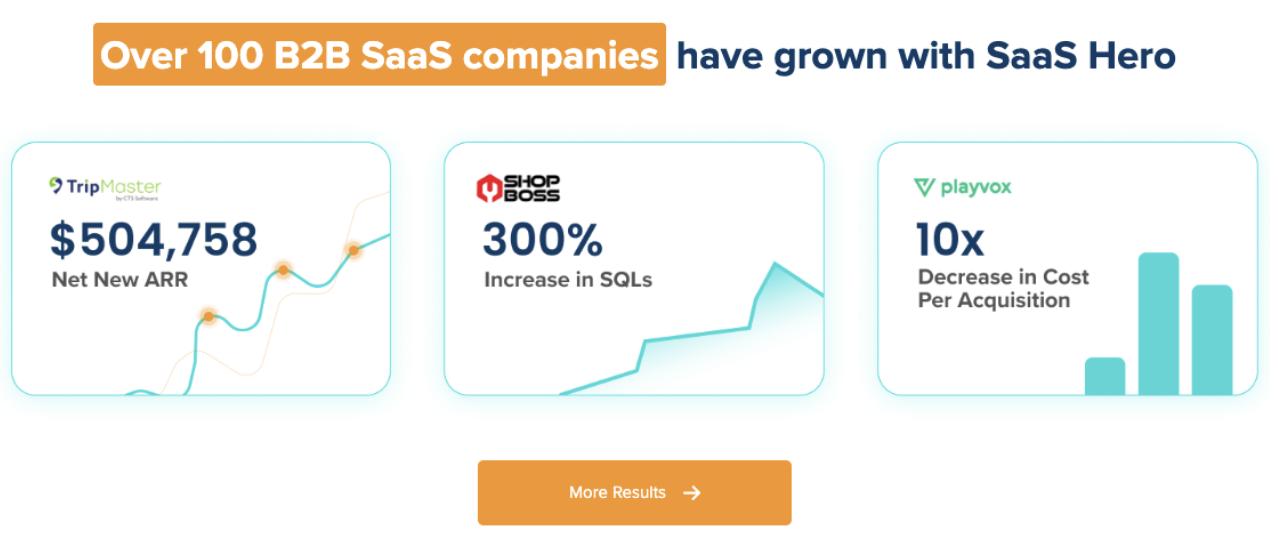
TripMaster (Transit Software) generated $504,758 in Net New ARR through SaaSHero’s hybrid retainer model, delivering 650% ROI with a 20% conversion rate from paid search. At standard SaaS valuation multiples, this performance represents roughly $2.5-5M in enterprise value.

TestGorilla (HR Tech) used performance-focused campaigns to reach an 80-day payback period while adding 5,000+ new customers. This efficiency metric supported their $70M Series A by proving strong unit economics.
Playvox (CX Software) saw a 10x decrease in Cost Per Lead after account restructuring and negative keyword refinement, while lead volume increased 163%. This combination of lower cost and higher scale reflects the core promise of performance-driven work.
| Client | Primary Outcome | ROI/Efficiency Gain | Strategic Impact |
|---|---|---|---|
| TripMaster | $504k Net New ARR | 650% ROI | Revenue acceleration |
| TestGorilla | 5,000+ customers | 80-day payback | $70M Series A |
| Playvox | 163% lead increase | 10x lower CPL | Cost optimization |
| Leasecake | Record growth | Market expansion | $3M VC round |
These outcomes differ sharply from percentage-of-spend models that reward higher budgets instead of better performance. SaaSHero’s flat retainers remove incentives to inflate spend and keep attention on conversion rates and qualified pipeline.
Across these examples, performance-aligned pricing works best when paired with deep B2B SaaS expertise, reliable attribution, and month-to-month accountability that sustains continuous improvement.
Common Pitfalls and Matching Customer Scenarios
Most performance-pricing failures trace back to data issues and misaligned incentives. Common implementation pitfalls stem from three connected challenges around attribution, lead quality, and baselines.
First, weak attribution systems fail to link marketing activity to closed revenue, which creates disputes over who deserves credit. This gap often fuels the second pitfall: unqualified lead volume, where agencies chase cheap form fills because lead scoring is missing or ignored.
Finally, baseline performance data often does not exist or remains incomplete. Companies without history struggle to set realistic CPA or CPL targets. Pure ‘pay only for rankings’ models are rare due to problematic incentives like focusing on low-value keywords and external factors.
These pitfalls show up differently depending on company stage and team capacity. The scenarios below illustrate how performance pricing can address specific pain points in real situations.
Overwhelmed Founder Scenario – A CEO running a $500k ARR SaaS product and managing Google Ads on weekends gains leverage from the $1,250 dedicated campaign manager tier. This support delivers professional optimization without a large budget increase.
Frustrated VP Scenario – A Series B marketing leader with a $50k monthly budget and vanity-metric reports benefits from the $4,500 full marketing team. This setup provides pipeline-focused analytics and ROI documentation suitable for board updates.
Post-Funding Scaler Scenario – A Series A startup with aggressive quarterly targets uses multi-channel performance campaigns to scale quickly while maintaining an 80-day payback that keeps investors confident.
Not sure which scenario fits your situation? Let’s discuss your growth stage and find the right pricing approach—schedule a discovery call.
Conclusion: Moving Toward Performance-Aligned Growth
Outcome-based pricing structures give B2B SaaS companies a path to lower risk, tighter alignment, and more efficient use of capital than traditional retainers. Average ROI from affiliate partnerships reaches $15 for every $1 spent, demonstrating high returns for performance marketing strategies.
Hybrid models that mix base retainers with performance bonuses often strike the best balance between agency stability and client protection. SaaSHero’s proven track record, including the TripMaster results detailed above, shows how specialized, performance-aligned partnerships can compound revenue growth.

AI-driven attribution and dynamic pricing will keep improving these models by enabling real-time optimization and clearer ROI measurement. B2B SaaS teams that adopt these frameworks now position themselves for durable, capital-efficient growth in a crowded market.
Ready to explore a performance-aligned partnership for your own pipeline goals? Schedule a discovery call and map out your path to measurable revenue growth.
Frequently Asked Questions
Should I choose hybrid or pure performance-based pricing for my B2B SaaS marketing?
Hybrid models that combine base retainers with performance bonuses usually provide the most practical balance for B2B SaaS teams. Pure performance structures can strain agency cash flow and push short-term tactics over durable growth. SaaSHero’s tiered flat retainers keep costs predictable while still aligning outcomes through transparent fees that scale with ad spend instead of percentages.
What does SaaSHero’s performance-aligned pricing look like in practice?
SaaSHero uses clear tiered flat retainers based on monthly ad spend bands. Companies spending up to $10k per month pay $1,250 for single-channel management, $2,500 for two channels, or $3,750 for three or more channels. This fixed-fee structure removes percentage-of-spend conflicts and keeps scaling costs predictable. Month-to-month terms maintain accountability without long commitments.
What performance-based pricing trends should I expect in 2026?
AI-driven dynamic pricing and credit-based models continue to gain traction. Better attribution technology supports more advanced multi-touch tracking, while hybrid pricing adoption grows beyond the current 61% rate. Expect stronger emphasis on outcome metrics like pipeline value and Net New ARR instead of impressions or clicks.
How effective are CPA and CPL models specifically for B2B SaaS marketing?
CPA and CPL structures perform well in B2B SaaS when backed by solid attribution. Typical CPL ranges from $50-$300 per marketing qualified lead, and CPA models often charge $200-$800 per closed customer depending on deal size. These models require tight CRM integration and clear qualification rules to avoid disputes and keep focus on lead quality, not just volume.
Which types of marketing agencies benefit most from performance-based pricing?
Performance-based pricing suits agencies that specialize in measurable work such as lead generation, PPC, and conversion rate improvements. Teams with strong attribution, vertical expertise, and a history of results can confidently use these models. Generalist or brand-only agencies usually struggle with performance structures because outcomes are harder to attribute.
What are the main risks of revenue share agreements with marketing agencies?
Revenue share agreements create income volatility for both sides and require detailed contracts covering attribution windows, commission rules, and termination terms. Complexity increases when many channels contribute to each deal, and agencies may favor short-term revenue over long-term brand health. Hybrid models with a base retainer plus performance bonuses often provide a more balanced risk profile than pure revenue share.