




Written by: Aaron Rovner, Founder, Saas Hero | Last updated: August 12, 2026
Key Takeaways for B2B SaaS Leaders
- Capital markets are tighter in 2026, so CAC, payback period, and unit economics now drive board decisions on agencies versus in-house teams.
- Traditional retainers often use percentage-of-spend billing and long contracts that inflate CAC and create lock-in risk, while flat-fee, month-to-month partners align incentives with net-new ARR.
- Outsourcing can deliver qualified pipeline in 2–4 weeks versus the 4–6 month ramp required for an in-house SDR hire, which shortens payback periods for Series A and B companies.
- Data ownership, brand control, and vanity-metric reporting remain key risks with generalist agencies; performance-aligned partners that integrate CRM tracking and report on SQLs and pipeline value reduce those risks.
- Companies ready to audit their current CAC and payback metrics can schedule a unit-economics modeling session with SaaSHero to identify the right engagement structure.
Executive Summary: How CAC, Payback, and Net-New ARR Shape Your Choice
Series A and B B2B SaaS companies usually face three structural options for lead generation: a traditional retainer agency, an in-house SDR and demand-gen team, or a performance-aligned partner on flat-fee, month-to-month terms. Each option creates a different CAC profile, payback trajectory, and net-new ARR risk exposure.
LinkedOtter’s June 2026 analysis covers the 205% surge in GTM engineer job postings and pay ranges of $132K–$241K, but not the fully loaded cost of an in-house demand-gen team. An in-house demand-gen team requires a minimum of six months to produce reliable pipeline. A traditional agency retainer for quality B2B lead generation in 2026 can vary significantly, and percentage-of-spend billing models create incentive misalignment that inflates effective CAC. A flat-fee, month-to-month partner decouples fee from spend volume, anchors reporting to net-new ARR, and eliminates lock-in risk, which is the structure SaaSHero uses across its tiered retainer model.
Side-by-Side Comparison: Traditional Agency vs. Performance-Aligned Partner
The table below highlights seven structural differences that directly affect CAC, payback period, and lock-in risk. Pay close attention to how pricing model and contract structure compound through the unit-economics column, because that pattern will shape the impact of any engagement on your own numbers.
| Dimension | Traditional Lead-Gen Agency | SaaSHero (Performance-Aligned Partner) | Unit-Economics Impact |
|---|---|---|---|
| Pricing model | Traditional B2B lead-gen agencies commonly use monthly retainers ($2,500–$20,000/mo), pay-per-lead, pay-per-appointment, or hybrid models | Flat monthly retainer from $1,250/mo (up to $10k spend, 1 channel) | Flat fee removes incentive to inflate spend, so CAC calculation stays clean. |
| Contract structure | Annual contracts standard, no monthly exit option | Month-to-month, agency re-earns the relationship every 30 days | Lock-in risk drops, and more payback-period risk stays with the agency. |
| Time to first pipeline | Traditional B2B demand generation agencies take an average of 4.7 months post-onboarding to deliver the first qualified opportunity | Campaigns live within weeks, with competitor conquest pages deployed rapidly | Faster time-to-pipeline compresses payback period compared with in-house. |
| Primary reporting metrics | Impressions, CTR, MQL volume | Net-new ARR, pipeline value, SQLs tied to CRM (HubSpot/Salesforce) | Revenue-anchored reporting enables accurate CAC and LTV:CAC tracking. |
| Data and domain ownership | Prospect lists and sender domains often stay with the agency on exit | Client retains all data, CRM records, and campaign assets | Brand deliverability stays protected, and restart CAC on exit disappears. |
| Specialization | Generalist across verticals (e-commerce, local, SaaS) | B2B SaaS and technology exclusively (HR Tech, Cybersecurity, MarTech, etc.) | Vertical depth shortens messaging ramp time and improves SQL rate. |
| Team structure | Senior sales, junior execution, SDR turnover creates quality variance | Senior-led, max 8–10 clients per manager, dedicated Slack channel | Consistent execution quality stabilizes CPL and SQL conversion rates. |
Map your CAC and payback metrics against SaaSHero’s flat-fee model in a 30-minute discovery session.
Time Savings vs. Ramp-Up Time and Internal Bandwidth
Outsourcing usually wins on speed to first pipeline. Outsourced lead generation delivers first qualified meetings in 2–4 weeks, while an in-house SDR hire requires 4–6 months to reach full productivity. For a Series A company with a 12-month board mandate to hit ARR targets, that four-month gap creates a material payback-period risk.

Speed varies by agency type and maturity. Managed lead-gen programs typically complete onboarding, ICP definition, messaging, and infrastructure setup in 2–4 weeks before first meetings appear. The ramp timeline should sit in a written SLA, not as a verbal estimate. Well-run outsourced programs can generate significant qualified meetings for a B2B client in 60 days, often beating what a demand-gen hire produces in the first six months, but that outcome requires existing infrastructure and B2B SaaS-specific playbooks, not a generalist firm.
Internal bandwidth remains the hidden cost on the other side of the ledger. Outsourcing shifts rather than removes management burden, because vendor governance, ICP alignment, and qualification-criteria oversight still require internal time. Companies without a dedicated revenue operations owner to manage the relationship consistently underperform against their agency SLA.
Instant Expertise vs. Brand Control and Data Ownership Risks
Specialist agencies bring pattern recognition from dozens of similar ICP campaigns. Outbound agencies provide cross-category pattern recognition that in-house SDRs develop only as single-company perspective over years. For a Series A company entering a new vertical or geography, that institutional knowledge shortens the path to a working outbound playbook.

Brand control becomes the main trade-off. Agency-led lead generation makes it harder to maintain brand consistency because external teams lack intimate knowledge of the company’s brand and target clients. Generalist agencies often rely on templated messaging sequences across clients. Agencies without deep SaaS product knowledge default to generic messaging, which creates brand control and credibility risks with sophisticated buyers.
Data ownership introduces a compounding risk. B2B tech buyers should confirm in writing who owns sender domains and prospect data, and what happens to lists if the relationship ends. Agencies that use lookalike sending domains instead of the client’s own domain risk damaging brand perception and deliverability when prospects discover the mismatch. SaaSHero’s model keeps all campaign assets, CRM data, and tracking infrastructure with the client, which creates structural protection that traditional agencies rarely offer without negotiation.
Scalability vs. Financial Risk and Vanity-Metric Reporting
Agencies provide scope flexibility that in-house teams cannot match on short timelines. Agencies provide month-to-month scope flexibility with no headcount risk, whereas scaling an in-house SDR team requires full recruiting cycles that add months of delay. For a company moving from $10k to $50k in monthly ad spend after a funding event, an agency with tiered pricing can absorb that scale without a new hire.
Financial risk in traditional agency models concentrates in billing structure and reporting integrity. Percentage-of-spend billing creates a direct incentive to recommend higher budgets regardless of efficiency. CPL-to-CPSQL multipliers vary significantly by channel, so raw CPL figures on an agency dashboard can hide a cost-per-SQL that exceeds the unit-economic ceiling for the product’s ACV. Cost per SQL should be evaluated as a percentage of ACV. Agencies that report on impressions and CTR instead of CPSQL and pipeline value prevent that calculation.
Audit your reporting stack to identify whether your agency is delivering pipeline or vanity metrics, then schedule a discovery session to walk through your current dashboard.
Maturity and Readiness Checklist for Outsourcing
Specific conditions signal readiness to outsource lead generation at Series A or B. A company meeting fewer than four of these criteria should close the gaps before signing an agency agreement, because outsourcing amplifies existing process failures rather than fixing them.
- Founder-led deal validation: Ten to twenty deals closed founder-led with a documented reason-for-purchase before handing the motion to an external team.
- Defined ICP: Industry, company size, and buying titles are documented and agreed internally, and a shared written definition of a qualified lead covering firmographic fit, persona fit, and intent signals exists.
- ACV threshold: ACV is high enough that closed deals can cover the retainer cost within an acceptable payback window.
- CRM and process maturity: HubSpot or Salesforce is configured to receive and track leads from campaign source through to closed-won revenue.
- Internal governance bandwidth: At least one internal owner, such as a VP of Revenue, Head of Marketing, or RevOps, has capacity to manage the vendor relationship and review output weekly.
- Pipeline urgency: Pipeline is needed in 60 days rather than 6 months, which makes the 3–5 month in-house SDR ramp economically unacceptable.
- Non-niche ICP: The target buyer is not so technically specialized that shallow AI-researched outreach is easily identified and dismissed by prospects.
Three Team Archetypes: When Each Model Wins
The build-versus-buy decision shifts with ARR stage, pipeline urgency, and internal capability. Three archetypes cover most Series A and B situations.
- The Post-Funding Scaler ($5M–$15M ARR, fresh capital): This company faces aggressive ARR targets, limited time to hire a full demand-gen team, and a proven ICP. For most B2B companies under $20M ARR, outsourcing demand gen has a clear ROI advantage over building in-house until the pipeline motion is well-defined and repeatable. A flat-fee, month-to-month partner with B2B SaaS specialization, deploying competitor conquest campaigns and CRM-integrated tracking from week one, compresses the timeline discussed earlier to an 80-day payback period. SaaSHero’s TestGorilla engagement produced that outcome and contributed to a $70M Series A raise.
- The Frustrated Migrator ($10M–$30M ARR, existing agency underperforming): This company sees reports full of impressions and CTR while the board asks about CAC and pipeline. The fix is not a larger retainer, but a structural change to flat-fee billing, revenue-anchored reporting, and senior-led execution. A healthy B2B lead generation programme shows sales acceptance above 50% and pipeline created at three to five times retainer cost on a rolling six-month basis. If those thresholds are not met, the agency model, not the budget, is the problem.
- The In-House Builder ($25M–$30M ARR, validated playbook): Building an in-house demand-gen team can make economic sense once ARR reaches the low millions and pipeline channels are proven, with dedicated sub-teams typically appearing above ~£25M ARR. Below that threshold, the high Year 1 fixed costs and the multi-month ramp discussed earlier create a payback-period risk that outsourcing eliminates. Companies approaching that ARR level can use a performance-aligned partner to document the playbook before transitioning it in-house.
Identify your current archetype and build a unit-economics model for the engagement structure that fits your stage.
Frequently Asked Questions
What is a realistic CAC payback period when outsourcing lead generation to a B2B SaaS agency?
Payback period depends on ACV, gross margin, and the efficiency of the agency’s channel mix, not the agency relationship alone. Similar benchmarks and LTV:CAC targets are reported by Optifai and Mowsix. The benchmarks outlined earlier in this article provide the reference points for evaluating whether your current payback period is competitive. An agency that reports on impressions and MQL volume rather than net-new ARR and cost per SQL makes it structurally impossible to calculate payback period accurately. The prerequisite for a reliable payback calculation is CRM integration that connects ad spend to closed-won revenue, which SaaSHero builds into every engagement from day one.
How does a flat-fee agency model affect CAC compared to a percentage-of-spend model?
A percentage-of-spend model creates a direct financial incentive for the agency to recommend higher spend regardless of efficiency. If an agency earns more when you spend more, every budget recommendation becomes structurally suspect. A flat-fee model decouples the agency’s revenue from your ad spend, so a recommendation to increase budget from $20,000 to $35,000 is driven by campaign data rather than agency economics. That structural alignment becomes the most important variable in producing a trustworthy CAC figure, because it keeps the denominator in your CAC calculation from being inflated by misaligned incentives.
What data and assets should a B2B SaaS company own when an agency engagement ends?
A company should retain full ownership of several asset categories before signing any agency agreement. These include all prospect and contact lists built during the engagement, all sender domains used for outreach, all CRM records and pipeline data, all ad account access and historical performance data, all landing pages and creative assets produced under the retainer, and all campaign playbooks and SOPs. Agencies that retain prospect lists or sender domains on exit create a restart CAC, which is the cost of rebuilding the pipeline infrastructure from zero, and that cost rarely appears in the original retainer comparison. SaaSHero’s model keeps every asset with the client by design, so the institutional knowledge built during the engagement remains with the company regardless of whether the relationship continues.
At what ARR stage does it make sense to build lead generation in-house instead of outsourcing?
The threshold discussed earlier, around £25M ARR, marks the point where in-house economics typically improve once the pipeline motion is validated, the ICP is documented, and the outbound playbook is repeatable enough to hand to internal hires without a long discovery phase. Below that threshold, the high Year 1 cost and minimum six-month ramp before reliable pipeline output create a payback-period risk that outsourcing eliminates. For most Series A and B companies in the $5M–$30M ARR range, outsourcing to a performance-aligned partner delivers faster time-to-pipeline, lower fixed-cost exposure, and a cleaner CAC calculation than an in-house build during the first 18 months.
What metrics should a B2B SaaS company require from a lead generation agency in 2026?
The minimum reporting standard for a B2B SaaS lead generation agency in 2026 covers six metrics. These are net-new ARR attributed to agency-sourced pipeline, cost per SQL (not cost per lead), sales acceptance rate on agency-sourced meetings (using the 50% threshold established earlier), pipeline value created as a multiple of retainer cost (target 3–5x on a rolling six-month basis), CAC by channel, and payback period by cohort. Any agency that cannot produce these figures, because it lacks CRM integration or reports only on ad-platform metrics, is structurally incapable of demonstrating its impact on unit economics. Vanity metrics like impressions, CTR, and raw MQL volume are not substitutes for these figures and should not appear as primary KPIs in any agency reporting cadence.
Next Steps: Run a Budget and Capability Audit
A structured internal audit helps a Series A or B revenue leader choose the right lead generation model. The four steps below build on each other, from baseline economics to contract risk.
- Current CAC baseline: Calculate fully loaded CAC using standard definitions, including paid media, salaries and commissions for marketing, SDR, and AE teams, tooling, content, and overhead, matched to the sales cycle window. This baseline becomes your reference point for evaluating whether any engagement model, in-house or outsourced, can improve on current efficiency. If this number is not available, the reporting infrastructure is the first problem to solve.
- Payback period by channel: Once you have your baseline CAC, segment payback by acquisition channel (paid search, LinkedIn, outbound, content) to identify which motion produces the fastest return on capital. Channels with payback periods exceeding the segment benchmark (~8–12 months SMB, ~14–18 months mid-market, 18–24 months enterprise) are candidates for structural change, not just budget reallocation. These underperforming channels set up the capability and contract questions in the next steps.
- In-house capability gap: With weak channels identified, assess whether the internal team has the management bandwidth, tooling, and SaaS-specific expertise to run a demand-gen motion at the required scale. If the answer is no, the cost of building that capability, including recruiting, ramp time, and turnover risk, should be modeled against a 12-month outsourced engagement before any hiring decision.
- Agency contract risk assessment: Finally, review any existing agency agreements for percentage-of-spend billing, annual lock-in terms, data ownership clauses, and the absence of performance review gates. Each of those terms represents a quantifiable risk to the CAC and payback figures calculated in step one, and a flat-fee, month-to-month structure can remove much of that exposure.
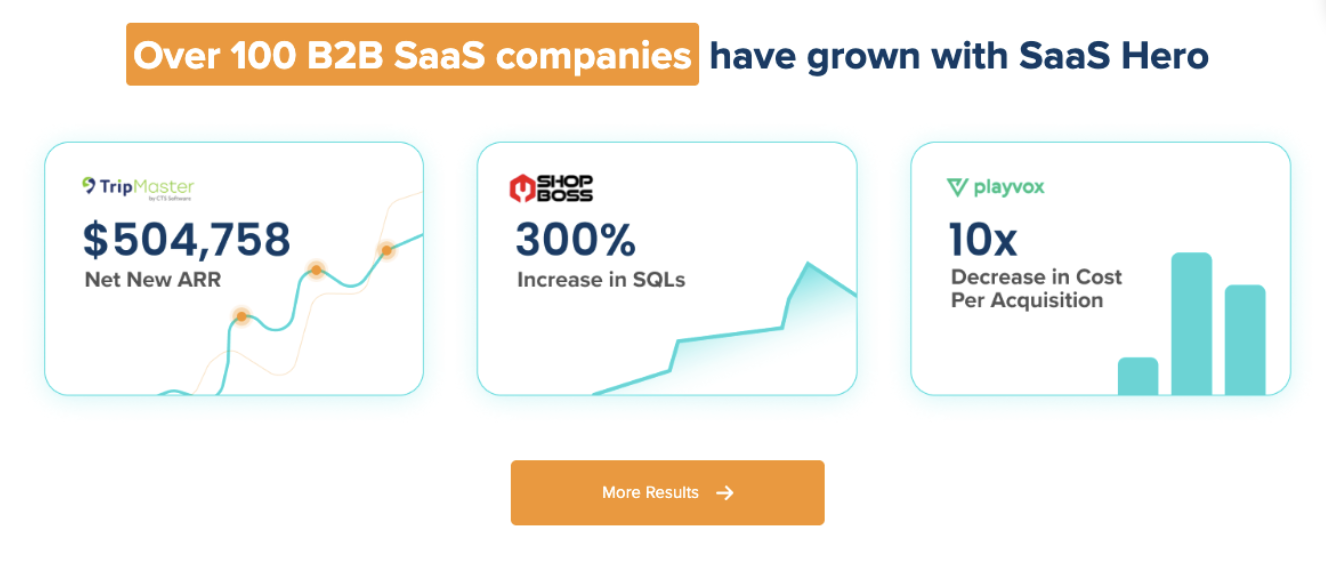
SaaSHero’s engagement model, which combines a flat monthly retainer from $1,250, month-to-month terms, senior-led execution, and reporting anchored to net-new ARR, is designed to remove each of the structural risks highlighted in this audit. The model has produced $504,758 in net-new ARR for TripMaster, an 80-day payback period for TestGorilla, and a 10x reduction in cost per lead for Playvox. These outcomes come from incentive alignment rather than ad spend volume.