




Key Takeaways for Replacing Your Google Ads Agency
-
Traditional Google Ads agencies charge 15-20% of ad spend, which creates conflicts of interest. Specialized B2B SaaS partners like SaaSHero use flat retainers starting at $1,250 per month, aligning incentives with performance instead of spend.
-
Revenue-aligned agencies deliver stronger pipeline and ARR growth, with case studies that outperform the industry’s typical 3.5:1 ROAS benchmark for Google Ads.
-
AI tools offer low-cost automation at $15-$200 per month but lack strategy for complex B2B SaaS funnels. Freelancers provide senior attention at $1,000-$3,000 per month but struggle to scale.
-
In-house teams cost $60,000-$120,000 per year and often carry 30-40% waste risk. Generalist agencies remain a last resort because of diluted expertise and long contracts.
-
Get a SaaSHero performance audit to review your current agency and map a transition to higher-value Google Ads management.
1. Revenue-Aligned SaaS Partners Like SaaSHero
Specialized B2B SaaS agencies that use flat retainers provide the most aligned replacement for percentage-based Google Ads agencies. These partners charge fixed monthly fees tiered by spend bands, starting at $1,250 for up to $10,000 in ad spend, which removes incentives to inflate budgets inside each band. Month-to-month contracts keep pressure on performance because the agency must re-earn your business every 30 days.

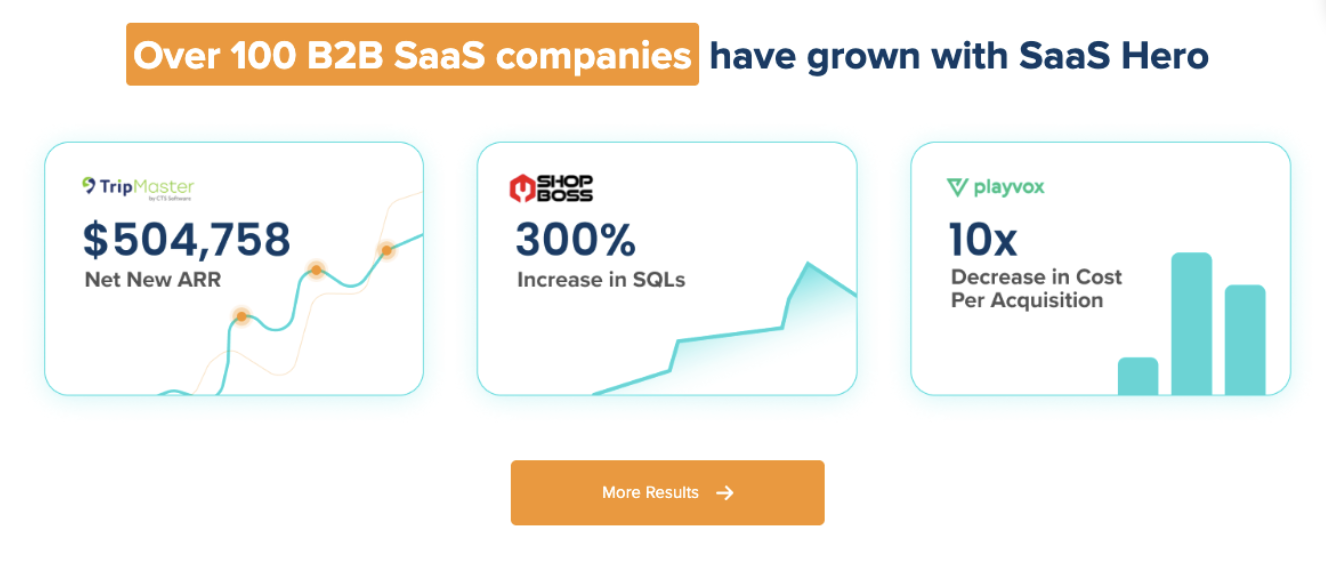
SaaSHero follows this model with senior-led account management, competitor intent targeting, and CRM integration that tracks every campaign from click to closed-won revenue. Their case studies show concrete outcomes: TripMaster generated $504,758 in Net New ARR, TestGorilla reached an 80-day payback period that supported a $70M Series A, and Playvox cut cost per lead by 10x while increasing volume by 163%.

Key advantages include Slack integration for real-time communication, HubSpot tracking for pipeline attribution, and deep familiarity with SaaS metrics such as churn, MRR, and sales cycles.
This specialization creates the main tradeoff, because these agencies serve only B2B SaaS companies and do not fit e-commerce or local businesses. However, the narrow focus supports client ratios capped at 8-10 accounts per manager, which is far lower than generalist agencies and enables more focused execution.
This model fits bootstrapped to Series A companies spending $5,000-$50,000 per month that need clear ROI and transparent pricing. Success metrics center on SQLs, pipeline value, and Net New ARR instead of impressions or CTR.

2. AI Agents and Software for Automated Google Ads
AI-powered tools like Groas and WASK provide 24/7 automated bidding and basic campaign adjustments starting at $15 per month. These platforms excel at tactical tasks such as adjusting bids, pausing weak keywords, and scaling winning ad groups without human intervention. For companies with limited budgets or simple funnels, AI tools can handle day-to-day management at a low cost.
AI agents struggle with B2B SaaS complexity because they cannot interpret dark funnel behavior where prospects research extensively before converting. They also lack native CRM integration for revenue tracking and often miss strategic plays such as competitor conquesting campaigns. They may reach solid ROAS levels, but they rarely beat top performers without human strategic oversight.

AI tools fit companies with straightforward lead generation goals, minimal funnel complexity, and budgets under $10,000 per month. They act as a bridge for startups that are not yet ready for a specialized agency but need more structure than manual management.
3. Freelancers for Hands-On Google Ads Management
Freelancers typically charge $1,000-$3,000 per month for Google Ads management and give you direct access to senior specialists. Where agencies often assign managers to 50 or more accounts, freelancers usually handle 5-8 clients, which allows deeper optimization and faster testing cycles.
The freelancer model combines cost efficiency with personalized service but offers limited scalability and minimal team depth. Single points of failure appear when a freelancer becomes unavailable, and many do not maintain full infrastructure for tracking, landing page testing, or multi-channel coordination. This extra attention can move landing page conversion rates from 3% to 8%, which makes freelancers attractive for budgets under $30,000 per month.
Freelancers suit pilot programs, companies testing Google Ads viability, and businesses that want hands-on optimization without full agency overhead. Results depend on selecting specialists with proven B2B SaaS experience and documented processes.
4. In-House Google Ads Teams for Mature SaaS
Building an in-house Google Ads function costs $60,000-$120,000 per year in salary, plus tools and training, and usually requires 3-6 months before the hire reaches full effectiveness. This approach gives complete control and deep product knowledge but locks in high fixed costs regardless of performance.
Audits of enterprise accounts often uncover 30-40% waste from basic optimization errors, which shows the risk when internal teams lack expert guidance. In-house managers also see fewer account variations than agencies, so they miss exposure to diverse strategies, competitive patterns, and rapid platform changes.
In-house management works best when paid ads represent a core growth engine at large scale, typically above $100,000 in monthly spend, and when the company can fund ongoing training and software. This model fits mature SaaS organizations with established marketing teams and strong unit economics.
5. Generalist Agencies as a Last-Choice Option
Traditional generalist agencies represent the legacy model that many SaaS companies now replace. They usually charge 15-20% of ad spend while serving many verticals from e-commerce to local services, which dilutes their B2B SaaS expertise. Long contracts shield these agencies from performance pressure while shifting risk to the client.
These firms often assign junior account managers to 30 or more clients, which creates a bait-and-switch dynamic where senior leaders sell the engagement and junior staff run the campaigns. Reporting tends to emphasize impressions and CTR instead of pipeline and revenue, which misaligns with SaaS companies that require clear ROI and attribution.
Generalist agencies belong at the bottom of your shortlist and only make sense when no specialized alternatives are available. Their percentage-based pricing, contract lock-ins, and limited SaaS focus reduce their suitability for B2B software companies that need accountable growth partners.
How to Switch Google Ads Agencies Safely and Protect Performance
Safe agency transitions follow a structured plan that prevents performance drops and data loss. Begin with an audit of your current account structure and documentation of all campaigns, keywords, and conversion tracking before you change access or budgets.
Follow this five-step process. First, audit existing contracts for lock-in clauses and termination rules so you understand legal and timing constraints. Once you confirm that you can proceed, set up parallel campaigns with your new agency while keeping current campaigns live, which lets you compare performance before committing fully.
During this parallel phase, export all historical data, including GCLIDs, keyword performance, and conversion tracking, so the new team can learn from past results. After validation and data transfer, shift budget gradually from old to new campaigns while monitoring key metrics to catch issues early. Finally, complete the transition over about 30 days with continuous monitoring to avoid avoidable performance dips.
SaaSHero’s $1,000-$2,000 setup fee covers migration support, tracking implementation, and strategy development to keep the transition smooth.
This upfront work reduces the performance risk that often appears during poorly managed agency switches. The table below compares total monthly costs and expected returns across budget tiers, showing how SaaSHero maintains strong ROI while other options either lack strategic depth or scale poorly.
|
Monthly Budget |
SaaSHero |
AI Tools |
Freelancers |
In-House |
|---|---|---|---|---|
|
$5,000 |
$1,250/mo, high ROI focus, ARR tracking |
$49/mo, 3.5:1 ROAS, basic optimization |
$1,000/mo, 4:1 ROAS, high attention |
$5,000+/mo, 3:1 ROAS, 6-month ramp |
|
$25,000 |
$2,250/mo, senior team, SaaS strategy |
$100/mo, 3.5:1 ROAS, limited strategy |
$2,000/mo, 4:1 ROAS, scale challenges |
$7,000+/mo, 3:1 ROAS, fixed costs |
|
$50,000 |
$3,250/mo, conquesting and expansion |
$200/mo, 3.5:1 ROAS, no CRM integration |
$3,000/mo, 3:1 ROAS, capacity limits |
$10,000+/mo, 2:1 ROAS, 30% waste risk |
Why Revenue-Aligned SaaS Agencies Lead These Alternatives
Revenue-aligned agencies like SaaSHero rank highest among these alternatives because they combine flat-fee pricing, month-to-month contracts, and focused B2B SaaS expertise. The case studies detailed earlier highlight the performance gap between specialized and generalist approaches, with results that consistently exceed typical industry benchmarks.
Companies spending under $10,000 per month can start with SaaSHero’s dedicated campaign manager tier for focused execution. Mid-market teams benefit from the full marketing team option, which adds strategy, creative, and analytics support. Percentage-based agencies that profit from higher spend rather than better outcomes sit lower in this value ranking.
The best time to replace an underperforming agency is before your next planning cycle, when budgets and targets are still flexible.
Get a performance audit and migration plan from SaaSHero to protect your pipeline while you move to a higher-value Google Ads model.
Frequently Asked Questions
Is replacing my Google Ads agency worth it for B2B SaaS companies?
Replacing an underperforming Google Ads agency is usually worthwhile when your CAC exceeds healthy payback periods. SaaSHero clients such as TestGorilla have reached 80-day payback windows compared to industry averages of roughly 23 months.
The combination of flat-fee pricing, SaaS-specific expertise, and revenue-focused tracking often improves pipeline quality and cost efficiency quickly. Companies spending $5,000 or more per month typically see ROI gains within 60-90 days after moving to specialized agencies.
How does SaaSHero compare to AI-powered Google Ads tools?
SaaSHero blends human strategy with AI execution to match the complex B2B SaaS buyer journey that pure AI tools overlook.
AI platforms handle bid changes and routine automation but cannot interpret dark funnel behavior, design competitor conquesting programs, or connect fully with CRM systems for revenue reporting. SaaSHero’s results, including the TripMaster case mentioned earlier, significantly outperform the 3.5:1 ROAS that AI-only management often delivers, especially for long sales cycles and high deal values.
What is the typical timeline for switching Google Ads agencies safely?
A well-managed transition usually takes about 30 days using a parallel testing approach. Week one covers account audits and new setup.
Weeks two and three run parallel campaigns to validate performance and collect data. Week four completes the migration once the new structure proves stable. SaaSHero’s setup process includes historical data export, conversion tracking implementation, and gradual budget shifts to prevent disruption. Rushed transitions often cause performance drops that take months to correct.
What is the most cost-effective alternative to traditional agencies?
For budgets under $10,000 per month, AI tools at $49-$200 per month provide basic optimization at the lowest cost but lack strategic depth. Freelancers at $1,000-$3,000 per month offer stronger expertise and attention but face capacity limits. SaaSHero’s $1,250 entry tier delivers agency-level execution with SaaS specialization, which creates a strong balance of cost and performance for most B2B SaaS teams.
Are Google Ads still viable for B2B SaaS in 2026?
Google Ads remain viable for B2B SaaS when specialists manage campaigns with a clear view of buyer behavior and attribution. The median 3.5:1 ROAS across the market shows baseline viability, while specialized agencies achieve higher returns through competitor targeting, intent-based campaigns, and structured funnel work. The key is partnering with teams that focus on Net New ARR and pipeline impact instead of vanity metrics so your ad spend contributes directly to revenue growth.