




Written by: Aaron Rovner, Founder, Saas Hero
Key Takeaways for B2B SaaS Leaders
- B2B SaaS faces rising CAC with a median 15‑month payback, so performance marketing drives quick ROAS while brand expands long-term LTV.
- Paid-only strategies suffer a performance penalty, while hybrid programs often achieve 2‑3x ROAS uplift on the back of strong brand foundations.
- Typical budget splits start at 80/20 performance/brand for early-stage teams, then move toward 60/40 as companies scale.
- Dark funnels require integrated attribution, and flat-fee models like SaaSHero’s keep the focus on Net New ARR instead of ad spend.
- SaaSHero’s hybrid campaigns have delivered 80‑day paybacks for clients like TestGorilla, so schedule a discovery call to tune your 2026 marketing mix.
Executive Summary: How Performance and Brand Work Together
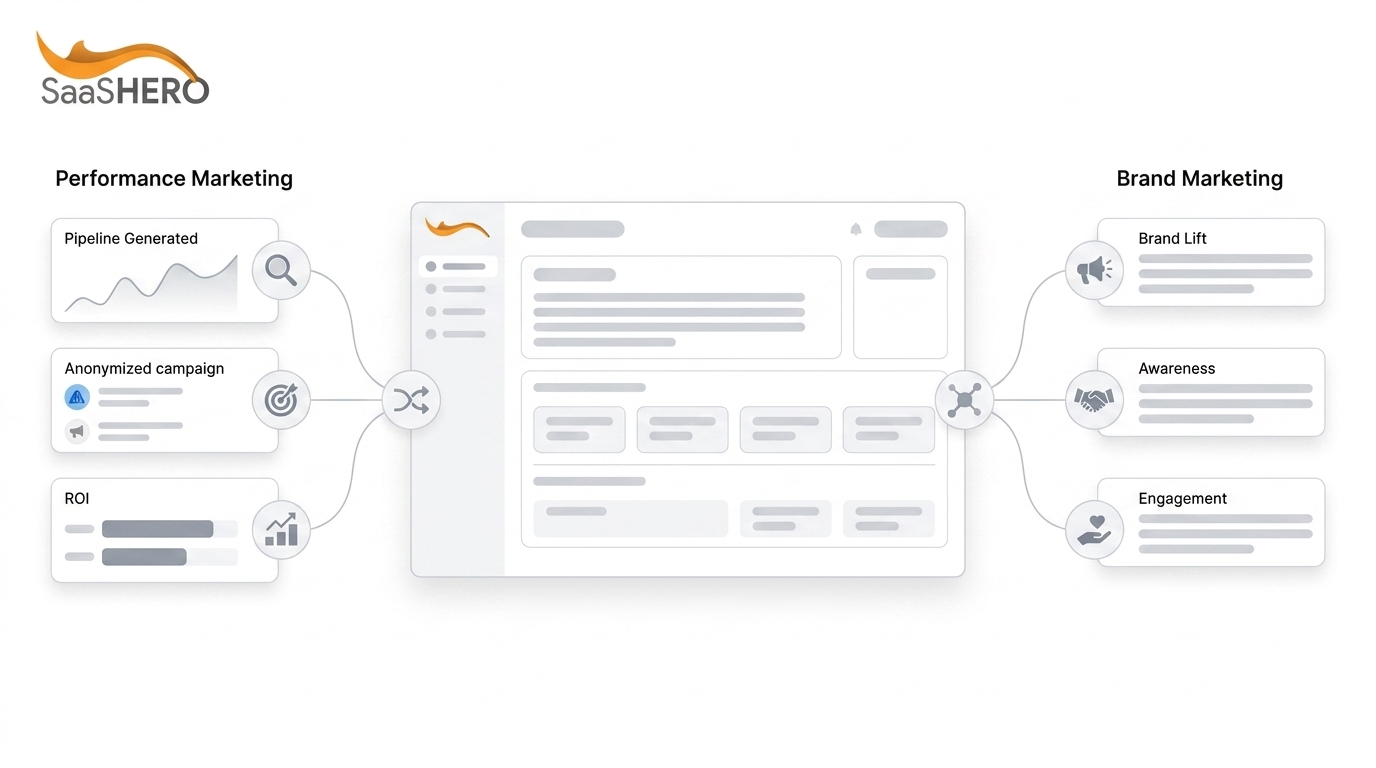
Performance marketing and brand marketing represent two different growth engines that work best in combination. Performance marketing focuses on immediate, measurable outcomes that prove unit economics quickly and generate pipeline on short timelines.
- Short-term CAC and ROAS improvements
- Google Ads and LinkedIn conquesting campaigns
- Direct SQL-to-ARR conversion tracking
- Typical payback between 6 and 12 months
Brand marketing builds long-term value that compounds over time. It creates awareness and trust that lower acquisition costs and increase expansion revenue.
- Awareness and trust development
- Content marketing, SEO, and thought leadership
- LTV expansion through retention and upsells
- Multiplier effect that often delivers 2‑3x ROAS uplift
Hybrid frameworks connect these two approaches into one system. Early-stage companies often start with an 80/20 performance/brand split, while mature organizations usually benefit from a 60/40 brand/performance mix. SaaSHero uses flat retainers that remove spend incentives and focus on Net New ARR, which has produced 80‑day payback periods for clients like TestGorilla.

The B2B SaaS Landscape: Dark Funnels and Attribution Traps
Hybrid approaches become essential once you look at how B2B SaaS buyers actually make decisions. Buyers complete about 70% of their research before sales contact, often inside dark funnels with many stakeholders and touchpoints. Traditional agencies often claim credit for final “brand search” conversions while ignoring the complex journey that created that demand.
Legacy agencies also rely on percentage-of-spend models that reward higher budgets instead of better efficiency. SaaSHero’s flat retainer structure removes that conflict and keeps attention on Net New ARR, not vanity metrics such as impressions or clicks.
SaaS Performance vs Brand Marketing: Key Differences at a Glance
| Metric | Performance Marketing | Brand Marketing | SaaS Impact |
|---|---|---|---|
| Timeline | Short-term (weeks) | Long-term (months) | Median payback: 15 months |
| CAC Payback | 80 days (best case) | 12‑24 months | Target LTV:CAC 3:1 |
| LTV Multiplier | 1‑2x baseline | 2‑3x ROAS uplift | Hybrid optimization |
| Primary Channels | PPC, LinkedIn Ads | SEO, Content, PR | Conquesting focus |
| Risk Factor | Performance penalty | Slow SQL generation | Capital efficiency |
Key Strategic Decisions: Managing Trade-offs and Performance Penalty
The performance penalty appears when companies depend on paid channels without a supporting brand. Fourth-quartile companies spend $2.82 for every $1.00 of new ARR, while the median CAC payback period sits at 15 months. The multiplier effect mentioned earlier, the 2‑3x ROAS uplift, comes from lower acquisition costs and higher customer lifetime value.
Optimal ratios change as your company matures and your primary objective shifts. Bootstrap-phase teams usually need performance-heavy allocation to validate their value proposition and prove demand quickly. As you enter the scale-up phase, a 60/40 brand/performance split builds the foundation for efficient growth. Mature companies can move to brand-dominant strategies that support sustainable expansion instead of initial market proof.
Performance marketing offers several clear advantages for SaaS leaders who need fast feedback. It delivers immediate data, sharper targeting, and direct links between campaigns and revenue.
- Immediate feedback and rapid testing cycles
- Up to 10x CPL improvements through precise targeting
- Direct attribution from campaigns to closed revenue
Brand marketing creates advantages that compound over time. It supports higher LTV, reduces price pressure, and softens competitive battles in crowded categories.
- Sustainable LTV expansion across the customer base
- Reduced competitive pressure as preference grows
- Premium pricing power supported by trust and authority
SaaSHero’s conquesting campaigns show this balance in practice. They target competitor keywords while case studies and thought leadership build authority that lifts conversion rates. See how our approach aligns with your growth stage, or review our pricing options.
Current Approaches and 2026 Hybrid Funnel Practices
Most teams still treat performance and brand as separate tracks, yet the strongest results come when they work together. Performance tactics often include competitor conquesting, conversion rate improvements, and intent-based targeting. Brand programs usually focus on LinkedIn thought leadership, SEO content, and G2 review growth.

Emerging practices combine these efforts into hybrid funnels that move prospects from awareness to revenue in a single connected system. This approach explains why hybrid programs often outperform isolated campaigns.
SaaS Hybrid Funnel Framework: The optimal setup uses three tiers. Brand activities such as awareness, SEO, and content fill the top of the funnel. Performance channels such as conquesting and retargeting convert that demand in the middle of the funnel. Bottom-funnel experiences such as demos and trials then turn qualified traffic into SQLs and closed ARR. This structure often creates a 2‑3x ROAS uplift compared to running performance or brand in isolation.
Top-of-funnel brand building generates recognition and trust. Mid-funnel performance marketing captures high-intent prospects through competitor campaigns and retargeting. Bottom-funnel optimization then converts that interest into revenue. Each stage strengthens the next, so brand equity consistently amplifies performance results.
SaaSHero delivers this framework through platform-agnostic campaigns run by senior strategists instead of junior account managers with overloaded books.
Readiness and Maturity Model for SaaS Marketing
Marketing Maturity Assessment
| Maturity Level | Characteristics | Recommended Approach |
|---|---|---|
| Low | Performance-only focus and vanity metrics | Add brand foundation |
| Medium | Mixed channels with basic attribution | Integrate tracking systems |
| High | ARR-integrated, hybrid strategy | Optimize and scale |
Most teams progress through a clear implementation sequence. First they audit current performance, then they establish a brand baseline. Next they layer performance campaigns on top of that foundation, integrate attribution, and finally scale the channels that prove efficient. SaaSHero’s $1,250 entry point keeps professional management accessible at every maturity level.
Common Pitfalls and How to Diagnose Them
Many B2B SaaS companies run into the same traps, including agency bait-and-switch staffing, percentage-of-spend fee structures, and weak CRM integration. These issues usually show up as unclear ROI, rising CAC, and confusion about which channels actually drive ARR.
Three quick questions help reveal these problems. If your ROAS is not directly tied to closed ARR, your reporting likely stops at leads instead of revenue. If you cannot track campaigns to specific revenue outcomes, your attribution model probably misses key stages in the funnel. If your agency benefits from higher spend regardless of performance, their incentives conflict with your efficiency goals.
- “Is your ROAS directly tied to closed ARR?”
- “Can you track campaigns to specific revenue outcomes?”
- “Does your agency benefit from higher spend regardless of performance?”
SaaSHero addresses these pitfalls with month-to-month agreements and revenue reporting that connects ad clicks to CRM data and closed ARR.
Real-World Scenarios: SaaSHero Case Studies
Founder-Led Growth (TripMaster): This transit software company achieved $504,758 in Net New ARR through integrated paid search and social campaigns supported by rigorous CRO.

VP-Led Scaling (Playvox): This CX software company saw a 10x decrease in Cost Per Lead after account restructuring and negative keyword refinement.
Post-Funding Acceleration (TestGorilla): This HR tech startup reached an 80‑day payback period and a $70M Series A by proving unit economics with efficient hybrid campaigns.
These cases show how a revenue-first approach can support founder-led growth, VP-led scaling, and post-funding acceleration across different verticals.
Conclusion: Balance Your Mix with SaaSHero
The 2026 B2B SaaS environment rewards companies that balance performance marketing efficiency with brand marketing scalability. Teams that master this integration achieve sustainable growth while protecting capital efficiency.
SaaSHero partners with B2B SaaS leaders to run ARR-tracked performance campaigns supported by strategic brand building. The flat-fee model keeps incentives aligned with your growth goals instead of agency revenue. Book a discovery call today and align your marketing mix with your 2026 targets.

FAQ
How do brand building and performance marketing work together in B2B SaaS?
Brand building and performance marketing work together through a hybrid funnel approach that compounds results. Brand activities such as content marketing, SEO, and thought leadership build awareness and trust, which makes performance campaigns more efficient. When prospects see your ads after engaging with your content, conversion rates usually rise sharply. This integration often delivers a 2‑3x ROAS uplift compared with running either approach alone.
What are specific examples of SaaS performance marketing vs brand marketing tactics?
Performance marketing examples include Google Ads competitor campaigns targeting “[Competitor] pricing” keywords, LinkedIn Ads aimed at specific roles and company sizes, retargeting for website visitors, and conversion-focused landing pages. Brand marketing examples include SEO-optimized blog content that addresses industry challenges, G2 review programs, executive thought leadership on LinkedIn, podcast sponsorships, and detailed case studies. The most effective SaaS companies run both sets of tactics at the same time.

Does performance marketing work without brand support in B2B SaaS?
Performance marketing on its own usually creates a performance penalty where acquisition costs rise over time. Companies that rely only on paid channels often see diminishing returns as competitors increase bids and prospects lack trust signals. The median SaaS company now spends around $2.00 to acquire $1.00 of new ARR, which reflects this imbalance. Brand building provides the foundation that keeps performance marketing sustainable and cost-effective.
What budget split should B2B SaaS companies use between performance and brand marketing?
Budget allocation depends on maturity and growth goals. Early-stage companies often put 80‑90% into performance for fast validation and 10‑20% into brand. Scaling companies usually move toward a 50‑60% performance and 40‑50% brand split. Mature companies often reverse that mix to 40% performance and 60% brand. The priority is maintaining both elements instead of choosing one and ignoring the other.
How long does it take to see results from hybrid SaaS marketing approaches?
Performance marketing results usually appear within weeks through better conversion rates and stronger lead quality. Brand marketing benefits develop over three to six months as content gains search visibility and thought leadership builds recognition. The compound effect becomes clear after six to twelve months when brand equity amplifies performance outcomes. Companies that adopt hybrid approaches often reach 80‑day CAC payback periods compared to the industry median of 15 months.