




Key Takeaways
- Salesforce Marketing Cloud Intelligence unifies data from 100+ sources for real-time B2B SaaS marketing analytics and cross-channel attribution.
- AI features like Einstein Insights and Agentforce support predictive LTV modeling, anomaly detection, and automated budget decisions.
- Setup follows clear steps across data ingestion, dashboard creation, and multi-touch attribution, usually completed in 4 to 8 weeks.
- Teams commonly see 20-30% CAC reduction, 80-day payback periods, and 85% attribution accuracy improvements after rollout.
- Partner with SaaSHero for expert implementation, ongoing improvements, and Net New ARR growth.
How Salesforce Marketing Cloud Intelligence Evolved From Datorama
Salesforce Marketing Cloud Intelligence is the modern version of Datorama after Salesforce acquired it in 2018. Salesforce rebranded and deeply integrated the platform into its ecosystem, turning it into a central analytics hub for marketing teams.
Datorama’s Transition Into Marketing Cloud Intelligence
Datorama became part of Salesforce’s Marketing Cloud suite and was rebranded as Marketing Cloud Intelligence in 2021. The core features stayed in place, while Salesforce added native CRM integrations and AI capabilities.
|
Core Capability |
Function |
B2B SaaS Impact |
|
Data Connectors |
100+ platform integrations |
Unified CAC tracking |
|
AI Analytics |
Einstein-powered insights |
Predictive LTV modeling |
|
Custom Reports |
Drag-and-drop dashboards |
ARR attribution clarity |
|
Attribution Models |
Multi-touch measurement |
Dark funnel visibility |
|
Real-Time Alerts |
Performance monitoring |
Budget optimization |
The 2026 updates introduce Agentforce Paid Media Optimization for 24/7 campaign monitoring and Segment Intelligence for audience analysis, which suits SaaS companies that rely on advanced attribution models.
Core Features B2B SaaS Teams Actually Use
Connecting Data With CRM and Ad Platforms
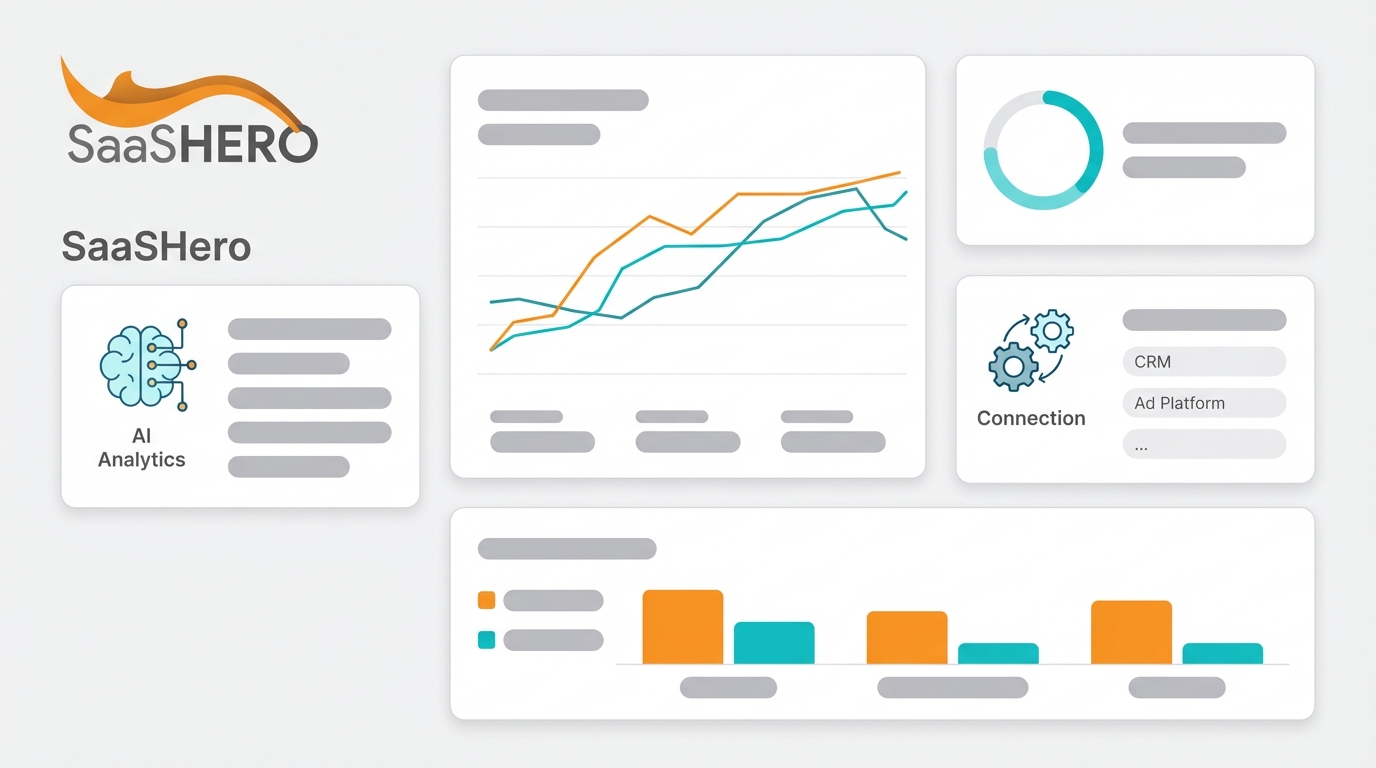
Marketing Cloud Intelligence connects directly to CRM systems like Salesforce and HubSpot, ad platforms like Google Ads and LinkedIn, and marketing automation tools. Native Salesforce CRM integration removes data silos and supports unified customer views, which matters for B2B SaaS teams managing long sales cycles.
AI Analytics and Practical Dashboards
Predictive Intelligence uses native AI to forecast behavior, automate decisions, and support real-time personalization. Einstein Marketing Insights monitors KPIs around the clock and suggests spend changes based on performance patterns.
Cross-Channel Attribution for Complex Journeys
Multi-touch attribution lets teams compare models side by side and configure them around specific conversion events. This flexibility helps SaaS companies measure long, multi-touch buyer journeys with more accuracy.
- 100+ native connectors across CRM, advertising, and analytics platforms
- Machine learning anomaly detection to flag performance outliers
- Custom KPI frameworks aligned to SaaS metrics
- Automated data refresh and scheduling
- Cross-channel campaign performance visualization
- Revenue attribution that moves beyond last-click models
- Real-time budget allocation recommendations
|
Platform |
Data Sources |
Attribution Models |
SaaS Focus |
|
Marketing Cloud Intelligence |
100+ |
Multi-touch, custom |
High |
|
Google Analytics |
Limited |
Last-click default |
Low |
|
Amplitude |
Product-focused |
Event-based |
Medium |
Step-by-Step Setup Guide for B2B SaaS Teams
Most teams need Salesforce admin access, clean CRM data, and clear conversion events before they start. Pricing starts at $3,000 per month for the Starter tier with 10 users and 3 million data rows, so budget planning should happen early.
- Login and Certification Setup: Access Marketing Cloud Intelligence from your Salesforce org. Complete Trailhead certification modules to learn data modeling basics and dashboard workflows.
- Data Ingestion Configuration: Use input connectors to pull data from CRM sources and output connectors to send results into targets. Configure API connections for Google Ads, LinkedIn, and HubSpot with valid authentication tokens.
- Dashboard Construction: Build dashboards around SaaS metrics such as CAC by channel, LTV cohorts, and pipeline velocity. Use drag-and-drop components to create executive views that answer revenue questions quickly.
- Attribution Model Setup: Configure Flexible Attribution beyond first and last touch with custom CRM objects. Map conversion events to revenue outcomes so ROI reporting reflects actual deals.
- AI Optimization Activation: Turn on Agentforce features for automated campaign monitoring and Segment Intelligence for audience insights. Set alert thresholds for overspend and performance anomalies so teams can react quickly.
Common Mistake: Many teams skip negative keyword filters during data ingestion, which inflates impression counts without real conversion value. Run quality checks before launching dashboards to confirm data accuracy.
ROI Benchmarks B2B SaaS Leaders Can Target
B2B SaaS teams usually target at least 20% CAC reduction and payback periods under 90 days. Companies using Agentforce AI reported a 99% reduction in reporting time, with cost per report dropping from $2,200 to $9.
|
Metric |
Pre-Intelligence |
Post-Intelligence |
Improvement |
|
Cost Per Lead |
$150 |
$105 |
-30% |
|
Payback Period |
120 days |
80 days |
-33% |
|
Attribution Accuracy |
60% |
85% |
+42% |
|
Reporting Time |
15 hours/week |
2 hours/week |
-87% |
A UK property business increased ROI by 15% using real-time analytics to reallocate budget. SaaSHero clients such as TestGorilla reached 80-day payback periods, and TripMaster generated $504,758 in Net New ARR within 12 months.

How Marketing Cloud Intelligence Compares to Alternatives
Marketing Cloud Intelligence has a steep learning curve and a high price point, which can strain teams without data analysts. Its deep Salesforce ecosystem integration, however, creates strong advantages for companies already using Sales Cloud or Service Cloud.
|
Platform |
Pros |
Cons |
Best For |
|
Marketing Cloud Intelligence |
Native Salesforce integration, AI features |
High cost, complexity |
Salesforce-centric stacks |
|
HubSpot Analytics |
User-friendly, integrated CRM |
Limited attribution models |
SMB SaaS companies |
|
Google Analytics 4 |
Free, redesigned interface |
Limited B2B features |
Basic tracking needs |
|
Amplitude |
Product analytics focus |
Marketing attribution requires integrations |
Product-led growth |
Most teams rely on agency support because of the technical setup and data modeling work. Book a discovery call to assess whether your internal team can handle implementation alone.
Why SaaSHero Is a Strong Partner for Intelligence Rollouts
SaaSHero uses flat-fee pricing that scales with client growth instead of percentage-of-spend models. As Google Premier Partners managing more than $30 million in annual ad spend, they connect marketing analytics directly to revenue outcomes.
Their month-to-month engagement model reduces long-term contract risk, and their focus on Net New ARR tracking keeps work aligned with SaaS growth metrics. TestGorilla reached a $70 million Series A raise with support from SaaSHero, which shows how strong attribution modeling can prepare companies for investor reviews.

|
Service Tier |
Monthly Fee |
Ideal For |
|
Dedicated Manager |
$1,250-$3,250 |
Founder-led teams |
|
Full Marketing Team |
$2,500-$7,000 |
Scale-up companies |
SaaSHero supports both implementation and ongoing improvements so analytics investments translate into measurable ROI. Book a discovery call to request an audit of your current analytics stack and a clear implementation roadmap.

Frequently Asked Questions
How long does Marketing Cloud Intelligence setup typically take?
Most implementations take 4 to 8 weeks, depending on data complexity and integrations. The first 2 to 3 weeks usually cover data ingestion and connector setup, followed by dashboard creation and attribution configuration. Teams with clean CRM data and clear conversion events move faster, while heavy data cleanup can extend timelines to 12 weeks.
What are the total costs beyond the platform licensing?
Beyond the $3,000 to $10,000+ monthly platform fees, teams should plan for implementation services of $5,000 to $15,000. Ongoing management often ranges from $2,000 to $5,000 per month, with possible data storage overages. Many companies underestimate the technical skills required, so agency partnerships help protect ROI and reduce setup errors.
Is Marketing Cloud Intelligence certification required for users?
Certification is optional but strongly recommended for administrators and power users. The Marketing Cloud Intelligence Specialist certification covers data modeling, dashboard building, and attribution setup. Most successful teams have at least one certified user, while many rely on partners like SaaSHero for day-to-day management.
How does this compare to the original Datorama platform?
Marketing Cloud Intelligence keeps Datorama’s core features and adds native Salesforce integrations, Einstein AI, and Agentforce automation. The updated platform offers deeper CRM connectivity and a better interface, although pricing has risen since the acquisition. Legacy Datorama users gain stronger attribution models and real-time optimization tools.
What ROI should B2B SaaS companies expect from implementation?
Well-run implementations often deliver 20 to 30% CAC reduction and 80-day payback periods within six months. The platform creates value by removing attribution blind spots, improving budget allocation, and giving executives clear visibility into performance. Companies with fragmented data sources usually see the largest gains, while those with mature unified analytics see more modest lifts.
Summary and Recommended Next Steps
Marketing Cloud Intelligence turns scattered B2B SaaS marketing data into actionable insights through AI-driven attribution and real-time optimization. Strong results depend on careful planning, technical skills, and consistent iteration against clear ROI targets.
The 2026 AI enhancements make the platform attractive for teams that need advanced attribution and automated campaign management. Next steps include auditing your current analytics stack, defining success metrics, and confirming implementation resources. Book a discovery call with SaaSHero to speed up your Marketing Cloud Intelligence rollout and aim for measurable ROI improvements within 80 days.