




Key Takeaways
- B2B SaaS CAC has risen to $2 per $1 ARR in 2026, so shift from vanity metrics to revenue-first tracking like Marketing Sourced Pipeline to prove ROI.
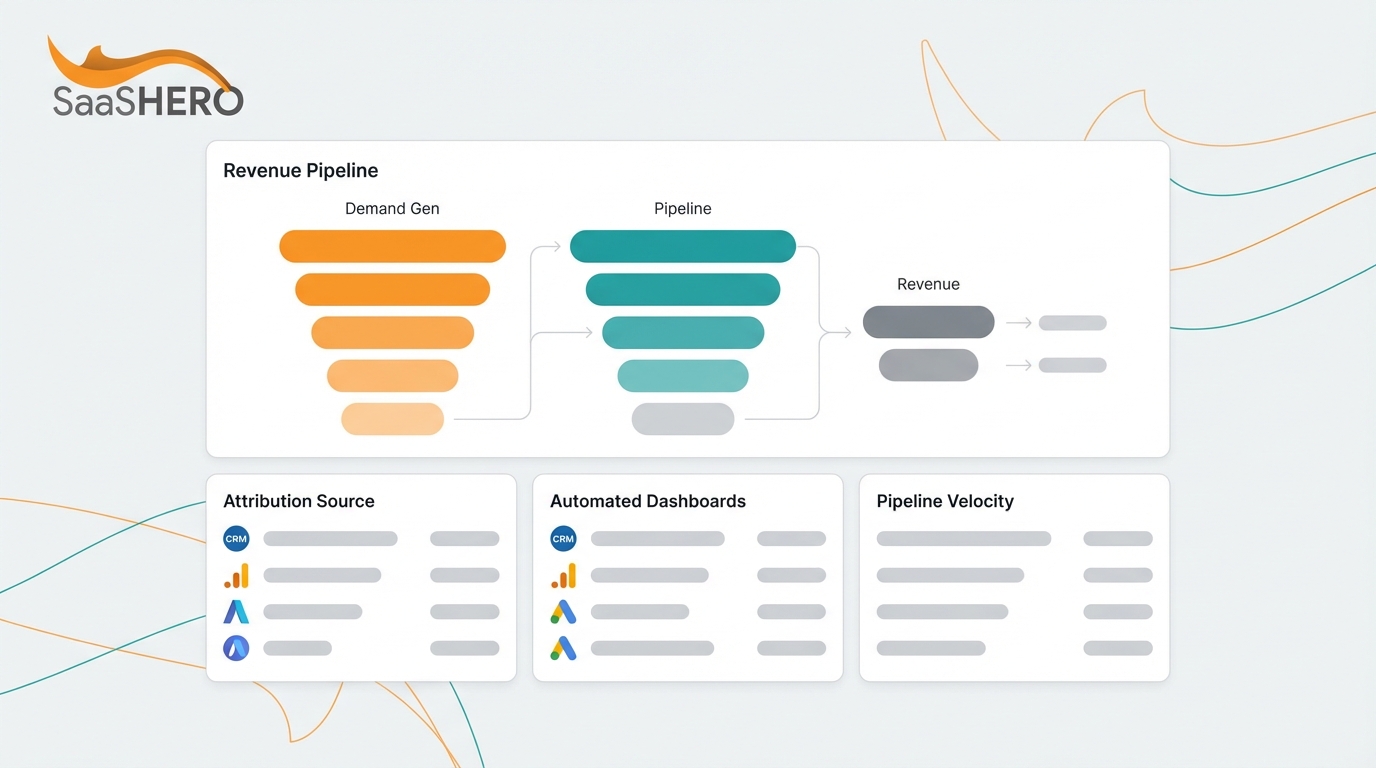
- Follow this 5-step playbook: define revenue objectives, implement hybrid attribution, track 10 core KPIs, build automated dashboards, and run weekly velocity reviews.
- Hit targets like under 100-day CAC payback, above 3:1 LTV:CAC ratio, and 44.6% Marketing Sourced Pipeline using tools like GA4, your CRM, and Looker Studio.
- TripMaster generated $504k Net New ARR with 650% ROI, and TestGorilla reached an 80-day payback period by applying this framework.
- Ready to move to revenue-first tracking, not just leads and clicks? Book a discovery call with SaaSHero for proven B2B SaaS demand generation results.
Tools, Definitions, and Setup Timeline
Confirm you have admin access to Google Analytics 4, your CRM system like HubSpot or Salesforce, and a visualization platform such as Looker Studio. Define key terms clearly so your team speaks the same language. Marketing Qualified Leads, or MQLs, are prospects that match your ideal customer profile and show buying interest. Sales Qualified Leads, or SQLs, are MQLs that your sales team has vetted and accepted. Hybrid attribution models like W-Shaped assign 30% credit to first touch, 30% to lead creation, 30% to conversion, and 10% to middle touchpoints. Sales velocity measures how quickly prospects move through your pipeline using this formula: (Number of Opportunities × Win Rate × Average Deal Size) ÷ Sales Cycle Length. Most teams complete the initial setup in 1 to 2 weeks, and the main risk comes from data silos that block accurate attribution.
Five-Part Revenue-First Tracking Framework
The revenue-first tracking framework follows five sequential steps that build on each other.
- Step 1: Define clear revenue objectives and payback targets
- Step 2: Implement hybrid attribution models that connect ads to your CRM
- Step 3: Track 10 essential revenue-focused KPIs
- Step 4: Build automated dashboards in Looker Studio or HubSpot
- Step 5: Run weekly velocity optimization reviews
This structured approach replaces surface-level metrics with numbers that show real, sustainable growth. Companies that apply this framework, such as TestGorilla, reach CAC payback periods near 80 days, which satisfies investor expectations and supports aggressive scaling.
Step-by-Step Instructions for Revenue-First Tracking
Step 1: Define Revenue Objectives and Payback Targets
Start by setting specific Net New ARR targets that match your growth stage and investor expectations. Early-stage companies should aim for CAC payback periods under 100 days to keep capital efficient. TestGorilla reached an 80-day payback period by prioritizing revenue efficiency instead of volume metrics. Set quarterly goals for Marketing Sourced Pipeline contribution, usually 40 to 50 percent of total pipeline for mature SaaS companies. Define acceptable CAC ratios, target less than $2 spent for each $1 of ARR, and maintain LTV:CAC ratios above 3:1.
Step 2: Set Up Hybrid Attribution Across Ads and CRM
Configure Google Analytics 4 so it passes UTM parameters and GCLID data directly into your CRM. This connection creates a clear line from ad click to closed revenue. Hybrid attribution models reveal 2.7 times more touchpoints per conversion than simplistic models because they combine tracked data with self-reported attribution. Add a form field that asks “How did you hear about us?” to capture dark funnel activity that tracking pixels miss. Configure several attribution models in parallel so you can compare performance across journeys.
|
Model |
Best For |
Credit Distribution |
Use Case |
|
Last-Click |
Direct response |
100% to final touch |
Immediate conversions |
|
W-Shaped |
B2B SaaS |
30% first, 30% lead, 30% opportunity, 10% middle |
Long sales cycles |
|
Linear |
Brand awareness |
Equal across all touches |
Multi-touch journeys |
Step 3: Track the 10 Revenue KPIs That Matter
Focus your reporting on 10 core metrics that directly affect revenue growth and investor confidence.
|
KPI |
Definition |
2026 Benchmark |
SaaSHero Example |
|
Marketing Sourced Pipeline |
Dollar value of opportunities from marketing |
44.6% of revenue |
TripMaster $504k ARR |
|
CAC Payback Period |
Months to recover acquisition cost |
<100 days |
TestGorilla 80-day |
|
Sales Velocity |
Speed of pipeline progression |
+10% QoQ growth |
18% cycle reduction |
|
LTV:CAC Ratio |
Lifetime value versus acquisition cost |
>3:1 |
650% ROI achieved |
|
SQL Conversion Rate |
MQL-to-SQL percentage |
13-20% |
20% conversion rate |
|
Pipeline Created |
Monthly new opportunities |
$X per $1 ad spend |
Consistent growth |
|
Cost Per Lead |
Blended CPL across channels |
Decreasing trend |
Playvox 10x reduction |
|
Average Contract Value |
Mean deal size |
Increasing annually |
Premium positioning |
|
Churn Rate |
Monthly revenue churn |
2.5-7% monthly |
Below benchmark |
|
Net Revenue Retention |
Expansion revenue minus churn |
>110% |
Growth efficiency |

Step 4: Build Automated Revenue Dashboards
Create real-time revenue dashboards in Looker Studio or with HubSpot reporting so your team can see performance at a glance. Automated dashboards cut reporting time by 75% while giving instant visibility into CAC, ROAS, and MRR trends. Configure funnel views that show each stage from ad click through to closed-won revenue. Add cohort analysis to track customer lifetime value by acquisition channel and campaign. Set automated alerts for KPI swings, and notify stakeholders when CAC rises above target or SQL conversion rates fall below benchmarks.
Step 5: Run Weekly Pipeline Velocity Reviews
Hold weekly performance reviews that focus on pipeline velocity and revenue movement, not just lead volume. Server-side tracking through Conversions API improves attribution by 15 to 30 percent compared with browser-based tracking that ad blockers disrupt. Map your sales process and find bottlenecks, such as leads that stall at the demo stage or during contract review. Use negative keywords to remove low-intent traffic that inflates vanity metrics without driving qualified opportunities. SaaSHero Pro Tip: Aim competitor conquest campaigns at high-intent modifiers like “pricing” and “alternatives” instead of broad brand terms. If the technical setup feels heavy, book a discovery call and let SaaSHero’s $1,250 per month flat-fee model handle configuration and ongoing optimization.

Measurement, Validation, and Data Quality
Track success by reaching CAC payback periods under 100 days and keeping SQL conversion rates above 20 percent. Companies that deploy comprehensive dashboards see 60 percent operational time reduction and 18 percent shorter sales cycles. Validate your tracking by comparing CRM revenue data with attribution reports, and treat any gap as a signal of broken tracking. Monitor data quality each week with automated audits that check for missing UTM parameters, duplicate leads, and incomplete opportunity records. Close attribution gaps by syncing CRM data back to ad platforms so every system reflects the same revenue truth.
Advanced Revenue Tracking and AI Enhancements
AI-powered sales automation cuts sales cycle time by 28 percent, which opens more room for velocity optimization. Use predictive lead scoring with machine learning models that analyze historical conversion patterns and firmographic data. Deploy intent data platforms to spot accounts that show buying signals before they fill out a form or request a demo. Mature teams extend multi-touch attribution with custom weighting that reflects deal size, sales cycle length, and buying committee complexity.
Summary, Audit Checklist, and Next Steps
Revenue-first tracking turns B2B SaaS demand generation from a cost center into a measurable growth engine. Follow this five-step checklist: define revenue objectives, implement hybrid attribution, track the 10 core KPIs, build automated dashboards, and run weekly velocity reviews. Make your next move a full audit of your current tracking setup so you can find gaps and clear opportunities for improvement. Book a discovery call for a free analysis of your demand generation tracking and specific recommendations for stronger revenue reporting.
Frequently Asked Questions
Revenue-First Tracking Setup Timeline
Most teams need 1 to 2 weeks to set up revenue-first tracking, including CRM integration, attribution model configuration, and dashboard creation. The hardest part usually comes from connecting separate data sources like ad platforms, website analytics, and CRM systems into one framework. Companies that work with specialized agencies such as SaaSHero often move faster because they use pre-built integrations and proven playbooks. Common pitfalls include partial UTM usage and missing conversion tracking, which both create attribution blind spots.
Core KPIs for B2B SaaS Demand Generation
Concentrate on metrics that tie directly to revenue instead of vanity indicators. Marketing Sourced Pipeline percentage shows how much of total revenue growth comes from marketing. CAC payback period reveals capital efficiency and shapes investor confidence. Sales velocity shows how quickly you convert prospects into paying customers. SQL conversion rates highlight lead quality and targeting accuracy. LTV:CAC ratios prove long-term profitability and unit economics. These KPIs connect directly to business growth and valuation multiples.
Approach to Dark Funnel Attribution in B2B
Use hybrid attribution models that blend quantitative tracking with qualitative feedback to capture dark funnel influence. Add self-reported attribution fields that ask prospects how they discovered your company, and review that data regularly. Apply probabilistic modeling to estimate dark social impact based on known conversion paths and content consumption. Deploy intent data tools that surface anonymous account research activity before form fills. Accept that perfect attribution is not realistic, and focus on capturing the majority of meaningful touchpoints.
Risks of Traditional Marketing Agencies
Traditional agencies often rely on percentage-of-spend pricing models that reward higher budgets even when performance stagnates. Long-term contracts protect the agency more than the client and shift most risk to your company. Many of these agencies report on impressions and clicks instead of revenue and payback periods. The common “bait and switch” pattern appears when senior strategists run sales calls while junior staff handle execution. SaaSHero’s month-to-month agreements and flat-fee pricing remove these misaligned incentives and keep focus on ARR.

Proving Marketing ROI to Executives and Investors
Build executive dashboards that show a direct link between marketing spend and Net New ARR. Calculate CAC payback periods and LTV:CAC ratios in formats investors already understand. Present cohort analysis that proves improving unit economics over time, not just one-off wins. Highlight Marketing Sourced Pipeline as a percentage of total revenue so leaders see marketing’s contribution. Use attribution modeling to show incremental revenue from campaigns instead of claiming credit for organic demand. Partner with SaaSHero for guaranteed ARR tracking and investor-ready reporting, and book a discovery call to upgrade your demand generation measurement approach.