




Written by: Aaron Rovner, Founder, Saas Hero
Key Takeaways for B2B SaaS Facebook Ad Pricing
- Traditional percentage-of-spend models reward agencies for bigger budgets, while tiered flat retainers like SaaSHero’s keep costs predictable and reduce waste.
- Facebook ads work well for B2B SaaS dark funnel demand, but you need CAC/LTV expertise to keep cost per lead under $30.
- Top transparent models include tiered flat retainers (#1), performance-based revenue shares (#4), and month-to-month contracts (#6) that align incentives with Net New ARR.
- SaaSHero’s pricing structure saves $3k to $18k per year versus percentage-based competitors, with fixed setup fees and month-to-month terms that demand consistent performance.
- Proven results include 650% ROI and more than $500k in Net New ARR; schedule a discovery call with SaaSHero to roll out revenue-focused Facebook ads for your SaaS.
Why Facebook Ads Drive B2B SaaS Growth in 2026
Facebook ads reach B2B SaaS buyers in the dark funnel while they research competitors, compare pricing, and look for alternatives. Average cost per lead for Facebook campaigns hit $27.66 in 2025, so precise targeting now matters for every capital-efficient founder.
The 2026 funding environment rewards agencies that understand CAC, LTV, and payback periods instead of chasing impressions. Effective B2B SaaS Facebook campaigns prioritize competitor conquesting, pricing comparison traffic, and nurturing prospects through long buying cycles. This work demands specialists who speak in terms like churn, MRR, and sales cycle length, not generalists who treat SaaS like e-commerce.

Top 7 Transparent Facebook Ads Pricing Models for B2B SaaS
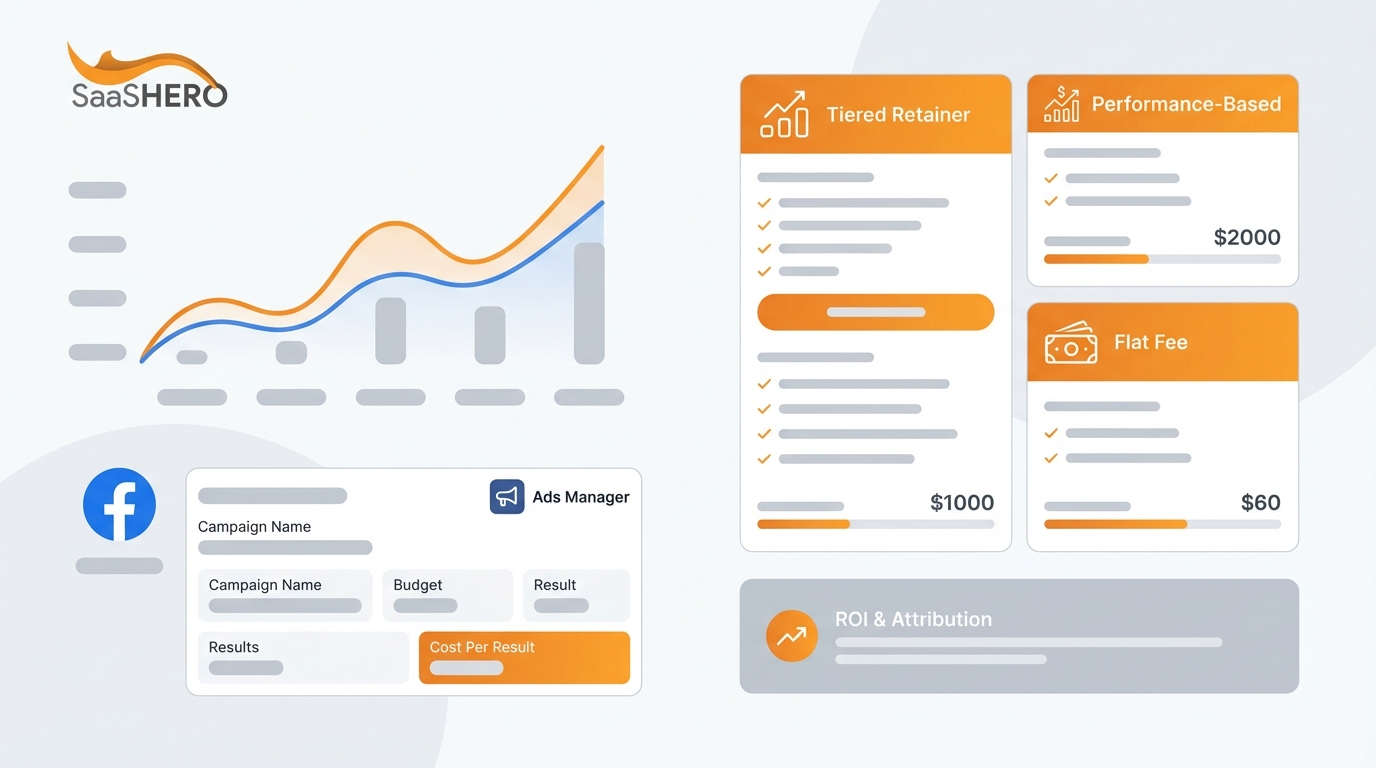
1. Tiered Flat Retainer (SaaSHero Model)
Pros: Fixed spend bands remove budget bloat incentives, month-to-month flexibility, and clear, predictable costs.
Cons: No meaningful downside for revenue-focused SaaS founders.
Example: $1,250 per month for up to $10k ad spend on a single channel.
2. Percentage of Spend (10–20%)
Pros: Fees scale as budgets grow, which feels simple at first glance.
Cons: Creates pressure to increase spend regardless of performance, and produces unstable revenue for agencies.
Example: $1,500 per month fee on $10k spend at a 15% rate.
3. Flat Fee Monthly Retainer
Pros: Costs stay completely predictable every month.
Cons: No built-in incentive to scale, and the fee may not match your current growth stage.
Example: $3,000 to $15,000 per month regardless of ad spend.
4. Performance-Based Revenue Share
Pros: High upside potential and strong alignment with revenue outcomes.
Cons: Volatile cash flow for agencies and complex attribution requirements for both sides.
Example: 5–10% of attributed revenue from paid campaigns.
5. Hybrid Retainer plus Performance Bonus
Pros: Blends baseline security with upside incentives for performance.
Cons: Still includes percentage-based elements that can misalign incentives as budgets rise.
Example: $5,000 base fee plus 5% of ad spend.
6. Month-to-Month Contracts
Pros: Reduce risk for founders and force agencies to perform every month.
Cons: Agencies must re-earn the relationship constantly, which some teams cannot sustain.
Example: Any pricing model offered without long-term lock-in or annual contracts.
7. Setup and Asset-Based Fees
Pros: Lower barrier to entry and coverage for heavy upfront work like tracking and creative assets.
Cons: One-time nature limits ongoing optimization and strategic support.
Example: $1,000 to $2,000 setup plus $750 for landing page design.
SaaSHero Tiered Retainer Pricing Explained
SaaSHero’s tiered flat retainer model removes the waste incentives that come with percentage-based pricing. The structure keeps fees predictable while still matching different growth phases for each client.
| Monthly Spend | SaaSHero (1-Channel) | 15% Competitor | Annual Savings |
|---|---|---|---|
| Up to $10k | $1,250 | $1,500 | $3,000 |
| $10k–$25k | $1,750 | $2,250 | $6,000 |
| $25k–$50k | $2,250 | $3,750 | $18,000 |
The tiered bands cap fees within each spend range and remove incentives for tiny budget tweaks. A client who increases spend from $12k to $15k per month still pays the same $1,750 fee. Recommendations then center on performance and Net New ARR instead of fee growth. Book a discovery call to see how this structure can match your current stage and future targets.
Additional transparent fees include $1,000 to $2,000 for setup, which covers tracking implementation and strategy work. Landing page design costs $750 at loss-leader pricing, and five ad creatives cost $300. These fixed fees prevent surprise invoices and give every campaign a solid technical and creative foundation.

Where Percentage-Based Pricing Breaks for SaaS Founders
Percentage-of-spend pricing creates a direct conflict between agency profit and your efficiency. Agencies that rely on percentage models face revenue swings when clients cut budgets, which makes it “nearly impossible to generate enough revenue to properly staff an adequate team.”
The bait-and-switch pattern often makes this worse. Founders meet senior strategists during sales conversations, then get handed to junior account managers who juggle 30 or more clients after signing. Long-term contracts protect this setup. When an agency cannot be fired for 12 months, the urgency to drive results in the first 60 to 90 days fades quickly.
SaaSHero’s month-to-month structure acts as a forcing function for performance. The team must re-earn your business every 30 days, which keeps attention on Net New ARR instead of vanity metrics like impressions and clicks.
B2B SaaS Case Studies from SaaSHero Clients
SaaSHero’s transparent pricing and SaaS-focused strategy deliver measurable gains across multiple verticals. TripMaster generated $504,758 in Net New ARR with a 650% ROI and 20% conversion rates from paid search.

TestGorilla reached an 80-day payback period, which many VCs treat as a “Holy Grail” metric, and that performance supported their $70M Series A raise. Playvox cut cost per lead by 10x through account restructuring and negative keyword work, which shows how SaaS-specific expertise removes wasted spend.
The main differentiator lies in how results are reported. SaaSHero reports on closed revenue instead of only pipeline. HubSpot and Salesforce integrations track each campaign from click to closed-won deal, which allows decisions based on actual customer acquisition instead of raw lead counts.

Pricing Recommendations by SaaS Stage
Overwhelmed Founder ($500k–$2M ARR)
Start with the $1,250 Dedicated Campaign Manager tier for single-channel ad management. Month-to-month terms let you test Facebook as a growth lever without a long commitment.
Scaling VP of Marketing ($2M–$10M ARR)
Choose the Full Marketing Team option at $2,500 to $4,500 per month for multi-channel strategy and execution. Integrated reporting supports board conversations about revenue, payback, and pipeline quality.
Post-Funding Rocket (Series A+)
Adopt an aggressive multi-channel plan with competitor conquesting and strong creative testing. Book a discovery call to plan rapid scaling while you still protect an 80-day payback window.
FAQ: Facebook Ads Pricing for B2B SaaS
Flat Fee vs Percentage of Spend for a $20k Budget
SaaSHero’s tiered model charges $1,750 per month for $10k to $25k in ad spend, which saves $6,000 per year compared with a 15% competitor at $3,000 per month. The flat fee removes incentives to inflate budgets and keeps your monthly costs predictable.
Month-to-Month Contracts and Agency Performance
Month-to-month contracts increase accountability because clients can leave at any time. This structure creates urgency and keeps the focus on results instead of contract renewals. SaaSHero’s case studies show that this approach supports stronger performance over time.
Calculating ROI Across Different Pricing Models
ROI comparisons should center on cost per acquisition and lifetime value, not agency fees alone. A $1,250 per month agency that generates $50,000 in Net New ARR creates better ROI than a $500 per month agency that delivers no qualified leads. Track closed revenue and payback period instead of impressions and click volume.
Typical Setup Costs with Transparent Agencies
Transparent agencies usually charge $1,000 to $2,000 for setup, which covers tracking implementation, account audits, and strategy development. Agencies that advertise “free setup” often recover those costs through higher retainers or weak service quality, so review the full pricing picture.
Timeline for Seeing B2B SaaS Results from Facebook Ads
Most B2B SaaS companies need 60 to 90 days to gather meaningful data once tracking is in place. Sales cycles run longer than e-commerce, so attribution takes more time. Focus first on leading indicators such as cost per lead and demo requests, then evaluate closed revenue as deals progress.
Conclusion: Transparent Pricing as a Growth Advantage
Transparent agency pricing models put founder outcomes ahead of agency profit. SaaSHero’s tiered flat retainer removes the waste incentives of percentage-based pricing and pairs that with month-to-month flexibility that demands consistent performance.
Case studies with 650% ROI and more than $500k in Net New ARR show how this approach supports durable growth. Transparent pricing now acts as a competitive edge for B2B SaaS partnerships, not just a nice-to-have feature. Book a discovery call today to see how transparent pricing can accelerate your revenue growth.