




Last updated: March 30, 2026
Key Takeaways
- 92% of B2B buyers check G2 before purchasing, so a strong presence is essential for capturing high-intent leads as CAC rises in 2026.
- Improve your G2 profile with AI-focused keywords, videos, and a 4.5+ star rating to triple views and increase AI citations.
- Collect 60 to 80 or more reviews through compliant, post-milestone campaigns to build credibility and strengthen social proof.
- Use G2 intent data with CRM integration to reach the reply rates mentioned later, while tracking ROI with UTM parameters.
- Follow this 7-step playbook for 20% conversion lifts and 650% ROI, and schedule a free G2 audit with SaaSHero to apply it faster.
Prerequisites and G2 vs Capterra Context
Set up G2 profile access, CRM integration with HubSpot or Salesforce, and basic UTM tracking before you roll out this playbook. G2 provides first-party intent data from buyer activity on its software marketplace, capturing signals when companies visit profiles, compare competitors, or research pricing. This capability positions G2 ahead of Capterra for bottom-funnel lead generation. The table below compares three core features that explain why G2 captures more high-intent buyers.
| Feature | G2 | Capterra |
|---|---|---|
| Intent Data | Real-time alerts | Basic |
| AI Visibility | High (LLM citations) | Medium |
| BoFu Leads | Strong | Weaker |
Implementation timeline: 2 to 4 weeks. Critical compliance note: Use only FTC-compliant review incentives to avoid platform violations.
7-Step G2 Playbook Framework for B2B SaaS Growth
This framework walks through seven connected steps that turn G2 into a predictable revenue channel. The steps are Profile Optimization, Review Acquisition, Intent Data Activation, CRM Integration, G2 Deals Campaigns, Competitor Monitoring, and ROI Measurement. This structure supports B2B SaaS growth, as shown by results such as 650% ROI and $504k ARR for TripMaster.
Step 1: Claim and Optimize Your G2 Profile for Visibility
The goal in Step 1 is to triple profile views through focused optimization. Companies positioned in the G2 “Leader” quadrant receive three times more profile views than those in the “Niche” quadrant, which directly affects pipeline generation.
Start by claiming your G2 profile and adding keywords that match 2026 AI visibility trends, such as “AI features” and “automation capabilities.” These keywords help AI engines understand your product when they generate software recommendations. Support this visibility with high-quality screenshots, demo videos, and clear calls to action that convert visitors into leads. Complete every profile field to increase your chances of AI citations from ChatGPT, Google’s AI Mode, and Perplexity. Review platforms are among the most-cited sources by AI engines when generating B2B software recommendations.
Use dedicated competitor conquest pages, which SaaSHero builds for clients, to capture traffic from buyers researching alternatives. Maintain a 4.5+ star rating to reinforce credibility for both human buyers and AI systems.
Avoid leaving profile fields incomplete, because missing information reduces AI citations and weakens organic visibility.
Step 2: Acquire Reviews to Build Credibility and Social Proof
Step 2 focuses on building 60 to 80 or more reviews to establish market credibility. Aim for 5 to 10 new reviews each month, timed after positive customer milestones such as successful implementation or ROI achievement.
Send post “aha moment” email campaigns that include clear review request templates. Offer $25 gift cards as incentives where platform rules allow, and follow FTC guidelines in every region. Respond to all reviews in a professional tone, thanking happy customers and addressing negative feedback with specific, constructive replies.
Systematic collaboration with customer success teams and compliance-first incentive programs increases review volume and keeps quality high. Once you have this review base in place, you can convert that social proof into active pipeline by targeting buyers who are already researching solutions.
Step 3: Use G2 Intent Data for Bottom-Funnel Targeting
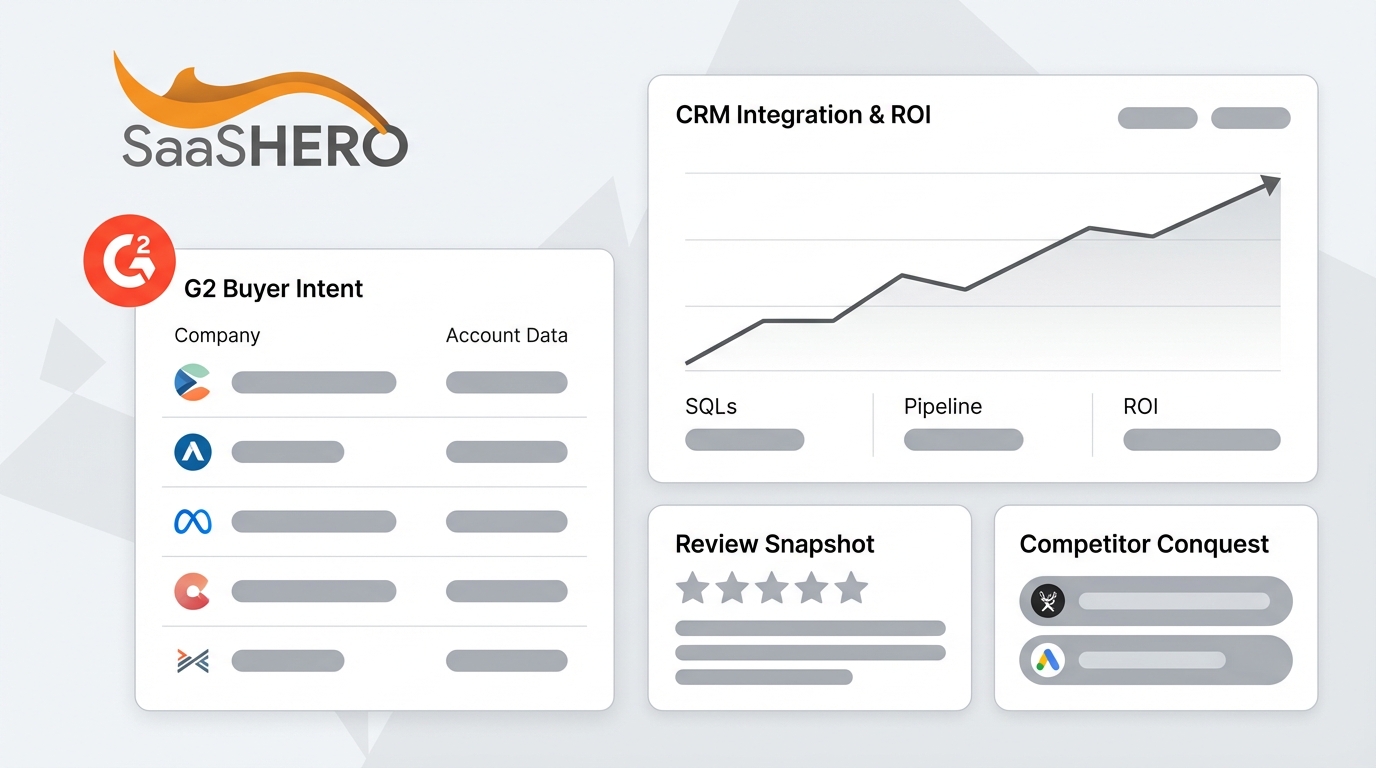
Step 3 targets high-intent buyers who are actively researching products like yours. G2 Buyer Intent delivers real-time alerts on companies viewing vendor profiles, categories, competitor pages, and pricing information.
Activate G2’s intent data features, which start around $10k per year, so your team receives alerts when prospects view competitor profiles or research pricing. Intent-driven outreach achieves reply rates of 15 to 25 percent versus the 3 to 5 percent industry average for cold outreach.
Begin with free G2 features, then upgrade to paid intent data once you confirm fit and process. These intent signals support targeted outreach campaigns that achieve the reply rates mentioned earlier, which significantly outperform generic cold outreach.
Step 4: Integrate Your CRM for Full-Funnel Attribution
Step 4 connects G2 activity to revenue by tracking dark funnel behavior and attributing G2-sourced deals. Set up HubSpot or Salesforce integration with UTM parameters so you can follow G2 traffic through every stage of the funnel.
Use a consistent UTM structure such as:
utm_source=g2_intent&utm_medium=review&utm_campaign=intent_alert
This tracking structure attributes closed-won deals back to specific G2 activity. It proves ROI and supports smarter budget allocation across channels. End-to-end tracking connects profile views to CRM revenue data and creates a clear feedback loop for optimization.
Ready to scale your G2 strategy with professional management? Schedule your free G2 audit and retainer consultation to explore SaaSHero’s $1,250 per month service.

Step 5: Run G2 Deals and Campaigns for Direct Conversions
Step 5 turns G2 traffic into direct conversions with tailored offers. Launch a G2 Deals page that features exclusive pricing or bonuses for G2 visitors. Pair this with SEO-focused comparison content that targets competitor keywords and captures buyers who are weighing options.
TripMaster generated $504k in ARR through coordinated deals campaigns and competitor conquest landing pages that guided G2 visitors into high-intent sales conversations.

Step 6: Monitor Competitors to Capture Market Share
Step 6 uses competitor monitoring to capture research traffic and win market share. Track intent signals on rival G2 profiles so you can see which accounts are actively evaluating alternatives.
Combine these signals with targeted LinkedIn outreach to prospects who are researching competitors. This competitor monitoring strategy produced a 10x cost-per-lead reduction for Playvox by intercepting competitor research and redirecting it into focused campaigns.
Step 7: Measure ROI and Improve Efficiency Over Time
Step 7 proves CAC reduction and Net New ARR impact while revealing improvement opportunities. Implement UTM-to-CRM tracking and connect it to Looker Studio dashboards for clear, executive-ready attribution reporting.
Track success through SQL generation, CAC reduction, and Net New ARR growth. SaaSHero’s reporting methodology delivered 80-day payback periods for TestGorilla and the ROI results mentioned earlier across multiple clients.
Success Metrics and Reporting Validation
Use SQL volume, CAC reduction, and Net New ARR as your primary success metrics for G2. Configure multi-touch attribution models in your CRM so you can see how G2 influences deals alongside other channels. Build Looker Studio dashboards that surface these insights for leadership.
Clients that follow this structured approach achieve 80-day payback periods and the ROI levels referenced earlier through consistent, data-backed G2 execution.
Advanced G2 Strategies and 2026 Extensions
Strengthen AI engine citations by maintaining recent, detailed reviews that influence enterprise buyer decision validation. Combine G2 with LinkedIn and Profound to run comprehensive competitor conquest campaigns that reach buyers across multiple research touchpoints.
SaaSHero provides full-stack support, including CRO and copywriting services with $750 landing pages, to convert more G2 traffic into pipeline. Explore advanced G2 optimization strategies with a free consultation.

Implementation Checklist and Next Steps for Your Team
Work through the seven steps in order: optimize your profile, acquire reviews, activate intent data, integrate your CRM, launch deals campaigns, monitor competitors, and measure ROI. Start by auditing your current G2 presence, then decide which gaps to close first based on revenue impact.
Get professional implementation support to accelerate your G2 lead generation with proven methodologies.
Frequently Asked Questions
How long does G2 optimization setup take?
The timeline mentioned earlier includes profile optimization, review campaigns, CRM integration, and tracking setup. The initial profile optimization usually takes 1 to 2 days, while the remaining work rolls out over the following weeks.
What review incentives are compliant with G2 policies?
G2 permits gift cards up to $25 per review in compliance with FTC guidelines. Focus on timing requests after positive customer milestones so you encourage authentic, detailed reviews instead of relying only on incentives.
How does G2 compare to Capterra for B2B SaaS marketing?
G2 offers stronger intent data capabilities, higher AI engine citation rates, and better bottom-funnel lead quality than Capterra. G2’s buyer intent features provide real-time alerts on prospect research activity, which Capterra does not match.
Can enterprise SaaS companies scale G2 strategies effectively?
Enterprise SaaS companies can scale G2 strategies effectively by using ABM integrations and advanced intent data features. Larger organizations use G2 for account-based marketing campaigns that target specific prospect accounts researching competitors and related categories.