





Written by: Aaron Rovner, Founder, Saas Hero | Last updated: August 7, 2026
Key Takeaways for Enterprise SaaS Leaders
- Enterprise B2B SaaS marketing now must prove pipeline and ARR impact, not just MQL volume, as boards demand measurable unit economics like CAC payback and LTV/CAC ratios.
- Agencies that chase impressions or MQLs are misaligned with enterprise SaaS revenue cycles, which require dark-funnel strategies and longer-cycle attribution.
- Revenue leaders should evaluate agencies on four criteria that work together: ARR attribution depth, sales-cycle alignment, pricing model incentives, and contract flexibility.
- Month-to-month flat-fee models often outperform percentage-of-spend or long-term lock-in contracts because they align agency incentives with client revenue outcomes.
- Schedule a benchmarking session with SaaSHero to compare your current agency against these criteria and uncover structural misalignments before your next renewal.
Executive Summary: Four Criteria That Predict Agency Fit
Revenue leaders evaluating enterprise B2B marketing agencies in 2026 should apply four non-negotiable criteria before signing any engagement.
- ARR and pipeline attribution depth. The agency must connect ad spend to closed-won revenue inside your CRM, not stop at the lead or MQL layer. This foundation enables accurate sales-cycle analysis.
- Sales-cycle alignment. Because enterprise deals take 6–18 months to close, strategies and reporting cadences must reflect these buying journeys, not 30-day conversion windows.
- Pricing model incentive alignment. Flat-fee structures separate agency revenue from media spend volume, while percentage-of-spend models reward higher spend regardless of efficiency.
- Contract flexibility. Month-to-month terms force agencies to re-earn the relationship every 30 days. In contrast, 12-month lock-ins often protect mediocrity and slow course correction.
SaaSHero is built around all four criteria. Its flat monthly retainer, month-to-month agreement, Salesforce and HubSpot CRM integration, and Net New ARR reporting framework create a structurally aligned alternative to traditional agency models. See how SaaSHero maps these criteria to your ARR stage and pipeline targets in a discovery call.

How to Evaluate Enterprise SaaS Agencies Against Revenue Outcomes
Revenue leaders achieve consistent comparisons by writing a one-page brief from their requirements, building a shortlist of three to five agencies whose proven niche matches that brief, and asking every candidate the same structured questions rather than allowing agency pitches to reshape selection criteria.
The evaluation process should test three things before any contract is signed, per a revenue-focused SaaS marketing agency evaluation framework:
- Whether the agency requires direct CRM and pipeline data access. Without this access, they cannot attribute revenue.
- Whether they define 90-day success in terms of pipeline leading indicators rather than vanity metrics.
- Whether their attribution model is explicit about its limitations, including dark-funnel gaps.
In a 6- to 12-month enterprise B2B SaaS sales cycle, leading indicators such as qualified pipeline entries, opportunity creation, and sales acceptance rates typically shift in 90 to 180 days, while closed revenue attribution lags by the length of the cycle. Any agency that promises closed-won attribution in 60 days is either lying or working with a different definition of “closed.”

Go-to-market motion is the strongest filter once basic attribution standards are met. Product-led growth requires expertise in activation and self-serve conversion, while sales-led growth demands demand generation, sales enablement, and longer-cycle pipeline handoff. These are two fundamentally different skill sets that most generalist agencies conflate.
8 Enterprise B2B Marketing Agencies That Drive Pipeline and ARR
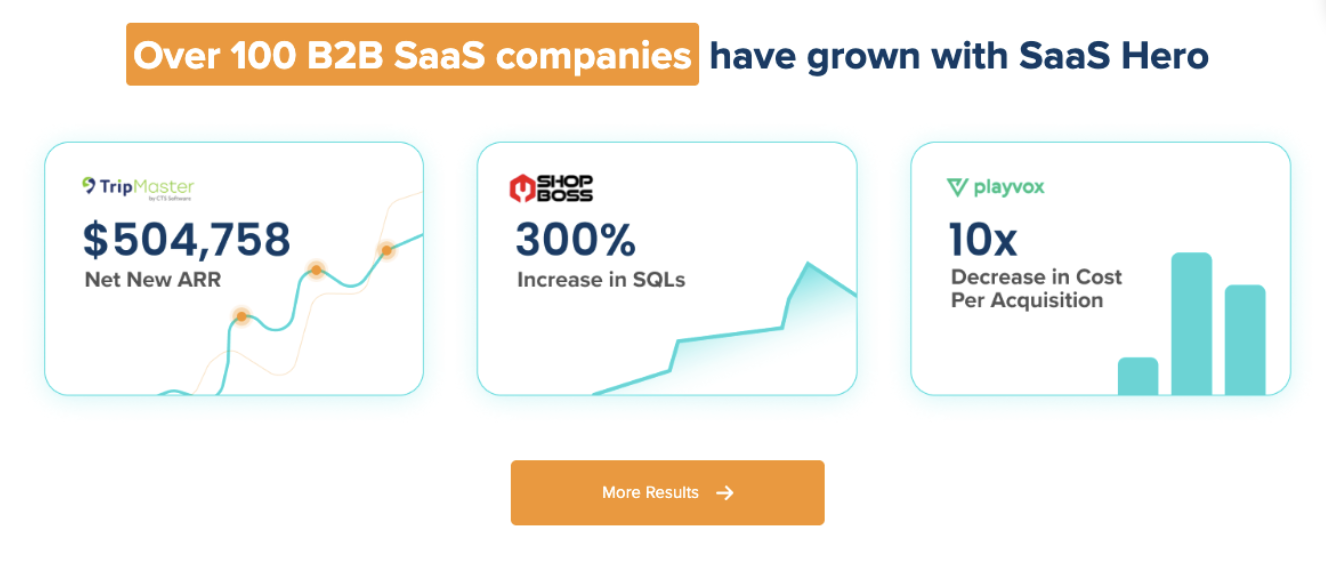
- SaaSHero – Flat-fee, month-to-month B2B SaaS specialist. Delivered $504,758 in Net New ARR for TripMaster in 12 months at 650% ROI, an 80-day CAC payback period for TestGorilla (which subsequently raised a $70M Series A), and a 10x reduction in cost per lead for Playvox alongside a 163% increase in lead volume. Reporting anchors to pipeline value and Net New ARR via Salesforce and HubSpot integration.
- Winning by Design – RevOps-integrated agency specializing in growth-stage (Series B to pre-IPO) and enterprise organizations requiring scalable execution, advanced forecasting, and cross-regional alignment.
- The Starr Conspiracy – HR Tech and enterprise SaaS specialist. Evaluates fit on named sub-vertical experience, demonstrated multi-touch attribution capability including anonymized pipeline reports with demand states and channel decomposition, and integrated strategy-plus-execution delivery.
- Carabiner Group – Serves enterprise organizations requiring sophisticated forecasting models, advanced analytics, and change management expertise across complex environments.
- Go Nimbly – Suited to growth-stage companies (Series B to pre-IPO) needing strategic depth combined with scalable execution to support rapid team expansion.
- Grey Matter – Builds demand generation campaigns measured against CAC payback period and pipeline efficiency instead of cost per lead, with sprint reports connecting marketing activity directly to LTV/CAC ratio, pipeline velocity, win rate, and net-new ARR sourced from marketing.
- Domestique – Excels at early-stage (seed to Series A) foundational systems, processes, and data hygiene for flexible, execution-focused revenue operations.
- CS2 Marketing – Analytics-forward demand generation. Advocates lift analysis comparing average deal size and win rate for closed opportunities that engaged with marketing versus those that did not, providing a direct measure of marketing’s revenue contribution that sidesteps sourced vs. influenced attribution debates.
Choosing Contract Terms for 6–18 Month Enterprise Sales Cycles
Once you have identified agencies with the right specialization and attribution capabilities, the next critical decision is contract structure. For enterprise SaaS with 11–17 month sales cycles, agencies recommend contract structures with a 3–6 month initial term followed by rolling 30–60 day notice, plus kill criteria that define specific leading indicators by day 90 to enable early exit if pipeline goals are not met.
Monthly retainers suit ongoing SaaS marketing work such as PPC, SEO, content, CRO, demand generation, and analytics when the agency must deliver consistent execution, refinement, and compounding learning over 6–18 month sales cycles. The risk is that a fixed fee with no exit clause removes the agency’s incentive to perform.
Month-to-month agreements resolve this by creating a forcing function. The agency must re-earn the relationship every 30 days. SaaSHero’s model follows this principle. A 12-month lock-in is viewed as unreasonable for a new relationship where trust has not been established. As discussed in the evaluation framework, these extended commitments breed the complacency that kills pipeline momentum.
B2B agency contracts should explicitly grant the client full administrative ownership of all ad accounts and all generated campaign data to prevent vendor lock-in and ensure continuity upon termination. Many long-contract agencies omit this term deliberately.
7-Row Decision Matrix: Comparing Pricing, Contracts, and Attribution
Compare your current agency against this framework in a free consultation and identify structural misalignments before your next renewal decision.
Red Flags When Hiring an Enterprise SaaS Marketing Agency
- Guaranteed results or rankings. Guaranteed results are a primary red flag; no agency controls the full revenue cycle.
- Case studies showing only percentages without absolute numbers. A “200% increase in leads” from a base of 5 is meaningless. Require absolute pipeline dollars and ARR figures.
- Reluctance to name the delivery team. The senior-sales/junior-execution bait-and-switch is endemic, so confirm named strategists and client-to-manager ratios before signing.
- Percentage-of-spend billing with no efficiency guardrails. Percentage-of-ad-spend pricing requires guardrails including CAC targets, qualified conversion definitions, and pipeline reporting to avoid incentivizing spend growth without efficiency accountability.
- No CRM integration requirement. As noted in the evaluation framework, this prevents revenue attribution. Agencies that do not require direct CRM and pipeline data access cannot connect campaigns to pipeline and ARR.
- 12-month lock-ins with no kill criteria. Contracts should define specific leading indicators by day 90 to enable early exit if pipeline goals are not met.
- Pitches that never reference your business model or ARR stage. Generic agency decks signal a generalist operation with no SaaS-specific depth.
Stage-Specific Agency Recommendations by ARR and Motion
Founder-Led ($500K–$3M ARR). The priority at this stage is proving unit economics before scaling spend. SaaSHero’s Dedicated Campaign Manager tier at $1,250/month for up to $10K in spend provides professional management at a cost lower than a junior hire, with month-to-month terms that de-risk the decision. The goal is establishing a repeatable CAC payback benchmark, not volume.

Series B ($5M–$20M ARR). This stage requires an agency that speaks boardroom language such as CAC, LTV, and pipeline velocity, and integrates with Salesforce or HubSpot to defend spend in front of investors. Healthy mid-market B2B SaaS organizations target CAC payback of 12–18 months, with top-quartile performance under 12 months. SaaSHero’s Full Marketing Team tier and competitor conquesting framework are calibrated for this stage.
Post-Series C and Enterprise. Enterprise organizations need multi-channel ABM, buying-committee mapping, and attribution infrastructure that handles Gartner reports a median of 11 stakeholders for enterprise software purchases (2022/2024). At this stage, evaluate agencies on sub-vertical depth, named delivery staff, and demonstrated multi-touch attribution capability including anonymized pipeline reports.
Implementation Checklist: Run Your Internal Agency Audit
- Document your current ARR, growth rate, GTM motion (product-led, sales-led, or hybrid), and the specific pipeline gap you need to fill.
- Pull your current agency’s last three reports and identify whether they reference pipeline dollars, CAC payback, or Net New ARR, or only impressions, clicks, and MQLs.
- Confirm ownership of all ad accounts (Google Ads, LinkedIn, Meta) and campaign data. Full administrative ownership must reside with the client from day one.
- Define 90-day success criteria in pipeline leading indicators such as qualified opportunities created, sales acceptance rate, and sourced pipeline value.
- Connect these metrics to your data foundation by auditing CRM data hygiene. A team with a CRM and a well-designed form will outperform a team with a $50K attribution platform and no process for collecting self-reported data.
- Build a shortlist of three to five agencies whose proven niche matches your ARR stage and GTM motion, then send the same one-page brief to each.
- Run a paid diagnostic or strategy sprint with your top candidate before committing to an ongoing retainer.
- Negotiate a month-to-month agreement with named delivery staff, kill criteria at day 90, and a 30-day documented offboarding handover period.
SaaSHero’s onboarding process covers steps four through eight in the first 30 days, including tracking setup, CRM integration, and a heuristic CRO audit of your existing landing pages. Start your agency audit with a strategy call.
Frequently Asked Questions
What metrics should enterprise SaaS teams use to evaluate marketing agencies on pipeline and Net New ARR?
Enterprise SaaS teams should evaluate agencies on five core metrics that connect marketing activity to revenue outcomes rather than activity volume. Marketing-sourced pipeline in both absolute dollars and as a percentage of total pipeline is the primary indicator, with benchmarks varying by GTM motion: 50–60% for inbound-led SaaS, 30–50% for mid-market mixed motion, and 20–35% for enterprise outbound-heavy organizations.
CAC payback period in months is the unit-economic proof point boards care about most, with healthy mid-market targets of 12–18 months and top-quartile performance under 12 months. Win rate by lead source reveals lead quality independent of volume. Pipeline velocity by source identifies which channels accelerate deals through the funnel.
Net New ARR, calculated as New ARR plus Expansion ARR minus Contraction ARR minus Churned ARR, is the ultimate closed-loop metric that confirms whether agency-driven pipeline converted to incremental recurring revenue. Any agency that cannot report on at least three of these five metrics inside your CRM is not operating at enterprise standard.
How do ABM programs in 2026 integrate with RevOps and Salesforce for 6–18 month cycles?
Effective ABM in 2026 requires tight integration between RevOps, marketing, and sales rather than treating ABM as a campaign bolted onto demand generation. The operational model starts with a shared account list built from intent signals, technographic data, and CRM history, then routes account-level engagement data such as ad impressions, content downloads, and website visits into Salesforce as activity records tied to the account and opportunity objects.
This approach allows sales to see marketing touchpoints in the context of the deal timeline rather than receiving disconnected MQL notifications. For 6–18 month cycles, the critical integration is mapping buying-group contacts. The average enterprise SaaS purchase involves 11 or more stakeholders, so Salesforce must track engagement across multiple contacts at the same account, not just the primary champion.
Healthy ABM benchmarks include three or more contacts engaged per Tier 1 account within 90 days and a 25–40% win rate on targeted accounts versus a 15–20% baseline for untargeted pipeline. SaaSHero implements this integration as part of its onboarding process, connecting GCLID-level ad data through to Salesforce opportunity records so campaign performance is measured against pipeline value and closed-won revenue, not form fills.
What contract structures best protect capital efficiency in enterprise SaaS?
The contract structure that best protects capital efficiency combines a flat monthly retainer with month-to-month termination rights, named delivery staff in the statement of work, explicit kill criteria at day 90 tied to pipeline leading indicators, full client ownership of all ad accounts and campaign data from day one, and a 30-day documented offboarding handover period.
This structure places performance risk on the agency rather than the client, removes the spend-growth incentive inherent in percentage-of-spend models, and ensures continuity of data and accounts if the relationship ends. A 6-month prepay option at a discount, SaaSHero offers approximately 20% off for prepay, is a reasonable trade when the agency has demonstrated early pipeline results, as it secures a lower effective rate without surrendering the right to exit.
Enterprise SaaS leaders should avoid any contract that lacks explicit kill criteria, withholds ad account ownership, or ties agency fees to media spend volume rather than a fixed scope of work.
How do agencies demonstrate revenue attribution when buying groups exceed 11 stakeholders?
Revenue attribution across buying groups of 11 or more stakeholders requires account-level tracking rather than individual contact tracking, because deals are bought by companies, not individuals. The practical implementation combines three layers.
The first layer is software-tracked touchpoints with a minimum 90–180 day lookback window to capture the full sales cycle. The second layer is self-reported attribution data collected via an open-text “How did you hear about us?” field on demo and sales forms to capture dark-funnel influence such as peer recommendations and Slack shares. The third layer is CRM-level account matching that ties every marketing touchpoint to the account and opportunity record rather than the individual lead.
For mid-market SaaS ($5–20M ARR), tools like HockeyStack or Dreamdata provide account-level attribution across buying committees of 3–7 stakeholders. For enterprise organizations ($20M+ ARR), Marketo Measure or custom CDP stacks support incrementality testing and multi-region reconciliation. SaaSHero implements the foundational layer, GCLID-to-CRM tracking via HubSpot or Salesforce plus self-reported form fields, as part of its standard onboarding, providing sufficient attribution depth for most Series B and Series C organizations without requiring a $50,000-per-year attribution platform.