




Written by: Aaron Rovner, Founder, Saas Hero
Key Takeaways for Your 2026 B2B Adtech Stack
- A modern B2B adtech stack uses seven connected layers to move from anonymous traffic to closed-won revenue through identity resolution, programmatic buying, and CRM integration.
- Traditional agency models fail because percentage-of-spend billing, junior execution, long contracts, and vanity metrics create misaligned incentives and weak revenue accountability.
- Each of the seven layers — Data & ABM, Visitor Identification, Programmatic DSP, Creative & Landing Pages, CRM Integration, Attribution & Measurement, and AI Optimization — must be active. Missing layers break the revenue signal.
- Decisions about ABM versus DSP, CRM integration depth, and vertical-specific channels determine whether ad spend turns into measurable pipeline.
- Use this framework to review your current stack and pinpoint where revenue signal is leaking before you increase budgets.
Why Traditional Agency Models Fail to Deliver Revenue Outcomes
The percentage-of-spend billing model creates a direct conflict of interest. An agency charging 15% of media budget earns more when spend increases, regardless of whether that increase produces pipeline. This gives the agency a clear incentive to spend as much money as possible, which makes budget recommendations structurally untrustworthy.
The second failure is the senior-sales, junior-execution bait-and-switch. Experienced strategists close the deal, then hand accounts to overloaded managers running 30 or more clients at once. The barrier to entry for starting an agency is virtually zero, so the market fills with generalists who do not understand churn, MRR, or a 211-day B2B sales cycle.
The third failure is the 12-month lock-in. Long contracts remove urgency. If an agency knows they cannot be fired for 12 months, the forcing function for results disappears. At the same time, agency monthly retainers have risen since 2019, which increases coordination overhead without improving revenue accountability.
The fourth failure is vanity-metric reporting. Impressions, clicks, and CTR have no guaranteed correlation with pipeline. SaaSHero anchors reporting in Net New ARR, pipeline value, and SQLs, outcomes that require deep CRM integration instead of a monthly PDF. The TripMaster engagement produced $504,758 in Net New ARR in 12 months. The TestGorilla engagement achieved an 80-day CAC payback period, which justified a $70M Series A.

The Seven-Layer B2B Adtech Stack Framework
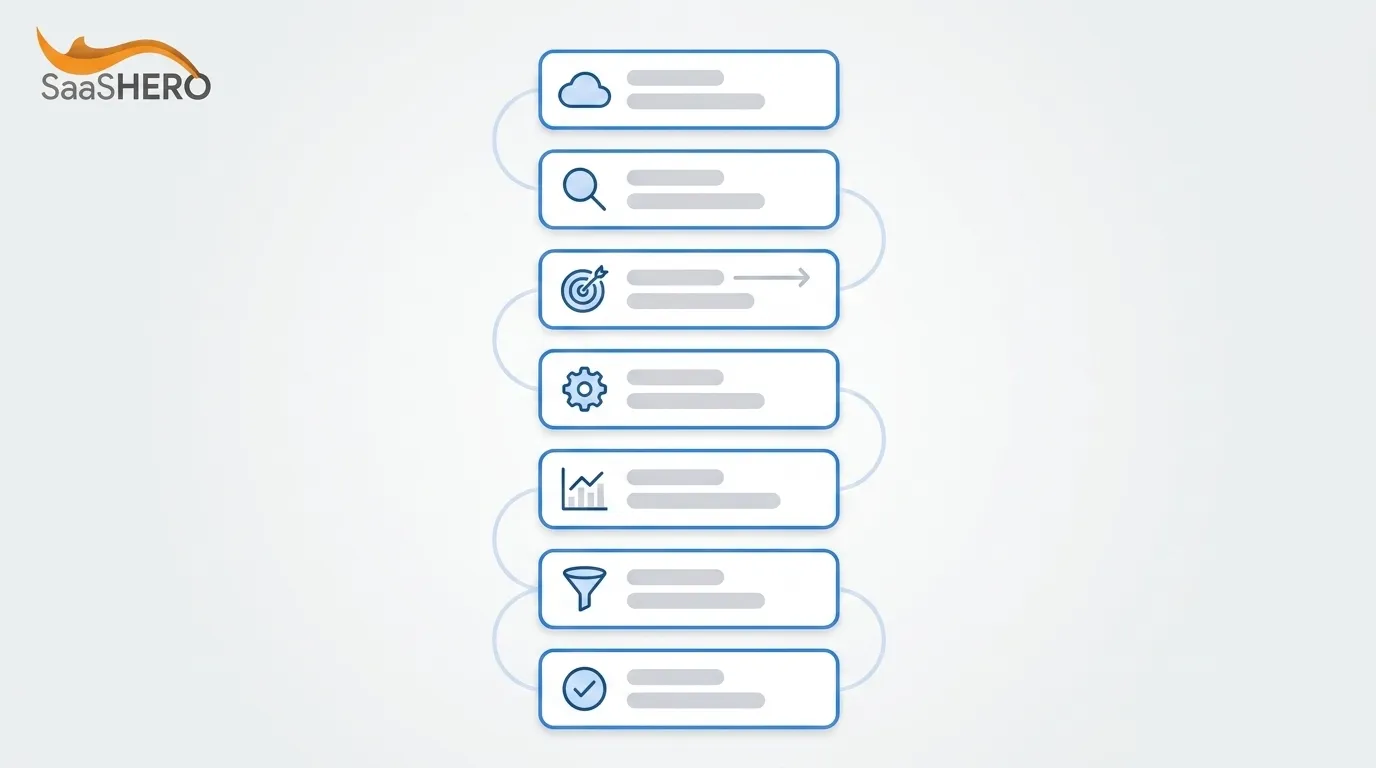
These agency failures persist because most B2B companies lack infrastructure that measures revenue outcomes directly. The seven-layer stack below solves that gap by creating an unbroken data path from anonymous intent signal to closed revenue, which makes vanity metrics obsolete and accountability unavoidable.

The stack describes how data flows from first touch to closed-won opportunity. Each layer supports the next and cannot be skipped without weakening the signal.
Layer 1 — Data & ABM: Define the Ideal Customer Profile and build target account lists using intent data. Platforms such as Demandbase or 6sense score accounts by buying-stage signals before any media spend. This layer decides who gets targeted, not just which keywords trigger an ad.
Layer 2 — Visitor Identification: Tools such as Clearbit or Factors.ai de-anonymize website traffic by matching IP and behavioral signals to company records. Adtech buys attention, martech converts it into pipeline, and visitor identification connects those two systems.
Layer 3 — Programmatic DSP: A DSP such as The Trade Desk, Amazon DSP, or StackAdapt runs real-time bidding across display, video, and CTV inventory. A DSP includes a bidder service that returns a bid in under 100ms, a budget pacing engine, audience management integrated with CDPs, and dynamic creative optimization. In B2B, DSPs reach in-market accounts from Layer 1 across channels beyond search.
Layer 4 — Creative & Landing Pages: Message match between ad and landing page is the highest-leverage CRO variable. SaaSHero builds dedicated comparison and competitor-conquest pages for each campaign segment. Campaigns using dynamic creative optimization can deliver higher click-through rates and lower costs per click compared to static creative.

Layer 5 — CRM Integration: GCLID and UTM parameters pass through the landing page form into HubSpot or Salesforce, which links every lead to its originating ad. 91% of companies with 10+ employees use CRM for marketing in 2023, yet most stop at lead volume instead of tracing records to closed-won opportunities.
Layer 6 — Attribution & Measurement: Multi-touch attribution distributes pipeline credit across the full journey. Multi-touch attribution assigns appropriate credit to upper- and mid-funnel touchpoints and maps ad exposure to downstream pipeline outcomes when integrated with CRM and marketing automation systems. Last-click attribution systematically undervalues every layer above Layer 3.
Layer 7 — AI Optimization: McKinsey & Company found that data-driven marketing can improve efficiency by 10–20%. In 2026, AI shapes bid strategies, budget reallocation, audience scoring, and creative selection within the 100ms auction window.
Stack Design Choices That Shape Revenue Impact
Tool selection trade-offs start with the ABM platform versus DSP decision. An ABM platform such as Demandbase identifies and prioritizes accounts, while a DSP executes media buys against those accounts. These tools work together rather than replacing each other. Buying a DSP without account-level intent data creates broad reach with weak signal quality. Running ABM without programmatic distribution limits reach to search and LinkedIn alone.
HubSpot and Salesforce integration complexity is often underestimated. Passing GCLID data through multi-step forms, tracking offline conversions, and syncing opportunity stages back to ad platforms all require deliberate configuration. Poor martech-adtech integrations can lead to lost ad budgets, according to Forrester Consulting.
Vertical-specific channel choices also shape performance. HR Tech buyers are reachable on LinkedIn by job title and company size. Cybersecurity buyers respond to intent-triggered search and review-site retargeting. Real Estate Tech buyers, as demonstrated by the Leasecake engagement, convert through LinkedIn targeting of specific property management roles. The strategy defines the channel mix, not the other way around.
Talk with our team to pinpoint which stack layers are blocking revenue signal in your current setup.
2026 Best Practices for AI, Privacy, and Programmatic Buying
In 2026, AI has moved beyond basic machine learning into agentic AI that automates campaign setup, streamlines trafficking, and continuously optimizes performance across channels. This shift reduces manual optimization work and increases the need for governance. Human oversight must protect brand safety and ensure explainable outcomes.
Privacy compliance has reshaped identity resolution. Clean rooms let advertisers and publishers combine first-, second-, and third-party data without exposing sensitive user information. Third-party cookies are already blocked in Safari and Firefox. First-party data from gated content, demo requests, and CRM records now serves as the primary targeting input for compliant programmatic campaigns.
Advertisers can see higher ROAS when using first-party data or AI-based contextual targeting compared to third-party targeting. Contextual targeting analyzes page-level language, themes, and sentiment in real time, which works effectively without any user-level identifier.
73% of B2B brands have integrated CTV into their core performance marketing strategies, and 98% plan to increase CTV spend. CTV requires at least a 90-day testing window and a minimum $25,000 initial budget to generate statistically significant lift results. DSPs such as The Trade Desk and Amazon DSP aggregate CTV inventory and enable frequency capping across streaming services.
Readiness and Maturity Checklist Before Scaling Spend
Confirm these conditions before you increase budgets:
- CRM captures lead source at the campaign and ad-group level, not just the channel.
- Offline conversion tracking passes closed-won data back to Google Ads and LinkedIn Campaign Manager.
- A defined ICP exists with firmographic and technographic criteria that map cleanly to ABM platform filters.
- Landing pages are campaign-specific instead of generic homepage redirects.
- Sales and marketing agree on the SQL definition and handoff criteria.
- A multi-touch attribution model is active, and last-click is disabled as the primary optimization signal.
- First-party data collection from gated assets, demo forms, and chat is sufficient to seed lookalike and retargeting audiences.
Measuring ad spend against net new ARR requires a CRM integrated with detailed web marketing statistics plus a regular reporting system to calculate LTV-to-CAC ratios on a per-channel basis. Without this infrastructure, scaling spend produces data that cannot be acted upon, so you generate leads without knowing which channels create profitable customers and which simply burn budget.
Common Pitfalls and How to Diagnose Them
Over-reliance on last-click attribution. Last-click assigns 100% of pipeline credit to the final touchpoint and undervalues awareness and consideration channels, as noted in the attribution layer. According to prior HockeyStack research, B2B SaaS prospects required an average of 54 touchpoints after the first website visit before becoming an MQL, though this has since risen to 71. With 71 touchpoints in play, assigning full credit to the last click makes 70 touchpoints invisible to optimization. Diagnostic question: Does your attribution model show zero pipeline influence for LinkedIn or display campaigns that run before the search click?
Poor negative-keyword hygiene. Navigational queries, such as users searching a competitor’s brand name to find the login page, consume budget without conversion intent. Negating the brand name alone while keeping modifiers like pricing, alternatives, and reviews filters out navigational noise and targets evaluative intent. Diagnostic question: What percentage of your competitor-campaign spend goes to single-keyword brand queries with no modifier?
Impression-focused reporting. The median CAC payback period for B2B SaaS companies is approximately 15 months, nearly twice the 80-day result mentioned earlier, which means impression volume has no short-term revenue correlation. Diagnostic question: Can your current agency show a direct line from a specific campaign to a closed-won opportunity in your CRM?
Three Real-World Deployment Scenarios for the Seven Layers
Founder-led teams. A founder managing ads on weekends needs a Dedicated Campaign Manager tier ($1,250 per month for up to $10k spend, month-to-month). The priority is tracking setup and negative-keyword hygiene before any creative expansion. The stack starts at Layers 5 and 6, CRM integration and attribution, then scales into Layers 3 and 4.
Frustrated VPs migrating from traditional agencies. A VP at a Series B company with $50k per month in spend and a PDF-reporting agency needs the Full Marketing Team tier ($4,500 per month). The immediate priority is rebuilding attribution to show pipeline influence instead of lead volume. The Playvox engagement, a 10x decrease in CPL and 163% volume increase, shows what account restructuring delivers when waste is removed first.
Post-funding scale-ups. A Series A company with aggressive Q1 targets and no time to hire needs rapid deployment across all seven layers at once. The TestGorilla engagement, which produced more than 5,000 new customers and an 80-day payback period, used competitor-conquest landing pages and multi-channel tracking from day one to satisfy investor unit-economic requirements within a single quarter.
Frequently Asked Questions About B2B Adtech Stacks
How much should a Series A B2B SaaS company budget for a full adtech stack?
Stack costs fall into three categories: media spend, tooling, and management. For companies spending $10k–$50k per month on media, tooling for ABM platforms, visitor identification, and attribution software usually adds 15–25% on top of media. Management through a flat-fee partner like SaaSHero runs $2,250–$4,500 per month depending on channel count, which removes the percentage-of-spend markup that inflates costs at traditional agencies. The goal is not the lowest stack cost but a stack where every layer produces traceable revenue signal before you scale spend.
Who owns the adtech stack, the agency or the client?
The client should own all accounts, pixels, CRM configurations, and creative assets built during an engagement. SaaSHero operates as an embedded team within client-owned accounts, so if the relationship ends, the client keeps full access to every campaign, tracking setup, and historical dataset. This structure differs from agencies that build campaigns inside agency-owned accounts and create dependency that survives the contract.
How long does it take to see pipeline impact from a properly integrated stack?
Paid search and paid social campaigns usually reach measurable ROI within 3–6 months. The first 30–60 days focus on tracking setup, negative-keyword hygiene, and landing page configuration. Pipeline attribution becomes reliable once CRM integration is complete and enough closed-won data exists to optimize against revenue outcomes instead of lead volume. The 80-day CAC payback in the TestGorilla engagement represents an accelerated case driven by aggressive competitor targeting and strong product-market fit.
What is the difference between an ABM platform and a DSP, and do B2B companies need both?
An ABM platform identifies, scores, and prioritizes target accounts using intent data and firmographic filters. A DSP executes programmatic media buys, including display, video, and CTV, against those accounts across ad exchanges. ABM platforms answer who to target, while DSPs answer where and when to reach them. Companies with defined ICPs and monthly media budgets above $15k benefit from running both in an integrated workflow. Below that level, LinkedIn Ads and Google Ads can serve as the execution layer while ABM intent data shapes audience segmentation.
How does a flat-fee agency model reduce risk compared to percentage-of-spend billing?
Percentage-of-spend billing creates a financial incentive for the agency to recommend higher budgets regardless of efficiency. A flat-fee model separates agency revenue from media volume, so budget recommendations rely on performance data alone. Month-to-month contracts remove the 12-month lock-in that protects agency revenue at the client’s expense. Together, these conditions force the agency to produce measurable pipeline outcomes every 30 days to keep the engagement.
Conclusion and Practical Next Steps
A seven-layer B2B adtech stack — Data & ABM, Visitor Identification, Programmatic DSP, Creative & Landing Pages, CRM Integration, Attribution & Measurement, and AI Optimization — connects ad spend directly to Net New ARR. Each layer supports the next. Skipping CRM integration turns attribution into guesswork. Running programmatic without ABM intent data buys reach without signal. Reporting on impressions instead of pipeline optimizes for the wrong outcome.
The execution partner shapes results as much as the stack design. Percentage-of-spend agencies are incentivized to inflate budgets. Junior-staffed teams struggle to configure revenue-tied tracking. Long-term contracts weaken accountability. A senior-led, flat-fee, month-to-month model aligns every recommendation with closed-won revenue, which is the only metric that convinces a board or investor.
Your next step is an internal capability assessment against the seven layers. Identify which layers are missing, misconfigured, or producing data that cannot be tied to pipeline. Then decide whether your team can close those gaps within a quarter or whether outside support is required.