





Written by: Aaron Rovner, Founder, Saas Hero | Last updated: August 10, 2026
Key Takeaways for Series-B SaaS Revenue Leaders
- Qualified meetings and Net New ARR are the two metrics that matter most when you evaluate a B2B lead-gen agency. Any framework that ignores them measures activity instead of revenue impact.
- Percentage-of-spend pricing creates a built-in conflict of interest, because agency revenue increases when client spend increases, not when client revenue grows.
- Long-term lock-in contracts of 6 to 12 months shift performance risk to the client and leave little leverage if results disappoint.
- Vanity metrics such as impressions or CTR hide the real story. Only CRM-level attribution tied to closed revenue shows whether an agency is aligned with your outcomes.
- SaaSHero’s flat-fee, month-to-month model removes three common misalignments: fixed pricing, a 30-day exit, and Net New ARR reporting. This structure makes SaaSHero a practical first agency to evaluate for Series-B SaaS leaders who want revenue alignment.
2026 B2B Lead Generation Costs for Mid-Market SaaS
The 2026 market for B2B lead gen services is primarily a risk-avoidance problem, not a pricing problem. Revenue leaders at Series-B SaaS companies have many agency options but few structures that remove incentive misalignment before the first invoice. The pricing bands below give a baseline for that evaluation.
B2B lead gen retainers for mid-market SaaS often range between $3,000 and $15,000 per month depending on scope and geography. Per-meeting pricing for mid-market targets commonly runs $300 to $600 per booked appointment. Percentage-of-spend models layer a 10–20% fee on top of the media budget, which compounds cost as spend scales.
| Agency / Model Type | Clutch / Trustpilot Signal | Min Contract Length | Reported Payback Period |
|---|---|---|---|
| Belkins (outbound retainer) | 4.9 / 5 on Clutch (with ~230 reviews) | 3–6 months typical | Not publicly disclosed |
| Operatix (enterprise-focused) | Strong Clutch presence; enterprise-focused | 6 months minimum | Not publicly disclosed |
| Cleverly (LinkedIn-first) | Mixed; volume complaints on Trustpilot | 3-month minimum | Not publicly disclosed |
| SaaSHero (flat-fee paid media, $1,250–$4,500/mo) | G2 High Performer; Google Premier Partner (Top 3%) | Month-to-month | 80 days (TestGorilla case study) |
Get a transparent cost model mapped to your current ad spend and ICP.
Client Complaints on Reddit and Review Sites in 2025–2026
The primary client risk with long B2B lead-gen agency contracts is paying for an extended period before value is proven, with little leverage to stop the contract if performance is weak. Reddit threads in r/sales and r/b2bmarketing in 2025–2026 highlight three recurring complaint categories.
| Complaint Category | Specific Pattern | Revenue Impact |
|---|---|---|
| Lead quality vs. volume | 79% of leads never convert due to poor nurturing and qualification | AE time wasted; pipeline inflated |
| Junior hand-off after signing | Senior strategist sells; junior executes across 30+ accounts | Campaign quality degrades; CAC rises |
| Hidden fees and loose definitions | Setup fees above $5,000, tooling pass-throughs, and loosely defined “qualified lead” criteria that omit BANT frameworks | True cost 30–60% above quoted retainer |
These complaints map directly to three decision pillars every Series-B revenue leader should score before signing: cost transparency, contract flexibility, and revenue attribution. The sections below examine each pillar in turn and show how pricing and contract choices either amplify or remove these risks.
Decision Pillar 1: Cost Transparency in Percentage vs Flat-Fee Models
The percentage-of-spend model charges 10–20% of the client ad budget. At $50,000 in monthly spend, that structure produces $7,500–$10,000 in agency fees, which grow automatically when the agency recommends increasing the budget, regardless of performance data. The conflict is structural because the agency’s revenue rises when spend rises, not when revenue rises.
SaaSHero’s tiered flat retainer removes that conflict. A client spending $25,000–$50,000 per month pays a fixed $2,250 per month on the Dedicated Campaign Manager tier or $3,500 on the Full Marketing Team tier. Moving spend from $30,000 to $45,000 within that band does not change the agency fee, so every budget recommendation is driven by campaign data rather than billing incentive. Monthly retainer pricing for B2B lead generation in 2026 typically ranges from $3,000 to $25,000+ per month, which makes SaaSHero’s $1,250–$4,500 range competitive at every spend band while removing the percentage-of-spend misalignment.
Additional one-time costs at SaaSHero are fixed and disclosed upfront. These include a $1,000–$2,000 setup fee, a $750 flat fee for landing page design, and $300 for five ad creative assets. Common contract red flags include setup fees above $5,000 and separate tooling pass-through charges, and neither applies here.
Decision Pillar 2: Contract Flexibility and Exit Options
The lock-in risk identified above becomes concrete when you examine typical contract terms. Use this checklist to evaluate any proposed agreement:
- Contract term exceeds 6 months without performance breakpoints, which Jeremy Dixon, CEO of Elevate Clients Inc., identifies as structurally risky.
- No IP ownership clause ensuring the client retains lists, copy, and sending infrastructure upon exit.
- No replacement policy or exit clause tied to results, which signals that the agency relies on contractual protection instead of proven performance.
- No defined escalation point, such as Day 60 with no booked meetings, and no defined exit signal, such as Day 90 with no closed contracts.
SaaSHero operates on a month-to-month agreement. Long minimum commitments of 6 to 12 months primarily protect agency revenue rather than client interests, while month-to-month or quarterly review terms with defined exit conditions create better alignment between agency performance and client outcomes. The 30-day exit functions as a forcing function. SaaSHero must re-earn the engagement every month, which ties agency survival directly to client revenue growth.

Decision Pillar 3: Revenue Attribution and Net New ARR
Sixty-eight percent of B2B organizations lack clearly defined, shared funnel-stage definitions, which turns lead-quality discussions with agencies into ongoing negotiations instead of objective diagnoses. The practical fix is a signed meeting contract in the statement of work before any campaign launches. That contract should specify ICP firmographics, authority level, acknowledged pain, timing window, confirmation cadence, no-show rules, and credit windows.
The 95/5 rule compounds this problem for agencies that optimize for volume. B2B buying decisions typically involve multiple stakeholders, and the broader principle holds that at any given moment, approximately 95% of the addressable B2B market is not actively in-market. Only about 2% of B2B website visitors ever fill out a form, while buyers complete approximately 70% of their research before contacting sales. An agency that chases volume metrics floods the pipeline with the 95% who are not ready to buy, which inflates meeting counts while suppressing meeting-to-opportunity conversion rates.
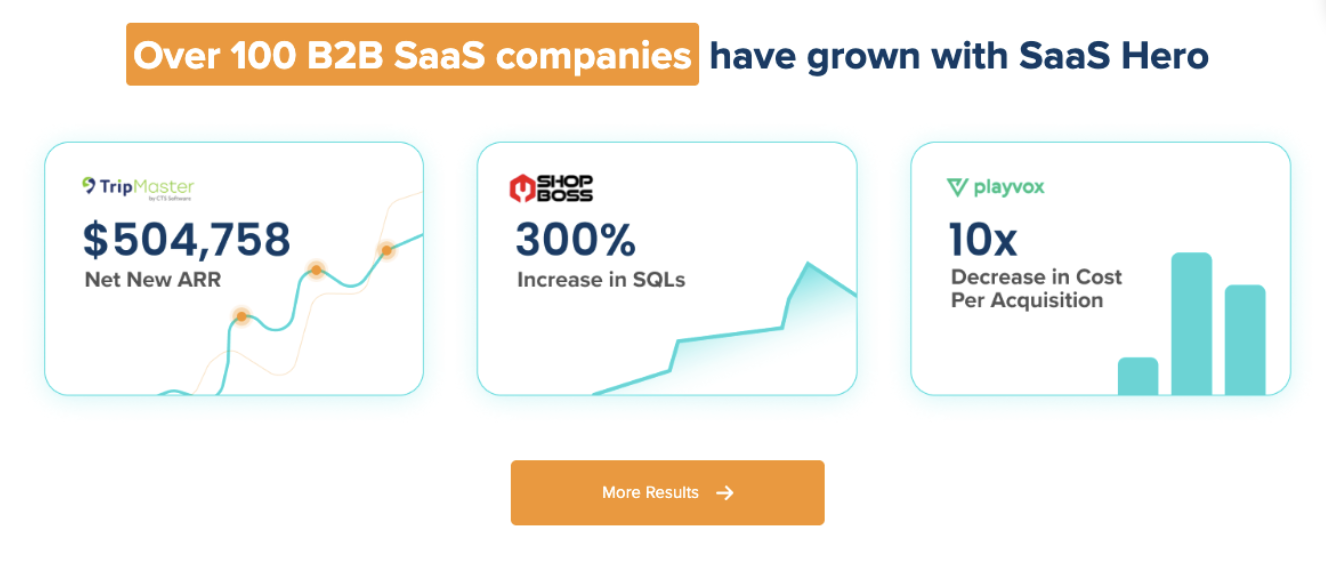
SaaSHero anchors reporting in Net New ARR, pipeline value, and Sales Qualified Leads, not impressions, clicks, or CTR. This focus on revenue metrics is made possible by end-to-end tracking that passes data from the ad click (GCLID) through the landing page and into HubSpot or Salesforce. That tracking enables campaign decisions based on who closed, not who clicked. That closed-revenue focus produces measurable outcomes: as shown in the comparison table above, TestGorilla achieved payback in 80 days and went on to raise a $70M Series A, while the TripMaster case study generated $504,758 in Net New ARR at 650% ROI over 12 months.

See how we connect your ad spend to closed revenue in your CRM.
Is Lead Generation Worth It for B2B SaaS in 2026?
Surveys of B2B marketers report that 37–42% cite generating quality leads as a top challenge, often ranking it above or near generating sufficient lead volume. The core question is whether the agency structure removes or reinforces the three misalignments that destroy ROI.
Score your current or prospective agency on these three dimensions before renewing or signing:
- Incentive alignment: The agency fee should remain fixed within a spend band. If the fee grows automatically as the budget grows, percentage-of-spend billing fails this test.
- Tracking depth: The agency should report on Net New ARR and pipeline value sourced to specific campaigns. If reporting focuses on impressions and CTR without CRM integration, the agency fails this test.
- Exit ease: The engagement should be terminable within 30 days without penalty, and the client should retain all data assets. Contracts longer than 6 months without performance breakpoints fail this test.
Mature B2B marketing teams in 2026 measure performance by Sales-Accepted Leads, cost-per-opportunity, pipeline velocity, and closed revenue contribution rather than MQL volume. A flat-fee, month-to-month structure removes all three misalignments at once. It decouples agency revenue from spend volume, forces CRM-level attribution to justify the retainer, and removes contractual protection as a substitute for results.
HubSpot’s State of Marketing 2026 finds the lowest CPL via SEO at $33–$34, compared with $874–$881 via events. Cost per lead is meaningful only when the lead definition is locked to ICP, authority, need, timing, and commitment criteria, and when downstream closed revenue is tracked back to the originating campaign.
Conclusion: Choosing a Revenue-Aligned Lead Gen Partner
The 2026 B2B lead gen agency market offers many retainer options but little structural alignment between agency incentives and client revenue outcomes. Percentage-of-spend billing rewards budget inflation. Six-to-twelve-month lock-ins reward complacency. Vanity metric reporting rewards activity over results. Each misalignment acts as a separate tax on Net New ARR.
SaaSHero’s flat-fee, month-to-month model is designed as a direct counter to all three misalignments. Fixed retainers from $1,250 to $4,500 per month remove the spend-inflation incentive. A 30-day exit clause removes contractual protection as a substitute for performance. CRM-integrated reporting tied to Net New ARR removes the vanity metric smokescreen. The agency must re-earn the engagement every 30 days, which means its survival depends on the same metric the client board tracks: closed revenue.
Series-B SaaS revenue leaders evaluating partners in 2026 can apply one practical filter. The agency’s fee structure should rise when your revenue rises, not simply when your spend rises.
Frequently Asked Questions
What is the difference between a qualified meeting and an MQL when evaluating a B2B lead gen agency?
An MQL is a marketing engagement signal, such as a content download, webinar registration, or form fill, that indicates some level of interest but does not confirm buying intent, authority, or fit. A qualified meeting is a materially higher bar. It is an attended conversation with a prospect who has already cleared pre-agreed criteria for ICP fit, decision-making authority, acknowledged need, plausible timing, and confirmed commitment. When you evaluate a B2B lead gen agency, a signed qualified-meeting definition in the statement of work before any campaign launches is the single most effective safeguard against inflated pipeline numbers built on low-intent calendar bookings. The downstream metric that validates handoff quality is the meeting-to-Sales-Accepted-Opportunity conversion rate, and a healthy outbound benchmark is 10–30%.
How does SaaSHero’s pricing compare to a percentage-of-spend agency at a $30,000 monthly ad budget?
At $30,000 per month in ad spend, a percentage-of-spend agency charging 15% would bill $4,500 per month in management fees. That fee then rises automatically if the agency recommends increasing the budget to $40,000 or $50,000, regardless of whether the data supports the increase. SaaSHero’s flat retainer for a $25,000–$50,000 spend band is $2,250 per month on the Dedicated Campaign Manager tier or $3,500 on the Full Marketing Team tier. The fee does not change if spend moves from $30,000 to $45,000 within that band, which means every budget recommendation is driven by campaign performance data rather than the agency’s billing interest. The flat-fee structure can save on management fees over 12 months at that spend level compared to a 15% percentage-of-spend model, before you account for any budget inflation the percentage model might encourage.
What contract red flags should a VP of Revenue look for when reviewing a B2B lead gen agency agreement?
The highest-risk contract structures share a common feature: they transfer all performance risk to the client while guaranteeing agency revenue regardless of results. Specific red flags include initial terms of 12 months with no performance breakpoints or exit clauses tied to results, setup fees above $5,000 that are non-refundable regardless of campaign outcomes, tooling and data pass-through charges that inflate the true monthly cost above the quoted retainer, loosely defined “qualified lead” or “qualified meeting” criteria that allow the agency to count any booked calendar event toward its delivery obligation, and the absence of IP ownership clauses that would leave the client without access to prospect lists, sending domains, ad account data, and copy assets upon exit. A straightforward test is to ask the agency on the discovery call what happens to all data assets if the engagement ends at 90 days. If the answer is ambiguous, the contract is not client-aligned.
What is the 95/5 rule and why does it matter for B2B lead generation in 2026?
The 95/5 rule holds that at any given moment, approximately 95% of a company’s total addressable market is not actively in-market for a purchase. Only the remaining 5% are in an active buying cycle. As discussed in the Revenue Attribution section, this rule explains why volume-focused agencies flood pipelines with prospects who are not ready to buy, which produces high meeting counts with low meeting-to-opportunity conversion rates and long, unproductive sales cycles. The correct response is a tightly defined qualified meeting that uses ICP fit, authority, acknowledged need, and timing criteria so that the pipeline reflects only the in-market 5%. Agencies that resist tight qualification definitions are typically protecting their ability to report volume metrics rather than revenue outcomes. The 95/5 rule also supports demand generation investment in content and brand that reaches the 95% before they enter the buying cycle, so that when they become in-market, the brand already sits in their consideration set.
How long does it take to evaluate whether a B2B lead gen agency is performing?
A 90-day window is the minimum required to make a fair performance assessment of a B2B lead gen agency. The first 30 days typically cover account setup, tracking implementation, ICP refinement, and initial campaign launch, which is a period where pipeline data is not yet meaningful. Days 31–60 should produce the first qualified meetings, and the absence of any booked meetings by Day 60 is a legitimate escalation point that warrants a structured review conversation with the agency. By Day 90, the pipeline should contain enough data to assess meeting-to-opportunity conversion rate, cost per qualified meeting, and early indicators of sales cycle length. The absence of any closed contracts or advanced-stage opportunities by Day 90 is a reasonable exit signal, particularly when the agency operates on a month-to-month agreement that allows exit without penalty. Agencies that require 6–12 month commitments before any performance data is available are structurally preventing clients from acting on this 90-day signal.